

Complex permanent tissue – Xylem
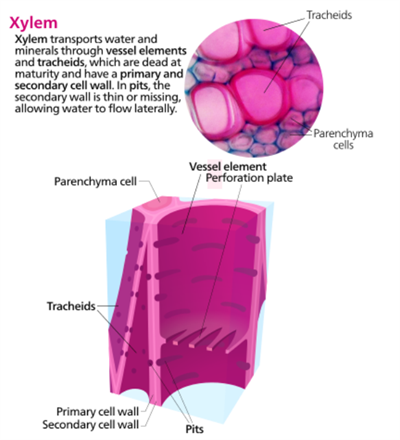
Xylem is a complex vascular tissue that transports water and minerals from roots to other parts of the plant. It also provides mechanical support.
Xylem
The term xylem was introduced by C. Nageli (1858) (Greek: xylon - wood).
Characteristics:
-
It is made of both living and dead cells (mostly dead).
-
Cell walls are thick and lignified.
-
Transport of water is unidirectional (upward).
Components of xylem:
-
Tracheids – Long, dead, tapering cells found in all vascular plants and it conduct water and give support.
-
Vessels (Tracheae) – Long tube-like dead cells with perforated ends, found mainly in angiosperms, highly efficient for water transport.
-
Xylem parenchyma – Living cells store food and help in lateral conduction of water.
-
Xylem fibres – Dead, thick-walled cells and it provides strength.
Tracheids and vessels are together called tracheary elements (main water-conducting parts).
Complex permanent tissue – Phloem
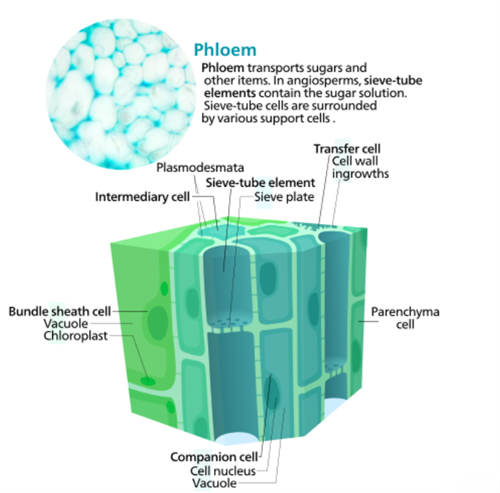
Phloem is a complex tissue that transports prepared food (mainly sucrose) from leaves to all parts of the plant.
The term phloem was introduced by C. Nageli (1858) (Greek: phloos = bark).
Phloem
Characteristics:
-
It consists mainly of living cells (except phloem fibres).
-
It transports food in bidirectional (both upward and downward).
Components of phloem:
-
Sieve elements – Main conducting cells for food.
-
Sieve tubes: Found in angiosperms; have sieve plates.
-
Sieve cells: Found in gymnosperms and pteridophytes; no sieve plates.
-
-
Companion cells – Living cells that assist sieve tubes; originate from the same mother cell.
-
Phloem parenchyma – Living cells store food and help in sideward transport and this is absent in monocots.
-
Phloem fibres (Bast fibres) – Dead, lignified cells providing mechanical strength.
Difference between simple and complex permanent tissues
| Feature | Simple permanent tissue | Complex permanent tissue |
|---|---|---|
| Composition | Made of one type of cell | Made of different types of cells |
| Function | All cells perform similar functions | Different cells work together for a common function |
| Types | Parenchyma, Collenchyma, Sclerenchyma | Xylem, Phloem |
| Nature of cells | All cells are living or all are dead | Both living and dead cells present |
| Function examples | Support, storage, photosynthesis | Transport of water, minerals, and food |