

Simple permanent tissue
Plants need tissues not just for growth but also for storage, support, and protection. These are performed by permanent tissues, which develop from meristematic tissues through differentiation - a process where dividing cells become mature and specialised. Permanent tissues are of two types: simple and complex.
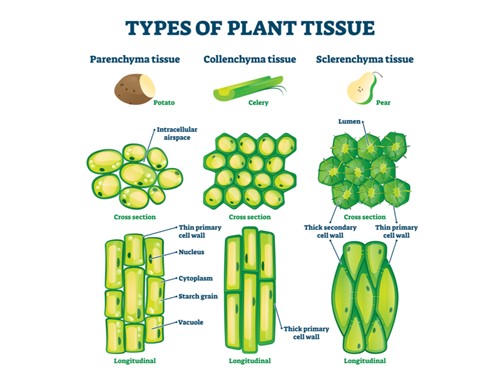
Different types of simple permanent tissues
Simple permanent tissues are made of similar cells performing the same function. They are generally found below the epidermis and have thin cellulose walls with intercellular spaces. They include parenchyma, collenchyma, and sclerenchyma.
Parenchyma
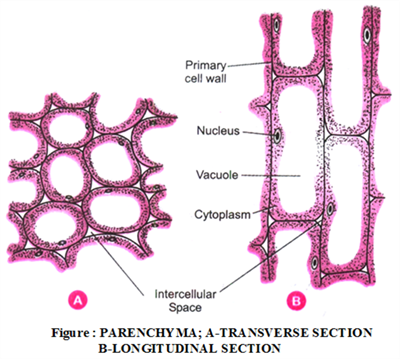
Parenchyma is the simplest and most common permanent tissue, consisting of living, thin-walled cells with large intercellular spaces. Found in the cortex, pith, and leaves, it helps in storage of food and water, mechanical support, and metabolic activities.
-
Chlorenchyma: Contains chlorophyll for photosynthesis.
-
Aerenchyma: Has large air spaces in aquatic plants for buoyancy (e.g., Water hyacinth).
Collenchyma
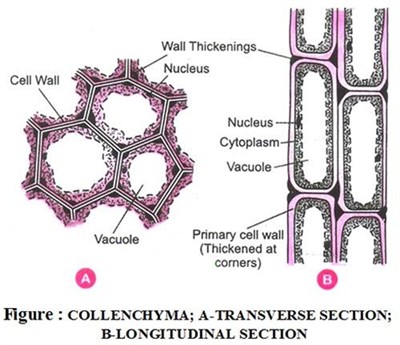
Collenchyma consists of living cells with unevenly thickened walls made of cellulose and pectin. Found below the epidermis in stems and leaf stalks, it provides flexibility and mechanical support, allowing bending without breaking.
Sclerenchyma
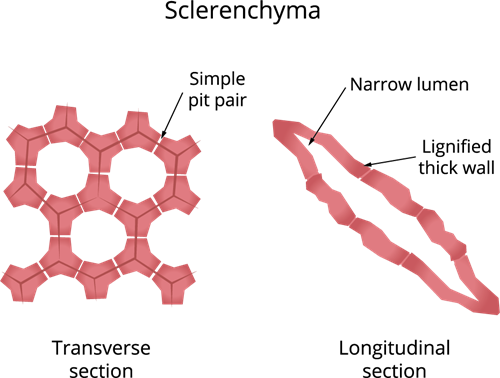
Sclerenchyma is made of dead cells with thick, lignified walls and no intercellular spaces. It provides rigidity and strength to plants and forms the hard parts like seed coats and husks.
-
Sclereids (stone cells): Short, irregular, give hardness to fruits and nuts.
-
Fibres: Long, narrow, provide strength and are used in making ropes and mats (e.g., jute, coir).
Protective tissue
Plants need protection from external factors such as water loss, mechanical injury, and infections. This is provided by protective tissues, found in stems, roots, and leaves. These tissues form outer coverings that safeguard internal parts and help reduce water loss. Protective tissues are of two types - epidermis and cork (phellum).
Epidermis
The epidermis is the outermost single layer of cells covering all plant parts. Epidermal cells are flat, tightly packed, and lack intercellular spaces. In aerial parts, the outer surface secretes a waxy, water-resistant layer called the cuticle, which prevents water loss and protects against injury and infection.
-
In dry or desert plants, the cuticle is thick to minimize evaporation.
-
The epidermis of leaves has small openings called stomata, each surrounded by two guard cells.
-
Function of stomata: Allow gaseous exchange (\(CO₂\) and \(O₂\)) and transpiration (loss of water vapour).
-
-
The epidermis of roots bears root hairs that increase surface area for water and mineral absorption.
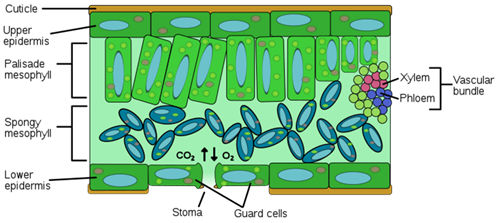
Epidermis
Cork (Phellum)
Cork forms the outer protective layer of older stems and roots. It arises from a secondary lateral meristem called the cork cambium. Cork cells are dead, compactly arranged, and contain suberin, a waxy substance that makes them waterproof and airtight.
-
Replaces epidermis in mature regions.
-
Prevents water loss and entry of pathogens.
-
Forms the bark of trees, giving mechanical protection.