

Animal tissues
Animals perform various movements such as walking, running, and flying in search of food, shelter, and mates. To carry out these activities efficiently, their bodies are made of specialised tissues. Unlike plants, animals do not have cell walls; hence, their tissues are compact, living, and flexible.
Growth in animals stops after maturity, though repair and regeneration continue throughout life. Different tissues perform specific functions - blood transports materials, muscles enable movement, connective tissue provides support, and nervous tissue helps in coordination and control.
Animal tissues are broadly classified into four types:
-
Epithelial tissue
-
Connective tissue
-
Muscular tissue
-
Nervous tissue
All these tissues develop from the three germ layers of the embryo - ectoderm, mesoderm, and endoderm.
Epithelial tissue – The covering tissue
Epithelial tissue forms the outer covering of the body and lines all internal organs and cavities. It acts as a protective barrier against injury, germs, and dehydration. The cells are tightly packed with little intercellular space and no blood vessels, receiving nourishment from the underlying connective tissue.
Epithelial tissues occur in the skin, mouth, lungs, kidney tubules, and intestine. Depending on cell shape and layers, it is divided into simple epithelium and stratified epithelium.
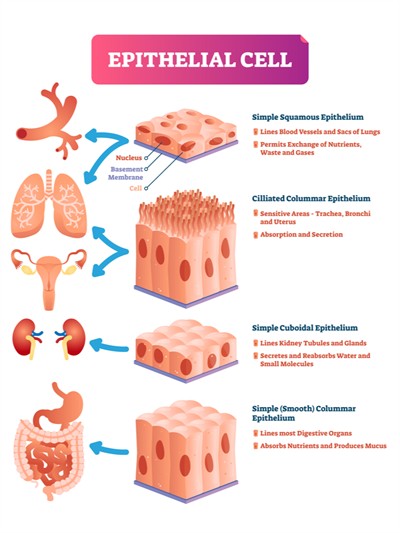
Simple epithelium
This epithelium has a single layer of cells and mainly performs absorption, secretion, and diffusion.
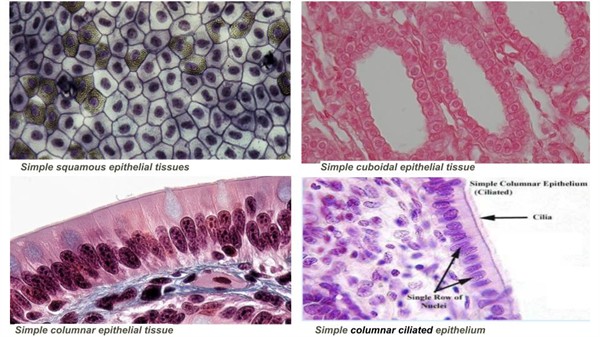
Simple epithelium
a. Simple squamous epithelium:
Composed of thin, flat cells forming delicate linings such as those of the lungs (alveoli), blood vessels, and kidney glomeruli. It allows easy diffusion and filtration.
b. Simple cuboidal epithelium:
Made of cube-shaped cells found in the kidney tubules and gland ducts, helping in secretion and absorption.
c. Simple columnar epithelium:
Tall, pillar-like cells found in the stomach and intestine, aiding in nutrient absorption and secretion of digestive fluids.
d. Ciliated epithelium:
Some epithelial cells possess cilia (hair-like projections) that move substances. Found in the respiratory tract, oviducts, and nasal passages, it helps move mucus or reproductive cells.
e. Pseudostratified epithelium:
Appears to have many layers but actually has one, with nuclei at different levels. Found in the trachea and bronchi, it helps move mucus.
Stratified epithelium:
This type has many layers of cells and mainly provides protection against mechanical stress.
The stratified squamous epithelium covers the skin, mouth, and oesophagus.
The stratified squamous epithelium covers the skin, mouth, and oesophagus.
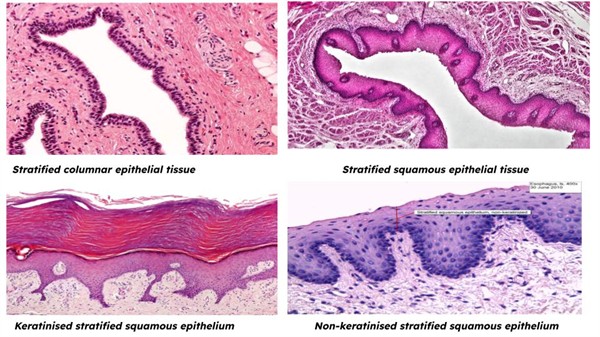
-
In skin, the outer layer is keratinized to prevent water loss.
-
In the mouth and oesophagus, it is non-keratinized and kept moist by mucus.
Other forms like stratified cuboidal and stratified columnar epithelium occur in ducts of sweat and salivary glands, offering protection and limited secretion.
Glandular epithelium
Some epithelial cells fold inward to form glands that secrete useful substances such as mucus, enzymes, and hormones.
These tissues are found in organs like the stomach, pancreas, and intestines, where they regulate various physiological functions.
These tissues are found in organs like the stomach, pancreas, and intestines, where they regulate various physiological functions.
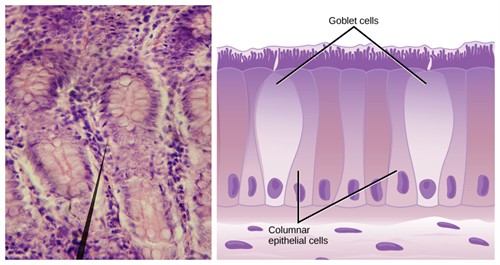
Glandular epithelial tissue