

Introduction
All living organisms are made up of cells, the fundamental unit of life. In unicellular organisms, a single cell performs all life processes like respiration, nutrition, and excretion.
However, in multicellular organisms, different groups of cells perform specific functions efficiently. These groups of similar cells performing a common function are called tissues.
In humans, muscle cells help in movement, nerve cells transmit messages, and blood cells transport oxygen, food, and waste. In plants, vascular tissues like xylem and phloem conduct water and food throughout the plant. Thus, tissues represent a division of labour in multicellular organisms, where each tissue performs a specialised role. Groups of tissues form organs, and organs together form organ systems.
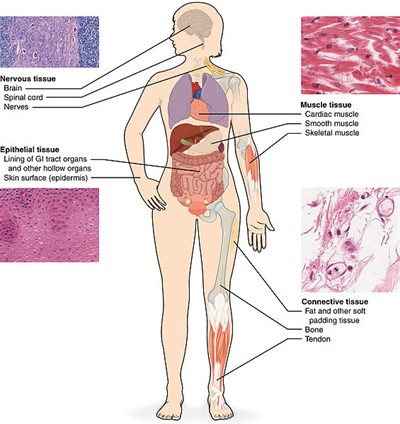
Different types of animal tissues present in the human body
The study of tissues is known as Histology (Greek: histos = tissue, logos = study). The term ‘tissue’ was coined by Grew (1682), and Marie François Xavier Bichat, known as the Father of Histology, identified 21 different tissue types forming human organs.
Classification of tissues
A tissue is a group of similar cells with a common origin that work together to perform a specific function.
Plant tissues are mainly of two types - meristematic (dividing) and permanent (non-dividing). They contain many dead supportive tissues, require less energy, and show continuous growth in certain regions due to meristems.
Animal tissues, on the other hand, are living and classified into four types - epithelial, connective, muscular, and nervous tissues. They require more energy, show complex organization, and have limited growth. Animal tissues support movement, while plant tissues provide mechanical strength and support for a stationary life.
Meristematic tissue
Plants grow in length and width due to meristematic tissues, made of actively dividing cells. The term meristem was coined by C. Nägeli (1858) from the Greek word ‘meristos’ (divisible). These tissues are found in growth regions like root and shoot tips.
Types based on origin
- Primary meristem: Formed from promeristem; causes primary growth (increase in length).
Example:Apical meristem
- Secondary meristem: Formed later from permanent tissues; causes secondary growth (increase in girth).
Example:Vascular cambium
Features of meristematic cells
Small, actively dividing, thin-walled, dense cytoplasm, large nucleus, and no vacuoles.
Types based on position
-
Apical meristem: At root and shoot tips; increases length.
-
Intercalary meristem: At nodes or leaf bases; helps in elongation.
-
Lateral meristem: Along sides of stem and root; increases thickness.
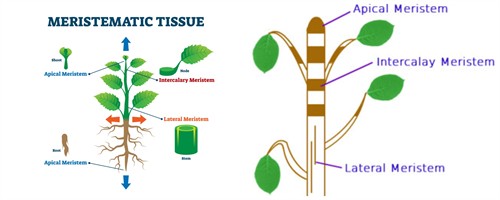
Types of meristematic tissue