

Learning outcomes
Control and coordination in plants:
- Control and coordination in plants: This includes an overview of plant movements such as tropism (with its types) and nastic movements, along with the differences between tropic and nastic movements.
- Plant hormones: An introduction to plant hormones, their types (auxins, cytokinin, gibberellins, abscisic acid, ethylene), and their physiological effects.
- Tropism and hormonal influence: A detailed discussion on various tropisms (geotropism, thigmotropism, hydrotropism, chemotropism) and how plant hormones regulate these movements.
Coordination in plants
Plants lack a nervous system and muscles but respond to stimuli through movements, which can be fast or slow:
Immediate responses (independent of growth/Nastic movements):
Movements in response to stimuli that do not depend on the direction of the stimulus.
Example:
Mimosa leaves fold on touch.
Mechanism:
Cells change shape by water movement (swelling/shrinking). Electrical-chemical signals convey information from cell to cell.
Growth-dependent responses (Tropic movements):
Directional growth movement towards or away from a stimulus.
Example:
Phototropism – shoots grow towards light.
Geotropism – roots grow downward, shoots grow upward.
Hydrotropism – roots grow towards water.
Chemotropism – pollen tubes grow towards ovules.
Mechanism: Directional growth influenced by environmental stimuli like light, gravity, water (hydrotropism), and chemicals (chemotropism).
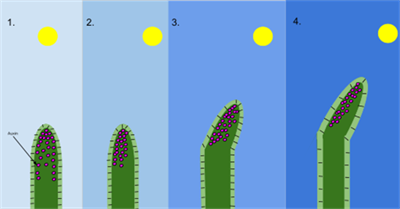
Shoot tip growing towards the direction of sun
Exam tips:
-
Nastic movement → fast, non-directional.
-
Tropic movement → slow, directional (phototropism, geotropism, hydrotropism, chemotropism).
- Example: Light → shoot tip → bends towards light → phototropism.
PYQ's
Plant hormones
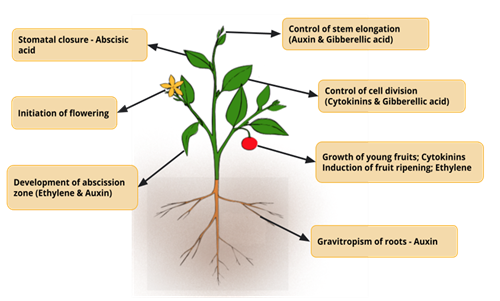
Hormonal interaction in plant growth and development
- Auxins promote cell elongation in shoots and help phototropism by accumulating on the shaded side.
- Gibberellins stimulate stem elongation and growth.
- Cytokinins promote cell division in fruits and seeds.
- Abscisic acid (ABA) inhibits growth and causes leaf wilting.
- Ethylene controls fruit ripening and leaf abscission.
Exam tips:
-
Auxin → cell elongation, phototropism.
-
Gibberellins → stem elongation.
-
Cytokinins → cell division.
-
Abscisic acid → inhibits growth, wilting.
-
Ethylene → ripening, leaf fall.
-
Tip: Use hormone names to justify movements in answer.
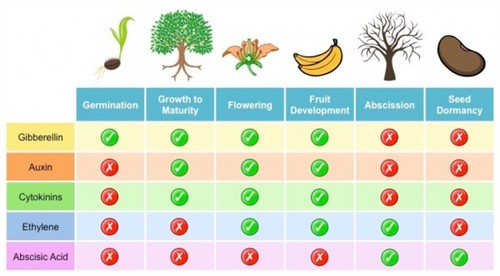
Functions of plant hormones
PYQ's
Common exam diagrams to practise
-
Bending of shoot towards light (phototropism).
-
Root bending downward (geotropism).
-
Mimosa leaf folding (nastic).
-
Tendril coiling around support.
(Keep diagrams small, neat, and labelled)