

Variation during reproduction:
Organisms show similarities to parents but also small differences called variations.
-
Asexual reproduction: Very little variation (only due to minor DNA copying errors).
-
Sexual reproduction: Large variation because offspring get genes from both parents.
-
Variations help some individuals survive better and become the basis of evolution.
Exam tips for this topic:
-
Be ready to write difference between asexual and sexual variation in 2–3 lines.
-
For 3-mark answers, always mention variation → survival → evolution.
-
Keep an example ready, like heat-resistant bacteria survive a heat wave.
PYQ's
What are inherited traits?
Traits are characteristics that are passed from parents to offspring.
All offspring show a basic body design but also differences.
Example:
Height, eye colour, earlobe type.
Exam tips for this topic:
-
Write a short definition of trait and variation—these often come in 1-mark questions.
-
Keep examples ready: free vs. attached earlobe, tall vs. short plants.
-
Don’t call acquired traits “inherited”—they are NOT passed to next generation.
Mendel’s experiments & Laws
a. Monohybrid cross – Law of dominance
Mendel crossed tall (\(T\)) and short (\(t\)) pea plants.
-
F1: All tall → tall is dominant.
-
F2: \(3\) tall : \(1\) short ratio → both traits were present but tall was expressed.
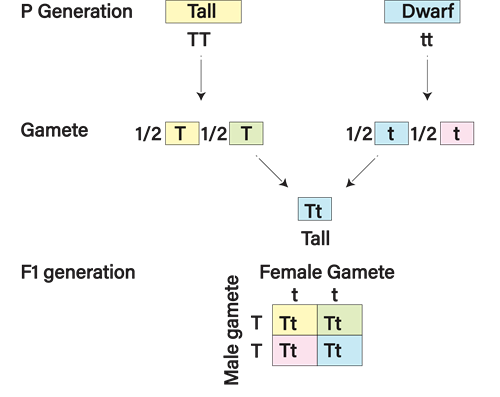
Monohybrid cross
Exam Tips
-
Always write F1 = \(100%\) dominant trait.
-
Always write F2 phenotype ratio = \(3:1\) and genotype ratio = \(1:2:1\).
-
Use a Punnett square if the question is for 3 or 5 marks—gets full marks.
b. Dihybrid cross – Law of Independent Assortment
Mendel crossed plants with two traits:
-
Seed shape: round (\(R\)) / wrinkled (\(r\))
-
Seed colour: yellow (\(Y\)) / green (\(y\))
F2 ratio: \(9:3:3:1\), showing traits assort independently.
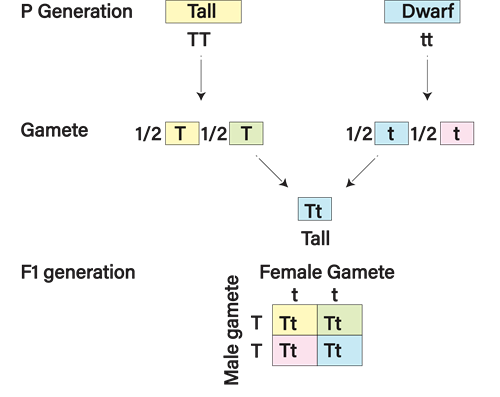
Dihybrid cross
Exam Tips
-
Memorize the \(9:3:3:1\) ratio — it is asked very often.
-
Use the phrase “new combinations appear in \(F2\) (round-green, wrinkled-yellow)”.
-
Diagram of a dihybrid Punnett square can fetch 1–2 extra marks.
PYQ's
Dominant & Recessive traits
-
Dominant trait = expressed even if one allele is present (T).
-
Recessive trait = expressed only when both alleles are recessive (tt).
Exam Tips
-
Always give an example: T = tall, t = short.
-
Use key words: allele, expression, genotype, phenotype.
-
For 1-mark MCQs, remember: dominant hides recessive.
PYQ's
How traits get expressed
Genes are portions of DNA that code for proteins. Proteins control physical traits.
Example:
A gene may produce an enzyme that controls plant height.
Exam Tips
-
Write “genes → proteins → traits” as a flow.
-
Define gene as a segment of DNA.
-
In 3-mark questions, mention how efficient/inefficient enzyme leads to tall/short.
Chromosomes and Inheritance
Each human cell has \(23\) pairs of chromosomes. Gametes (sperm/egg) contain only one set (23). During fertilization, the child receives one set from each parent → equal genetic contribution.
Exam Tips
-
In 2–3 marks, mention “gametes are haploid”.
-
Use the word “equal genetic contribution”.
-
Draw a simple labelled diagram of chromosome pairs for extra marks.
Sex determination in humans
-
Females: \(XX\)
-
Males: \(XY\)
Mother always contributes X.
Father contributes X or Y → decides sex of child.
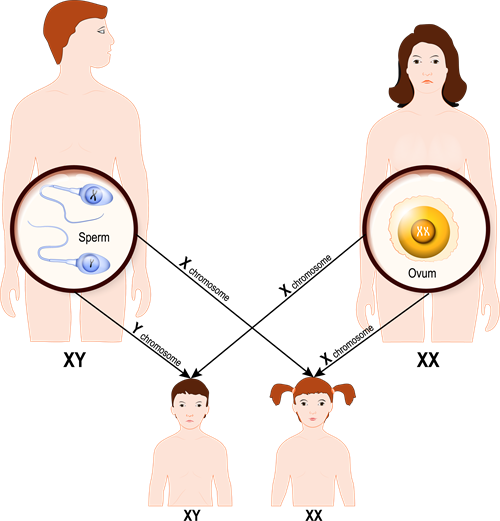
XX-XY type sex determination system in humans
Exam Tips
-
Must conclude: “Father determines the sex of the child.”
-
Draw the\(\ XX–XY\) chart—this alone can earn full marks in a 3-mark question.
-
If asked for reasoning, include:
“Because father produces two types of gametes (X and Y), mother produces only one (X).”
PYQ's
Key points summary (Quick Revision)
-
Variations occur due to reproduction.
-
Dominant traits mask recessive traits.
-
Traits assort independently.
-
Gametes are haploid; inheritance restores diploid state.
-
Father determines sex of baby.