

Steps of photosynthesis:
-
Absorption of light energy by chlorophyll.
-
Conversion of light energy to chemical energy and splitting water into hydrogen and oxygen.
-
Reduction of carbon dioxide to carbohydrates.
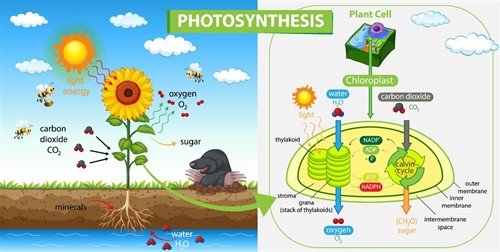
Mechanism of photosynthesis
Photosystems are functional units of photosynthesis present in the thylakoid membranes of chloroplasts. They are multiprotein pigment complexes containing chlorophyll that absorb and transfer light energy during the light reaction.
Types of photosystems:
-
Photosystem II (PS II): Located mainly in the grana; initiates the light reaction by absorbing light and splitting water.
-
Photosystem I (PS I): Located mainly on the outer thylakoid membrane; carries out the final stage of the light reaction to form energy-rich molecules.
Important!
Chlorophyll a is known as the universal photosynthetic pigment as it is found in all photosynthetic plants except bacteria. As it performs the reaction of photosynthesis it is also known as primary photosynthetic pigment.
Light-dependent reactions
The light-dependent reactions take place in the thylakoid membrane of the chloroplast. In this stage, light energy is converted into chemical energy in the form of ATP and NADPH. Water molecules are split by light to release oxygen, and the movement of electrons follows the Z-scheme.
Light-independent reactions (Calvin cycle)
The light-independent reactions occur in the stroma of the chloroplast. These reactions do not require light directly but use ATP and NADPH produced in the light reactions. Carbon dioxide is reduced to form glucose, which is used by the plant as food.
Transpiration
Transpiration is the process by which plants lose excess water in the form of water vapour mainly through the stomata present on the leaves.
Process
During the daytime, when the stomata are open, water evaporates from the leaf surface. This continuous loss of water creates a suction force known as transpirational pull, which helps in the upward movement of water from the roots to the leaves through the xylem.
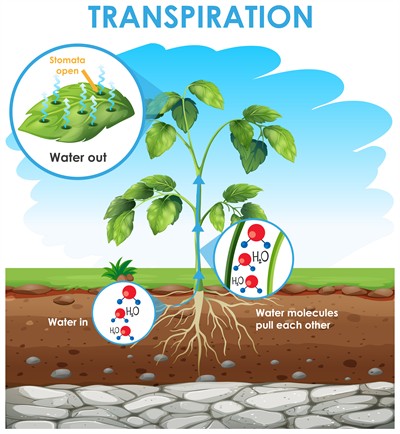
Transpiration
Importance
Transpiration helps in cooling the plant body, maintaining the flow of water in plants, and transporting minerals along with water. It also supports photosynthesis by providing water to the leaves.
Transpiration helps in cooling the plant body, maintaining the flow of water in plants, and transporting minerals along with water. It also supports photosynthesis by providing water to the leaves.
Difference between C3 and C4 plants:
|
C3 plants
|
C4 plants
|
| These plants use Calvin cycle for the dark reactions of photosynthesis. | These plants use the Hatch and Slack pathway. |
| These are cool season plants that are found in the cold and wet areas. | These are warm season plants that are commonly seen in the dry areas. |
| C3 plants make up around \(95%\) of all plant species on the globe. | They are about \(5%\) of the plant species. |
| Their leaves lack Kranz anatomy. | Their leaves show Kranz anatomy. |
| Their bundle sheath cells do not contain chloroplasts. | Their bundle sheath cells contain chloroplasts. |
| These plants can perform photosynthesis only when the stomata are open. | These plants can perform photosynthesis even when the stomata are closed. |
| Photorespiration rate is very high in these plants. | Photorespiration rate is vey low or mostly absent in these plants. |
| Carbon-di-oxide fixation is slow in these plants. | Carbon-di-oxide fixation is comparatively faster in these plants. |
| Carbon dioxide fixation occurs only once. | Carbon dioxide fixation occurs twice. |
| C3 photosynthesis is the oldest and the most common. | C4 photosynthesis is a recent phenomenon, emerging after C3 photosynthesis |
Food provides carbon-based molecules that are broken down through chemical reactions to release energy and this happens in mitochondria. Most organisms use oxygen to oxidize food, a process known as respiration.
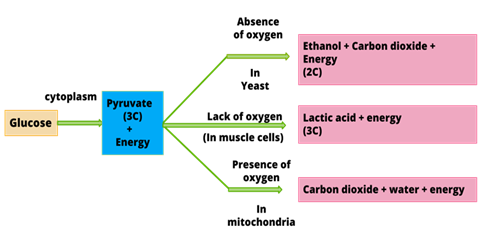
Cellular respiration