

Acoustics is a branch of physics that deals with the production, transmission, reception, control, and effects of sound.
You can conclude that vibrations produce sound by touching a ringing bell or a musical instrument while producing music. The vibrating bodies produce sound in the form of waves, and they are nothing but sound waves.
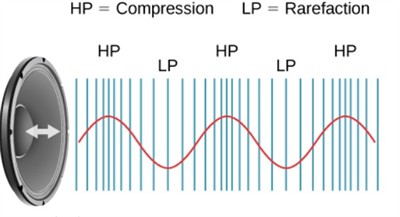
Sound waves are longitudinal waves that can travel at different speeds through any medium (solids, liquids, or gases) depending on the properties of the medium. When sound travels through a medium, the medium's particles vibrate in the wave's propagation direction. Individual molecules are displaced longitudinally from their mean positions in this displacement. This causes compressions and rarefactions, which are a series of high and low-pressure areas.
Categories of sound waves based on their frequencies
Audible sound: \(20\ to\ 20,000\ Hz\)
Infrasonic waves: less than \(20\ Hz\)
Ultrasonic waves: greater than \(20\ Hz\)
Factors affecting the velocity of sound:
The velocity of sound waves is affected by the elastic properties and density of solids when the sound wave travels in the solid medium. Their elastic moduli characterise the elastic property of solids. The velocity of sound is directly proportional to the square root of the elastic modulus and inversely proportional to the square root of the density.
Effect of density: In a gas medium, the velocity of sound is inversely proportional to the square root of the density. As a result, as the density of the gas increases, the velocity decreases.
Effect of temperature:
For air, \(=\) \(331\)
Hence, the velocity of sound changes by \(0.61\) when the temperature changes by one degree Celsius.
In a gas medium, the velocity of sound is proportional to the square root of the temperature . The velocity of sound in a gas increases as the temperature increases.
The following equation gives the velocity at temperature \(T\):
Here, is the velocity of sound in the gas medium at \(0° C\).
For air, \(=\) \(331\)
Hence, the velocity of sound changes by \(0.61\) when the temperature changes by one degree Celsius.
Effect of relative humidity:
The speed of sound increases as humidity rises. That is why, during rainy seasons, you can clearly hear sounds from a long distance.
There are two types of velocities associated with waves:
Particle velocity:
Particle velocity is the rate at which the medium's particles vibrate in order to transfer energy in the form of a wave.
Wave velocity:
The wave velocity is the velocity at which the wave travels through the medium. In other words, the velocity of a sound wave is the distance travelled by a sound wave in one unit of time.
It is mathematically represented as,
If one wavelength (λ) represents the distance travelled by one wave and one time period (\(T\)) represents the time taken for this propagation, the expression for velocity can be written as
As a result, the distance travelled by a sound wave per second can be defined as velocity,
We know,
Solids have the highest sound wave velocity because they are more elastic than liquids and gases. The velocity of sound in a gaseous medium is the lowest because gases are the least elastic. Therefore,
Rarer medium:
Rarer medium refers to a medium in which the velocity of sound increases in comparison to other medium (Water is rarer compared to air).
Denser medium:
Denser medium refers to a medium in which the sound velocity decreases when compared to other medium (In terms of sound, air is denser than water).
When it is necessary to focus sound at a specific point, parabolic surfaces are used. Therefore, many halls have parabolic reflecting surfaces. Sound waves from one focus will always be reflected to the other focus on elliptical surfaces, regardless of where it strikes the wall.
An echo is a sound that is reproduced due to the original sound being reflected off from various rigid surfaces such as walls, ceilings, mountain surfaces, and so on.
Application of echoes:
-
Some animals use sound signals to communicate and locate objects over long distances.
-
Obstetric ultrasonography, which creates real-time visual images of the developing embryo or foetus in the mother's uterus, uses the echo principle. Because it does not use any harmful radiation, this is a safe testing tool.
-
In any medium, echo is used to determine the velocity of sound waves.
When there is a relative motion between the source and the listener, the frequency of the sound received by the listener differs from the original frequency produced by the source. This phenomenon is called doppler effect. This relative motion could be caused by a number of factors, such as:
- The listener moves towards or away from a stationary source.
- The source moves towards or away from a stationary listener.
- Both source and listener move towards or away from one other.
- The medium moves when both source and listener are at rest.
|
Case no
|
Position of source and listener
|
Note
|
Expression for apparent frequency
|
| 1. |
|
a) Distance between source and listener decreases.
b) Apparent frequency is more than actual frequency.
|
|
| 2. |
|
a) Distance between source and listener increases.
b) Apparent frequency is less than actual frequency.
c) and become opposite in \(case-1\).
|
|
| 3. |
|
a) Apparent frequency depends on the velocity of the source and the listener.
b) becomes opposite to that in \(case-2\).
|
|
| 4. |
|
a) Apparent frequency depends on the velocity of the source and the listener.
b) and become opposite to that in \(case-3\).
|
|
| 5. |
|
a) Distance between source and listener decreases.
b) Apparent frequency is more than actual frequency.
c) \(=\) \(0\) in \(case-1\).
|
|
| 6. |
|
a) Distance between source and listener increases.
b) Apparent frequency is less than actual frequency.
c) \(=\) \(0\) in \(case-2\).
|
|
| 7. |
|
a) Distance between source and listener decreases.
b) Apparent frequency is more than actual frequency.
c) \(=\) \(0\) in \(case-1\).
|
|
| 8. |
|
a) Distance between source and listener increases.
b) Apparent frequency is less than actual frequency.
c) \(=\) \(0\) in \(case-2\).
|