

Power station:
A power station is also called a power plant or power generating station where electricity is generated in large amounts.
Distribution of current:
The electricity generated at power plants is supplied via overhead and underground cables to all domestic and industrial consumers. For domestic purposes, electricity is distributed via residential electric circuits wired by electricians.
Main box:
In the first stage of the household circuit, the power supply is provided to the main box from a distribution panel or transformer.
(i) Electric meter:
The meter keeps track of how much electricity is utilised.
A fuse box usually contains a fuse wire or a miniature circuit breaker (MCB). The purpose of a fuse wire or a miniature circuit breaker (MCB) is to safeguard electrical appliances like an electric iron or hairdryer from overloading due to excessive current.
A miniature circuit breaker (MCB) is a type of switch that can be operated automatically and manually. When the current exceeds the safety limit, an electromagnet attracts a spring attached to the switch. As a result, the switch is automatically turned off, and the circuit is broken. Thus, the electrical appliances are protected. The switch is turned on again, and the circuit is completed.
 In other words, the short-circuit happens due to the wear and tear of insulation on the wires due to temperature changes or other external forces. The direct contact of wires leads to an overflow of currents in the circuits, which eventually causes a short-circuit.
The vital components of the main box are:
(i) Electric meter:
The meter keeps track of how much electricity is utilised.
(ii) A fuse box:
A fuse box usually contains a fuse wire or a miniature circuit breaker (MCB). The purpose of a fuse wire or a miniature circuit breaker (MCB) is to safeguard electrical appliances like an electric iron or hairdryer from overloading due to excessive current.
Miniature circuit breaker:
A miniature circuit breaker (MCB) is a type of switch that can be operated automatically and manually. When the current exceeds the safety limit, an electromagnet attracts a spring attached to the switch. As a result, the switch is automatically turned off, and the circuit is broken. Thus, the electrical appliances are protected. The switch is turned on again, and the circuit is completed.
Always use an MCB with an ISI mark on it. Nowadays, MCB's are improvised with a built-in mechanism to restart automatically.
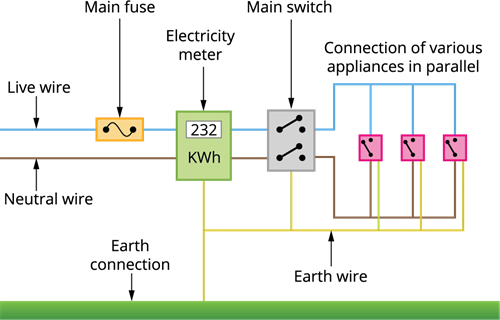
Schematic representation of domestic electric circuit
Schematic representation of domestic electric circuit
The live and neutral wires enter the main box, where the live wire is linked to the main fuse. These live and neutral wires enter the electricity meter, then runs into the main switch. This main switch helps to turn off the power supply whenever needed. Both the live and neutral wires are linked to live wires of two distinct circuits after passing through the main switch.
One of these two circuits has a 5 A rating and is used to power equipment with lower power ratings, such as tube lights, lamps, and fans. The other circuit has a 15 A rating and is used for high-power electric equipment, including air conditioners, refrigerators, electric irons, and heaters.
Importance of parallel connection:
It is important to note that all the electric circuits in a house are connected in parallel. The connections are made in parallel so that the removal of one circuit does not impact the other circuits. Another benefit of connecting circuits in parallel is that each electrical appliance receives the same amount of voltage.
Overloading:
When many electrical devices are connected in series to a single socket, there will be an overflow of current, causing the electrical circuit to overload. When the current running through a wire exceeds the maximum limit, the wires become overheated and causes fire. It is then referred to as overloading.
Short-circuiting:
A short-circuit occurs when a live wire makes contact with a neutral wire.
In most household circuits, a third wire, known as the earth wire, is attached to the body of the metallic electric device. The earth wire has green insulation, and its opposite end is attached to a metal tube or an electrode buried in the ground. This wire gives a low-resistance channel to the electric current.
Light Emitting Diode:
Light Emitting Diode:
An LED (Light Emitting Diode)bulb is a semiconductor device that emits visible light when an electric current passes through it. The type of materials utilised will determine the colour of the emitted visible light.
LED bulbs are used in a variety of applications. Some of them are listed below.
- Digital watches
- Calculators
- Traffic signals
- Street lighting
- Ornamental lights
A display device utilised to provide an output in numbers or text is known as a seven-segment display.
Applications of seven-segment display:
Seven-segment displays are commonly found in
- Digital metres
- Clocks
- Microwave ovens
An LED TV is an LCD (Liquid Crystal Display) television with a LED (Light Emitting Diode) display. An LED display uses Light Emitting Diodes for backlight, and pixels are created by a grid or an array of LEDs.