

Theory:
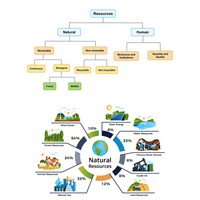
Resources and types
Types of natural resources:
-
Renewable resources (solar, wind, water) can be naturally replenished, whereas non-renewable resources (coal, petroleum, minerals) are limited and can be exhausted over time.
-
Natural resource management is essential because resources support livelihoods, food production, and economic development, and must be conserved to meet the growing demands of an increasing population.
Conservation and judicious use of resources:
-
Demand for natural resources is increasing due to population growth, changing lifestyles, and technological advancements, leading to rapid depletion of resources.
-
Resource planning and management ensure the optimal and equitable use of limited and unevenly distributed natural resources while protecting them from overexploitation.
-
Conservation and sustainable use of resources are necessary to maintain environmental balance, reduce pollution and wastage, and preserve resources for future generations.
Forests and their importance:
-
Biodiversity refers to the wide variety of living organisms (plants, animals, and microorganisms) on Earth and their interdependence, which is essential for human survival and ecosystem stability.
-
Forests play a vital role by providing habitats for wildlife, supplying valuable resources (timber, medicines, food), producing oxygen, regulating climate, conserving water, and preventing soil erosion and natural disasters.
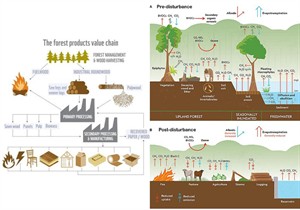
Forest products and acting as a carbon sink
Deforestation:
-
Deforestation: Large-scale cutting and clearing of forest trees to use land for other purposes.
-
Causes: Agriculture expansion, urbanization, construction of roads, dams and industries, and forest fires.
-
Effects: Soil erosion, floods and droughts, loss of biodiversity and wildlife, and climate change.
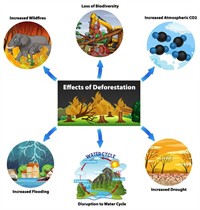
Effects of deforestation
Conservation of forest:
-
Afforestation: Planting trees on barren land (e.g., Van Mahotsav) to restore forest cover, reduce pollution, and prevent soil erosion and desertification.
-
Social forestry: Community participation in planting and managing trees on common lands to meet needs for fuelwood, timber, and fodder while reducing pressure on natural forests.
-
Forest conservation laws and movements: Government policies (Forest Conservation Act, National Forest Policy) and movements like the Chipko Movement help protect forests from excessive cutting.
Wildlife management:
-
Wildlife refers to undomesticated animals living in natural habitats (forests, grasslands, deserts) and plays a vital role in maintaining biodiversity and supporting tourism-based economies.
-
Decline in wildlife population occurs due to deforestation, habitat loss from human encroachment, pollution, poaching, invasive species, and harmful chemicals.
-
Wildlife conservation and management aim to protect endangered species and habitats through measures such as banning hunting and establishing protected areas like Jim Corbett National Park, wildlife sanctuaries, and biosphere reserves like Nilgiris.
Wildlife protection act:
-
Wildlife Protection Act \(1972\) prohibits hunting and trade of wild animals and provides for protected areas like wildlife sanctuaries and national parks.
-
Conservation organisations such as Indian Board for Wildlife, World Wide Fund for Nature, and International Union for Conservation of Nature work to protect wildlife and natural habitats.
-
Major conservation initiatives in India include Project Tiger, Project Elephant, and the Crocodile Conservation Project to safeguard endangered species.
WWF, IUCN, Wildlife Preservation Society of India, CITES and BNHS (clockwise)
Soil erosion:
Soil is the uppermost layer of the Earth’s crust containing minerals, humus, and living organisms that support plant growth and provide habitat for many organisms. Soil erosion is the removal of fertile topsoil by wind or water due to natural factors and human activities such as deforestation, farming, overgrazing, and mining. It can be controlled by measures like afforestation, maintaining vegetation cover, crop rotation, controlled grazing, terracing, and contour ploughing.
Types of resources:
-
Non-renewable energy resources: Energy sources that are limited and cannot be replenished quickly, such as coal, petroleum, natural gas, and nuclear power.
-
Renewable energy resources: Energy sources that are naturally replenished and available continuously, such as solar, wind, hydro, geothermal, and biomass energy.
Non-renewable energy resources:
Fossil fuels such as coal, petroleum, and natural gas are energy-rich resources formed from the buried remains of plants and animals over millions of years, widely used for electricity, transport, and cooking, but since they form very slowly and exist in limited amounts, they must be conserved to prevent depletion.
Renewable energy resources:
Solar, wind, water (hydropower), tidal energy, and biogas are renewable energy sources used to generate electricity or fuel, while shale gas is a fossil fuel extracted from sedimentary rocks through hydraulic fracturing.
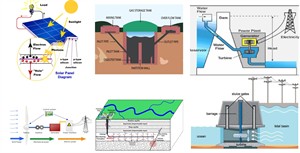
Solar energy, Biogas, Hydroelectric and Tidal power plant, Shale gas and Wind energy (clockwise)
Rainwater harvesting:
Water conservation and rainwater harvesting involve managing water resources efficiently and collecting and storing rainwater (from rooftops, tanks, pits, or ponds) to recharge groundwater and ensure future water availability.
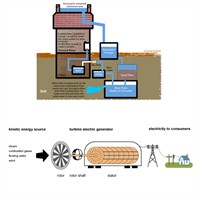
Rainwater harvesting and Electricity generation
Electrical energy:
Electricity is generated when turbines powered by steam, water, or wind rotate a generator to convert mechanical energy into electrical energy, and conserving electricity through efficient use helps reduce energy costs and preserve natural resources.
E-wastes, sewage and Solid Waste:
- E-waste refers to discarded or non-repairable electronic and electrical devices such as computers, mobile phones, televisions, and household appliances. These wastes contain toxic metals like lead, mercury, cadmium, and chromium, which can cause soil, water pollution, and serious health problems if not properly recycled or managed.
- Sewage is wastewater from homes and industries containing pollutants and microbes that contaminate water sources. It is treated through steps like screening, aeration, sludge removal, and disinfection before the water is reused.
-
Solid waste includes garbage from homes, hospitals, industries, and electronic devices, and improper disposal leads to environmental pollution and waste accumulation.
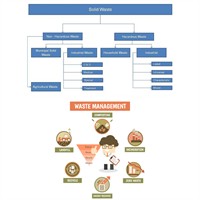
Waste and waste management
Solid waste management:
-
Solid waste management involves the collection, segregation, treatment, and proper disposal of waste from household and industrial activities.
-
Methods of disposal include segregation (biodegradable and non-biodegradable), sanitary landfills, incineration, composting, recycling, and the \(4R \) approach (Reduce, Reuse, Recovery, Recycle).
Did you find an error?