

The chapter "Optics" carries an average weightage of \(8–12\) marks, making it one of the most important topics in Physics.
A strong understanding of "Optics" helps students clearly explain how light behaves, how images are formed by mirrors and lenses, and how phenomena like reflection, refraction, and dispersion occur in everyday life. This chapter also forms the foundation for numericals involving mirror and lens formulas, magnification, and refractive index.
To score well in this unit, it is essential to understand the laws of reflection and refraction, ray diagrams for mirrors and lenses, and applications such as the human eye and optical instruments.
Students should also be able to differentiate concepts such as real vs. virtual images, concave vs. convex mirrors, and refraction vs. dispersion of light.
Light is an energy that travels in waves. A ray of light is a path of light, and a group of these rays is referred to as a beam of light. Any object that emits light is referred to as a source of light.
Below is the question pattern expected from this chapter:
Question Distribution:
-
Part I: (\(1\) mark) – One question
-
Part II: (\(2\) marks) – One question
-
Part III or IV: (\(4\) marks) – One question
- Part III or IV: (\(7\) marks) – One question
Learning Outcomes:
-
Reflection of light: Understand the laws of reflection and explain image formation by plane, concave, and convex mirrors using ray diagrams.
-
Refraction of light: Learn how light bends at the boundary of two media, understand refractive index, and apply Snell’s law.
-
Mirrors and lenses: Use mirror and lens formulas to solve numericals involving image distance, focal length, and magnification.
-
Human eye and defects: Explain the working of the human eye and understand defects like myopia and hypermetropia along with their corrections.
-
Dispersion and scattering: Understand the splitting of white light into colours and explain natural phenomena like rainbow and blue sky.
Exam Tips:
-
Learn laws of reflection and refraction clearly
-
Practice ray diagrams neatly
-
Solve numericals using sign convention
-
Remember mirror and lens formulas
-
Check unit conversions (cm to m) before calculations
Properties of light:
- Light is a form of energy that always travels along a straight line.
- Light do not need any medium for its propagation. It can even travel through a vacuum.
- The speed of light in a vacuum or air is \(C\ =\ 3\ \times\ 10^{8}\ m/s\).
- Since light is in the form of waves, it is characterized by a wavelength \(λ\) and a frequency \\(ν\), which are related by the following equation, \(C\ =\ vλ\)
When a light ray travels obliquely from one transparent medium to another, it deviates from its original path. Refraction is the term for the deviation of a light ray. The difference in the velocity of light in different media causes refraction. In a rarer medium, light travels faster, while in a denser medium, it travels slower.
The refraction of light is governed by two refraction laws.
First law of refraction: The incident ray, the refracted ray of light and the normal to the refracting surface all lie in the same plane.
Second law of refraction: The ratio of the sine of the angle of incidence and sine of the angle of refraction is equal to the ratio of refractive indices of the two media. This law is also known as Snell’s law.
When a white or composite light beam is refracted through a transparent medium like glass or water, it splits into its component colours. The term for this phenomenon is "light dispersion." A spectrum refers to a group of colours. This spectrum consists of the following colours: Violet, Indigo, Blue, Green, Yellow, Orange, and Red. The abbreviation "VIBGYOR" stands for these colours.
Types of scattering:
Many types of scattering occur when a beam of light interacts with a constituent particle of the medium. Scattering can be classified based on the initial and final energy of the light beam.
- Elastic scattering
- Inelastic scattering
The nature and size of the scatterer result in different types of scattering. They are
- Rayleigh scattering
- Mie scattering
- Tyndall scattering
- Raman scattering
Rayleigh's scattering law:
Rayleigh's scattering law states that "The amount of scattering of light is inversely proportional to the fourth power of its wavelength".
Exam question:
Tyndall Effect:
When a ray of sunlight shines through a window into a dusty room, its path is visible to us. This is due to the tiny dust particles in the room's air scattering the light beam. This is a case of Tyndall Scattering in action. Tyndall Scattering or Tyndall Effect is the scattering of light rays by colloidal particles in a colloidal solution.
Lens:
Two spherical surfaces bulging outwards are possible in a lens.
Covex lens - Converging lens
Concave lens - Diverging lens
Rules for ray diagram:
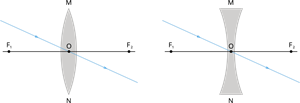 |
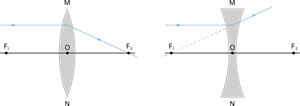 |
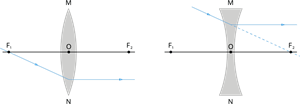 |
Rules for ray diagram
Image formation by convex lens:
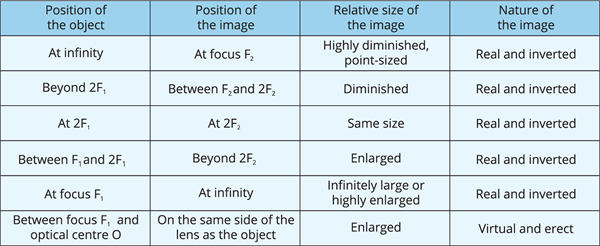
Image formation by convex lens
Image formation by concave lens:
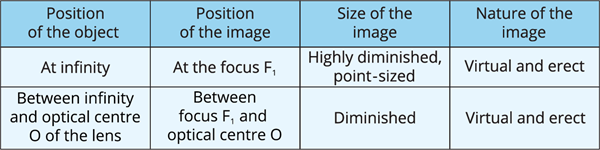
Image formation by concave lens
The lens equation is given by,
\(\frac{1}{f}\ =\ \frac{1}{v}\ -\ \frac{1}{u}\)
The magnification is given by,
\(M\ =\ \frac{v}{u}\ =\ \frac{h'}{h_o}\)
Power of a lens:
The power of a lens is the degree of convergence or divergence of light rays it achieves.
\(P\ =\ \frac{1}{f}\)
The 'dioptre' is the SI unit of lens power.
A lens with a focal length of one metre has a power of one dioptre.
Lens maker's formula:
where \(µ\) is the refractive index of the material of the lens; and are the radii of curvature of the two faces of the lens; \(f\) is the focal length of the lens.
Structure of the eye:
The eyeball has a diameter of about \(2.3 cm\) and is roughly spherical in shape.
Important parts of the human eye:
- Cornea - thin and transparent layer on the front surface of the eyeball
- Iris - coloured portion of the eye
- Pupil - centre of the Iris
- Retina - eye's back surface
- Eye Lens - convex in nature.
- Ciliary muscles - adjust the focal length of your eye lens
Working of Eye:
- Persistance of vision - If the time interval between two successive light pulses is less than \(\frac{1}{16}\ seconds\), the human eye cannot distinguish them separately.
- Power of accomodation - the capability of the eye lens to focus nearby and distant objects
Defects of eye:
- Myopia - shortsightedness - concave lens
- Hypermetropia - farsightedness - convex lens
- Presbyopia - old age hypermetropia - Bifocal lens
- Astigmatism
Exam question:
Microscope is an optical instrument, which helps us to see tiny (very small) objects. It is classified as
- Simple microscope
- Compound microscope
Simple microscope:
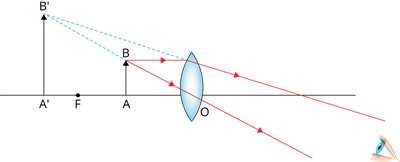
Simple microscope
Uses of Simple microscope:
a. by watch repairers and jewellers.
b. to read small letters clearly.
c. to observe parts of flowers, insects etc.
d. to observe fingerprints in the field of forensic science.
Compound microscope
A compound microscope has two convex lenses. The lens with short focal length is placed near the object and is called an objective lens or objective piece. The lens with large focal length and larger aperture placed near the observer’s eye is called an eye lens or eyepiece. Both the lenses are fixed in a narrow tube with adjustable provision.
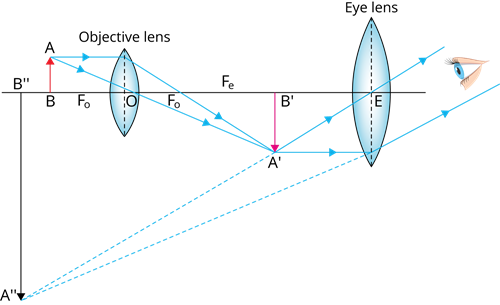
Compound microscope
Telescope:
Based on optical property, it is classified into two groups:
- Refracting telescope
- Reflecting telescope
Types of telescope:
Astronomical Telescope - Astronomical telescopes are used to observe celestial objects such as stars, planets, galaxies, and satellites.
Terrestrial Telescopes - In an astronomical telescope, the image is inverted. As a result, it is not suitable for viewing objects on the Earth's surface. As a result, a terrestrial telescope is employed. It gives the impression of being upright.
Advantages of Telescopes:
- Elaborate view of the Galaxies, Planets, stars and other heavenly bodies is possible.
- Camera can be attached for taking photographs of celestial objects.
- Telescope can be viewed even with the low intensity of light.
Disadvantages of Telescopes:
- Frequent maintenances needed.
- It is not an easily portable one.