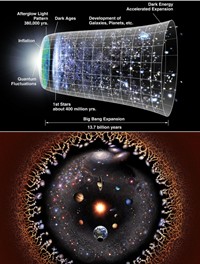
Georges Lemaitre proposed that a massive explosion \(15\) billion years ago initiated the expansion of the universe, leading to the formation of atoms, galaxies, Earth (\(4.5\) billion years ago), and eventually life.
Theory of special creation:
The Theory of Special Creation states that a supernatural powercreated all living organisms in their present form without evolution, but scientists rejected it due to lack of scientific evidence and fossil records showing gradual change.
Big bang and theory of special creation
The theory of spontaneous generation:
The theory of spontaneous generation (abiogenesis) held that life arose from non-living matter. However, experiments by Lazzaro Spallanzani, Francesco Redi, and Louis Pasteurdisproved it and established the theory of biogenesis, which holds that life arises from pre-existing life.
Redi’s Experiment:
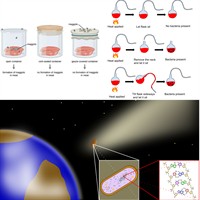
Francesco Redi showed that maggotsdeveloped only when flies laid eggs on exposed meat, proving that life arises from pre-existing life, not non-living matter.
Pasteur’s Experiment:
Louis Pasteur demonstrated with a swan-neck flask that boiled broth remained sterile unless exposed to air, proving that microorganisms arise from existing microbes, not spontaneously.
Cosmozoic Theory (Panspermia):
Svante Arrhenius proposed that life on Earth originated from outer space as spores (panspermia). However, scientists rejected it due to a lack of evidence for spore survival and transfer through space.
Redi's and Pastuer's experiment and theory of Panspermia (clockwise)
Chemical Evolution of Life:
Alexander Oparin and J. B. S. Haldane proposed that life originated through chemical reactions on early Earth, and Stanley Miller and Harold Urey experimentally supported this idea by synthesising organic molecules under primitive Earth conditions.
Evidences of evolution
Biological evolution involves generational changes in organisms, including convergent and divergent evolution and adaptive radiation, supported by evidence that all species descended from a common ancestor.
The three major pieces of evidence that prove biological evolution are as follows:
1. Evidence from morphology and anatomy
Scientists compare anatomical and morphological features to identify structural and functional similarities and variations that indicate common characteristics among organisms.
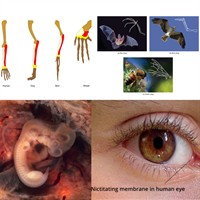
Homologous organs: Organs with similar structure and developmental origin but different functions indicate common ancestry and divergent evolution.
Analogous organs: Organs with different structures and origins but similar functions result from convergent evolution.
Vestigial organs:Rudimentary, non-functional organs that were functional in ancestors indicate evolutionary change.
Atavism: The reappearance of ancestral traits in modern organisms.
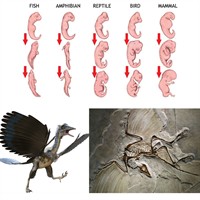
2. Evidence from Embryology: Similarities in early embryonic stages of different organisms indicate their common ancestry.
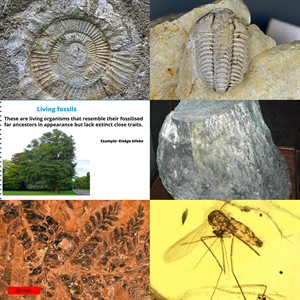
3. Evidence from Palaeontology:Fossil records provide evidence for evolution by showing the gradual development of organisms from simple to complex forms.
Embryological evidences and Archeopteryx
Theories of evolution
The formation of new species due to changes in specific characters over several generations in response to natural selection is calledevolution.
Evolution occurs in response to natural changes, and scientists like Jean-Baptiste Lamarck and Charles Darwin explained how these changes lead to the formation of new species.
Principles of Lamarckism
1.Internal vital force: Jean-Baptiste Lamarck proposed that organisms possess an internal vital force that drives growth and progressive change.
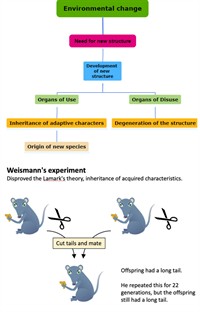
2. Effect of environment and new needs: Environmental changes create new needs, causing organisms to developadaptive (acquired) characteristics.
3.Use and disuse of organs: Frequently used organs strengthen and develop, while unused organs gradually degenerate.
4. Inheritance of acquired characters: Organisms pass acquired traitsdevelopedduring their lifetime to their offspring.
Principles and Critics of Lamarckism
Critics of Lamarckism:
1. Scientists rejected Lamarck’s idea that all acquired characters are inherited, as many acquired traits (e.g., pierced ears) do not pass to offspring.
2.August Weismann disproved the inheritance of acquired traits through his germplasm theory and rat-tail experiment, showing that only germ cell changes are inherited.
Neo-Lamarckism:
1. Neo-Lamarckism states that environmental factors can influence heredity, but only some acquired traits may be inherited.
2. It rejects the internal vital force and emphasises that mainly variations in germ cells are passed to offspring.
Darwinism
Charles Darwin (\(1809\)–\(1882\)) developed the theory of natural selection after his voyage on the HMS Beagle (\(1831\)–\(1835\)) and published it in \(1859\) in On the Origin of Species.
Principles of Darwinism
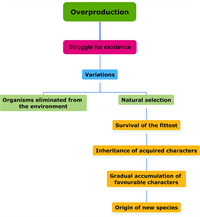
Darwinism, or natural selection, is based on the following principles:
1.Overproduction: Organisms reproduce in large numbers, producing more offspring than can survive in the environment.
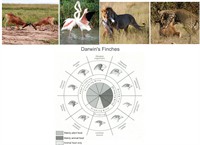
2.Struggle for existence: Due to limited resources, organisms compete (intraspecific, interspecific, and environmental struggle) to survive.
Intraspecific struggle, Interspecific struggle and Variations in the beaks of finches based on the food cosumption
3.Variations: Small heritable variations arise among organisms, and favourable ones increase survival chances.
Sexual reproduction and mutations create genetic variations, which are essential for evolution.
Variations may be somatic (non-heritable) or germinal (heritable), with germinal variations being continuous or discontinuous.
4.Survival of the fittest/Natural selection: The environment selects organisms with favourable variations to survive and reproduce.
5.Origin of species: Accumulation of favourable variations over generations leads to speciation, as observed by Charles Darwin in the finches of the Galapagos Islands.
Postulates of Darwinism
Criticism against Darwinism:
1.Darwinism failed to explain the genetic basis and transmission of variations, including the role of germ cells.
2. Not all variations arise from environmental adaptation, and even non-useful traits (e.g., vestigial organs) can be inherited.
Palaeobotany is the branch of palaeontology that studies ancient plant fossils to understand plant evolution and past ecology.
Fossils are preserved remains or impressions of ancient plants that help in plant classification and tracing evolutionary history.
Kaspar Maria von Sternberg is known as the Father of Palaeobotany, and Birbal Sahni is regarded as the Father of Indian Palaeobotany.
2.Fossilisation:
Fossilisation is the process by which plant or animal remains become preserved in rocksover time.
Main methods: Fossils form through petrification, moulds and casts, preservation (in ice or amber), compression, and infiltration/replacement by minerals.
Process summary: These methods preserve organisms by replacing minerals, forming sediment impressions, or protecting them from decay, helping to record ancient life.
Petrification, Moulds (molds) and cast, Carbonization, Preservation, Compression and Infiltration (clockwise)
3.Determination of the age of fossils
Scientists determine the age of fossils using relative dating(comparing with known fossils) and absolute dating (radiometric methods).
Radiocarbon \(C^14\) dating, discovered by Willard F. Libby, measures the decay of radioactive carbon in once-living organisms to calculate the time since death.
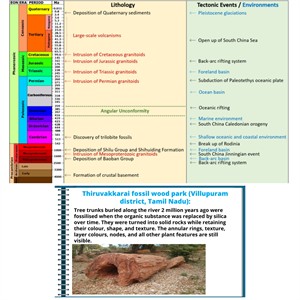
Geological time scale
4.Ethnobotany
Ethnobotany is the study of plants of a particular region and their traditional uses by local cultures, a term coined by John W. Harshberger, and it plays an important role in nutrition, healthcare, biodiversity conservation, and the discovery of medicinal plants.
5.Astrobiology
Astrobiology (formerly exobiology) studies the origin and possibility of extraterrestrial life, focusing on the habitable or “Goldilocks” zone where planets like Earth and possibly ancient Mars can support liquid water and potentially extremophile life forms.