

Reproduction
Reproduction is the biological process through which organisms produce offspring that are genetically identical to themselves.
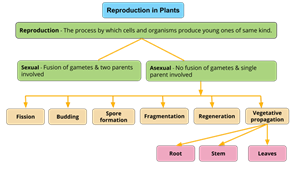
Types of reproduction
Asexual reproduction:
In asexual reproduction, offspring are produced by a single parent (uniparental), and there is no fusion of gametes. Thus, the offspring produced are exact copies of the parent.
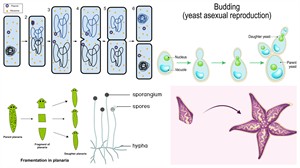
Types of asexual reproduction: Clockwise from top left: Binary fission, Budding, Regeneration, Spore formation, and Fragmentation
Sexual reproduction:
The process in which a male and a female gamete fuse to produce offspring of their own kind is known as sexual reproduction.
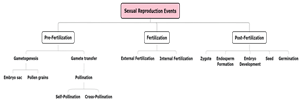
Sexual reproduction
Pollination and its types
The transfer of pollen from anther to stigma is called pollination, which can be self-pollination (same plant) or cross-pollination (another plant of the same species).
| Type of Pollination | Term and Example |
|---|---|
| Pollination by wind | Anemophily (e.g., maize, grasses) |
| Pollination by water | Hydrophily (e.g., Vallisneria, Hydrilla) |
| Pollination by insects | Entomophily (e.g., sunflower, hibiscus) |
| Pollination by birds | Ornithophily (e.g., hibiscus, Butea) |
| Pollination by bats | Chiropterophily (e.g., durian, kapok tree) |
Life cycle in flowering plants:
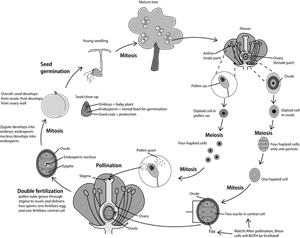
Life cycle in flowering plants
Human reproductive system
The reproductive system comprises of two different parts:
1. Primary reproductive sex organs - It includes the gamete producing gonads, i.e., the testes (in a male) and the ovaries (in female).
2. Secondary or accessory reproductive sex organs.(Vas deferens and prostate gland etc. in males and Fallopian tubes and uterus etc. in females).
1. Primary reproductive sex organs - It includes the gamete producing gonads, i.e., the testes (in a male) and the ovaries (in female).
2. Secondary or accessory reproductive sex organs.(Vas deferens and prostate gland etc. in males and Fallopian tubes and uterus etc. in females).
Male Reproductive System:
a. Structure of Testes: Male reproductive glands in the scrotum, each covered by tunica vaginalis, tunica albuginea, and tunica vasculosa, divided into \(~250\) lobules containing seminiferous tubules, Sertoli cells, and Leydig cells.
b. Spermatogenesis: Occurs in seminiferous tubules; Sertoli cells support sperm development and secrete inhibin to regulate FSH.
c. Hormone Secretion: Leydig cells between tubules secrete testosterone, which initiates and maintains spermatogenesis.
b. Spermatogenesis: Occurs in seminiferous tubules; Sertoli cells support sperm development and secrete inhibin to regulate FSH.
c. Hormone Secretion: Leydig cells between tubules secrete testosterone, which initiates and maintains spermatogenesis.
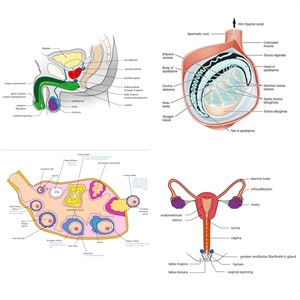
Male and Female reproductive organs
Female Reproductive System:
a. Structure and Function: The female reproductive system includes ovaries, fallopian tubes, uterus, vagina, and vulva, and its functions are to produce eggs, receive sperm, provide a site for fertilization and embryo development, and secrete hormones controlling ovulation and pregnancy.
b. Ovary & Follicle Development: Ovaries are almond-shaped organs with cortex (follicles) and medulla. Primordial follicles develop into primary \(\rightarrow\) secondary \(\rightarrow\) tertiary (Graafian) follicles, with the Graafian follicle releasing the ovum during ovulation. Females are born with \(1\)–\(2\) million eggs, but ovulate only \(300\)–\(400\) in a lifetime.
c. Accessory Organs & Glands: Fallopian tubes transport eggs and are sites of fertilization; uterus supports implantation and fetal development; vagina receives sperm and acts as birth canal; vulva is external genitalia; accessory glands include Bartholin’s glands and mammary glands for lubrication and lactation.
b. Ovary & Follicle Development: Ovaries are almond-shaped organs with cortex (follicles) and medulla. Primordial follicles develop into primary \(\rightarrow\) secondary \(\rightarrow\) tertiary (Graafian) follicles, with the Graafian follicle releasing the ovum during ovulation. Females are born with \(1\)–\(2\) million eggs, but ovulate only \(300\)–\(400\) in a lifetime.
c. Accessory Organs & Glands: Fallopian tubes transport eggs and are sites of fertilization; uterus supports implantation and fetal development; vagina receives sperm and acts as birth canal; vulva is external genitalia; accessory glands include Bartholin’s glands and mammary glands for lubrication and lactation.
Gametogenesis is the process of the formation of gametes or sex cells, i.e., sperm in males (spermatogenesis) and ovum in females (oogenesis).
Menstrual cycle
The menstrual cycle is a monthly (\(~28\) days) series of rhythmic reproductive changes in females, beginning at puberty (menarche, \(~11–13\ \)years) and ending at menopause (\(~48–50\) years).
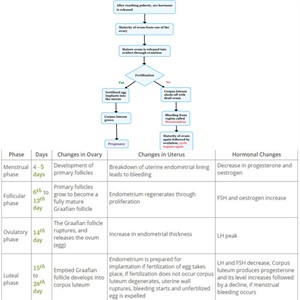
Menstrual cycle
Fertilization:
Fertilization is the fusion of a haploid sperm and a haploid ovum to form a diploid zygote.
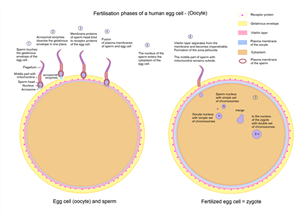
Phases involved in the fertilization
Post fertilization:
1. Embryogenesis & Gestation: Development from zygote to birth is called embryogenesis; it lasts ~280 days (gestation period).
2. Stages of Development: Includes cleavage (blastula formation) \(\rightarrow\) implantation (attachment to uterus) \(\rightarrow\) gastrulation (formation of ectoderm, mesoderm, endoderm) \(\rightarrow\) organogenesis (organ formation).
3. Placenta Function: Connects foetus to mother via umbilical cord; helps in nutrition, respiration, excretion, protection, and hormone secretion.
4. Pregnancy & Birth: Embryo develops in uterus; parturition is childbirth, triggered by hormones like oxytocin causing uterine contractions.
5. Lactation & Twins: Lactation is milk production (colostrum provides immunity); twins can be identical (one zygote) or fraternal (two zygotes).
2. Stages of Development: Includes cleavage (blastula formation) \(\rightarrow\) implantation (attachment to uterus) \(\rightarrow\) gastrulation (formation of ectoderm, mesoderm, endoderm) \(\rightarrow\) organogenesis (organ formation).
3. Placenta Function: Connects foetus to mother via umbilical cord; helps in nutrition, respiration, excretion, protection, and hormone secretion.
4. Pregnancy & Birth: Embryo develops in uterus; parturition is childbirth, triggered by hormones like oxytocin causing uterine contractions.
5. Lactation & Twins: Lactation is milk production (colostrum provides immunity); twins can be identical (one zygote) or fraternal (two zygotes).
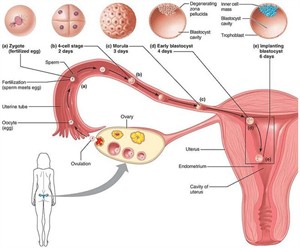
Picture depicting the process of cleavage and implantation of blastula
Contraception
- Contraception refers to methods used to prevent pregnancy.
- It includes barrier methods like condoms, hormonal pills, IUCDs, and surgical methods.
- It helps in family planning and controlling population growth.
- Certain methods like condoms also help prevent sexually transmitted infections.
Personal Hygiene
- Personal hygiene is the practice of maintaining cleanliness of the body.
- It includes habits like regular bathing, hand washing, and oral care.
- Good hygiene helps prevent infections and diseases.
- It is essential for maintaining overall health and well-being.