

Chapter plan
Importance
The chapter Structural Organisation of Animals explains how cells, tissues, organs, and organ systems are structurally and functionally organized in animals. It introduces animal tissues and their specific functions, forming the base for understanding complex organ systems.
The chapter provides detailed study of Leech (invertebrate) and Rabbit (vertebrate) to highlight structural adaptations. Overall, the chapter is moderately scoring, with emphasis on definitions, functions, and diagrams.
Expected question distribution - 2marks / 4 marks
-
Part II (2 marks):
-
Animal tissues and their functions
-
Organ vs organ system
-
-
Part III (4 marks):
-
Leech adaptations / organ systems
-
Rabbit digestive, respiratory, or nervous system
(Either one 2-mark or one 4-mark question may appear.)
-
Learning objectives
-
Identify the four types of animal tissues and explain their specific functions.
-
Differentiate between organ and organ system with suitable examples.
-
Describe the external morphology and organ systems of leech.
-
Explain the digestive, respiratory, circulatory, nervous, and urinogenital systems of rabbit.
-
Understand parasitic adaptations in leech and structural specialization in rabbit.
Hirudinaria granulosa (Indian cattle leech)
Classification:
-
Phylum: Annelida
-
Class: Hirudinea
-
Order: Gnathobdellida
Habit & habitat:
-
Found in ponds, lakes, swamps, and slow streams.
-
Ectoparasitic and blood-sucking (sanguivorous).
-
Feeds on fishes, frogs, cattle, and humans.
External features:
-
Body is soft, elongated, and segmented (33 segments).
-
Dorsal side is olive green; ventral side is orange/yellow.
-
Two suckers:
-
Anterior sucker – helps in feeding.
-
Posterior sucker – helps in attachment and locomotion.
-
External apertures of leech
The \(33\) segments of leech's body is divided into six regions.
| Cephalic region | \(1 - 5\) segment |
| Pre-clitellar region | \(6 - 8\) segment |
| Clitellar region | \(9 - 11\) segment |
| Middle region | \(12 - 22\) segment |
| Caudal region | \(23 - 26\) segment |
| Posterior sucker | \(27 - 33\) segment |
Body wall
- Layers: cuticle → epidermis → dermis → muscles → botryoidal tissue.
- Muscles: circular and longitudinal.
- Botryoidal tissue surrounds the gut.
Digestive system:
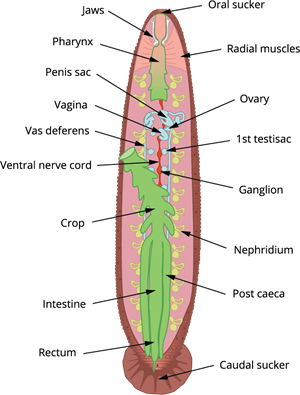
Triradiate mouth with three jaws and saliva contains hirudin (prevents blood clotting). Blood stored in crop and digested slowly.
Respiration:
-
Breathing occurs through moist skin by diffusion.
-
Skin has capillaries filled with haemocoelic fluid.
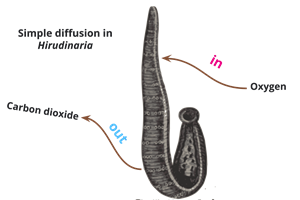
Simple diffusion in leech
Circulation:
Haemocoelic system with longitudinal channels; haemoglobin present.
Reproductive system:
-
Hermaphrodite: has male and female organs.
-
Internal fertilization occurs.
-
Cocoon forms around clitellar segments (9–11).
-
Development is direct; young resemble adults.
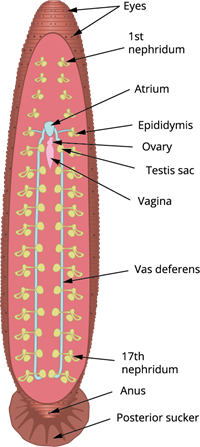
Reproductive system of leech
Other systems:
- Excretion: 17 pairs of nephridia (segments 6–22).
-
Locomotion: Looping/crawling and swimming.
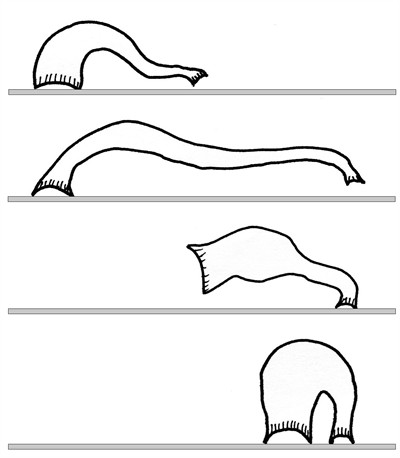
Looping or crawling movement of leech
-
Nervous system: Nerve ring surrounds pharynx and paired ventral nerve cord.
-
Parasitic adaptations: Suckers, painless Y-shaped bite, hirudin secretion, blood storage in crop, absence of setae and parapodia.
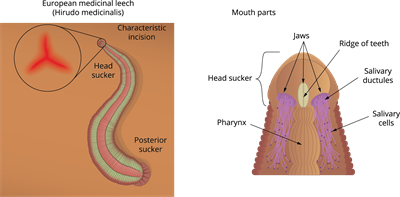
The anatomy of leech sucker