

Introduction
Light is a form of energy that travels as waves, and we can see objects only when light reflected from them enters our eyes. Some objects like the Sun and stars are luminous objects as they emit their own light. In this chapter, we study scattering of light, lenses, the human eye, and optical instruments.
Properties of light:
- Light is a form of energy.
- Light travels in a straight line in a homogeneous medium.
- Light travels in the form of waves.
- Light does not require a material medium and can travel through vacuum.
- The speed of light in vacuum is \( 3\times 10^{8}\).
- When light strikes a surface, it undergoes reflection.
- Reflection follows the laws of reflection.
- Light undergoes refraction when it passes from one transparent medium to another.
- Refraction occurs due to the change in speed of light.
- White light splits into its constituent colours (dispersion).
- Scattering of light explains natural phenomena like the blue colour of the sky.
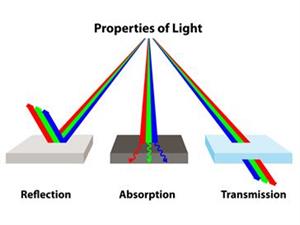
Properties of light
Refraction of Light:
Refraction of light is the change in direction of light when it passes from one transparent medium to another.
It occurs due to the change in speed of light in different media. The bending takes place at the boundary of separation of two media.
Laws of Refraction:
- The incident ray, refracted ray, and the normal lie in the same plane.
- The ratio of the sine of angle of incidence (\(sin\ i\)) to the sine of angle of refraction (\(sin\ r\)) is a constant.
\(\frac{sin\ i}{sin\ r}=\mu \)
The refractive index is given by,
where \(c\) is the speed of light in vacuum and \(v\) is the speed of light in the medium.
Dispersion of Light:
White light is a composite light made up of seven colours called VIBGYOR. When it passes through a glass prism, each colour bends by a different amount because they have different wavelengths and travel with different speeds in the medium. This splitting of white light into its constituent colours is called dispersion of light, and the coloured band formed is known as the spectrum.
Scattering of Light:
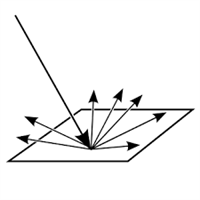
When light passes through a medium containing small particles, it gets deviated in different directions. This phenomenon is called scattering of light.
Scattering depends on the wavelength of light and explains natural phenomena like the blue colour of the sky and the reddish appearance of the Sun during sunrise and sunset.
Scattering of light