

Importance:
The chapter "Acids, bases and salts" carries significant weightage around \(5\) marks, highlighting its significance in the overall curriculum. A clear understanding of this chapter will enhance how acids, bases, and salts interact with each other and their impact on various natural and industrial processes.
Question distribution:
- (\(1\) marks) - One question
- (\(2\) marks) - One question
- (\(3\) mark) - One question
(Note: The exact mark distribution may vary slightly across examinations)
Learning objectives:
-
Identify acids and bases using natural indicators (such as litmus) and synthetic indicators (such as phenolphthalein and methyl orange).
-
Describe and explain the chemical properties of acids and bases, including their reactions with metals, carbonates, and oxides.
- Explore how acids and bases neutralise each other.
- Prove that acids and bases conduct electricity, identifying this as a common property due to the presence of ions in their aqueous solutions.
Everyday life is full of invisible chemical reactions happening around us – from the sour taste of lemon juice to the slippery feel of soap. These reactions are often caused by two special kinds of substances called acids and bases. Let us explore the science behind the reactions, indicators, and pH value mysteries — where each solution has a story!
Acids and bases:
| Property | Acids | Bases |
| Taste | Sour | Bitter |
| Nature | Corrosive | Slippery or soapy |
| Ions released in aqueous solution | \(H^+\) ions | \(OH^-\) ions |
| Litmus test | Turn blue litmus red | Turn red litmus blue |
| Phenolphthalein | Colourless | Pink |
| Methyl orange | Red | Yellow |
| Onion, vanilla essence, clove oil | Retains the odour | Odourless |
| pH range | Less than \(7\) | Greater than \(7\) |
| Electrical conductivity | Conducts electricity due to presence of ions (\(H^+\)) | Conducts electricity due to ions (\(OH^-\)) |
- Strong acids: Completely ionise in water and release more \(H^+\) ions - \(H_2SO_4\), \(HCl\), \(HNO_3\) and most of inorganic acids.
- Weak acids: Partially ionise in water and release fewer \(H^+\) ions - \(CH_3COOH\), \(H_2CO_3\), most of organic acids.
-
Strong bases: Completely ionise in water and release more \(OH^-\) ions - \(NaOH\), \(KOH\).
-
Weak bases: Partially ionise in water and release fewer \(OH^-\) ions - \(NH_4OH\).
Reactions of acids and bases:
| Reaction | Acids | Bases | Example | Test |
| Metals | Form salt + hydrogen gas | Form salt + hydrogen gas |
Acid: \(Zn + 2HCl → ZnCl_2 + H_2↑\)
Base: \(2NaOH + Zn → Na_2ZnO_2 + H_2↑\)
|
Pop sound |
| Metal carbonates and bicarbonates | Produce salt + water + \(CO_2\) gas | No reaction |
\(Na_2CO_3 + 2HCl → 2NaCl + H_2O + CO_2\)
|
Limewater turns milky
|
| Neutralisation | Reacts with base to form salt + water | Reacts with acid to form salt + water |
\(HCl + NaOH → NaCl + H_2O\)
|
Exothermic
|
| Metal/non - metal oxide | React with metal oxides to form salt + water | React with non-metal oxides to form salt + water |
Acid: \(MgO + 2HCl → MgCl_2 + H_2O\)
Base: \(2NaOH + CO_2 → Na_2CO_3 + H_2O\)
|
Metallic oxides are basic.
Non-metallic oxides are acidic.
|
Acids and bases exhibit unique chemical properties through their reactions with metals, oxides, and carbonates, helping us understand their real-world significance. In the next session, we will explore the pH scale, its importance, and the key chemicals obtained from common salt.
Acid and base in a water solution:
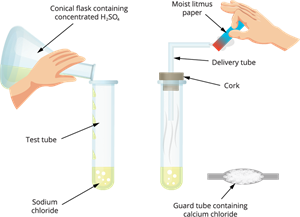
Acid produces hydrogen ions in water
- Dry \(HCl\) gas: Does not have separate \(H+\) ions, fails to turn blue litmus paper to red. Do not show the acidic character of an acid.
- \(HCl\) solution: Contains separate \(H^+\) ions, turns blue litmus red. Proves the acidic character of an acid.
- Acids: \(H^+\) ions
- Bases: \(OH^-\) ions
- Guard tube: Calcium cholride - Absorb moisture from the gas.
PYQ - Acid in water
Water is mixed with an acid or a base:
- Dissolving an acid and a base in water is an exothermic process
- Always add acid to water, never water to acid
- Adding water to an acid or a base decrease the concentration of the ions
- Concentrated acid/base: High percentage of acid/base and a low percentage of water
- Diluted acid/base: High percentage of water and a low percentage of acid/ base
PYQ - Dilution of an acid
Neutralisation reaction:
\(Acid\ + Base\ → Salt\ + Water\)
pH scale:
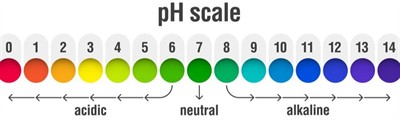
pH scale
- pH - potenz (potential) of hydrogen
- \(0\) to \(7\) - Acid
- \(7\) - Neutral
- \(7\) to \(14\) - Base
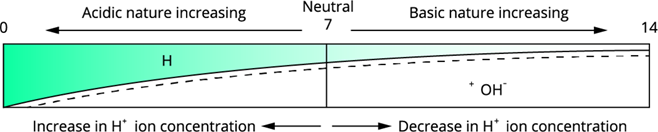
Variation of pH
PYQ - pH, pH of a solution