

- Understand the pH scale and identify whether substances are acidic, basic, or neutral, with examples from daily life like soil and water quality.
- Explain neutralisation reactions and relate them to real-world uses such as antacids and soil treatment.
- Describe how salts are prepared through reactions like neutralisation and identify different types of salts and their applications.
- Recognise practical uses of acids, bases, and salts in cleaning, digestion, food preservation, and various industries.
Neutralisation reaction:
\(Acid\ + Base\ → Salt\ + Water\)
pH scale:
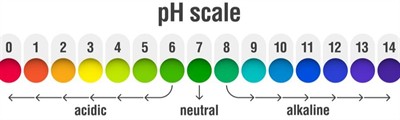
pH scale
- pH - potenz (potential) of hydrogen
- \(0\) to \(7\) - Acid
- \(7\) - Neutral
- \(7\) to \(14\) - Base
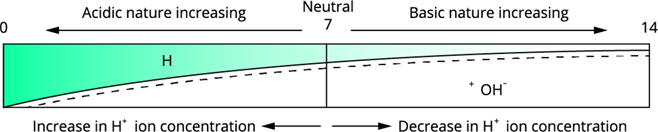
Variation of pH
PYQ - pH, pH of a solution
Importance of pH in everday life:
| Situation | Cause | Effect | Neutralisation |
| Insect/Bee sting | Formic acid | Pain & burning | Base (Baking soda/lime paste) |
| Wasp sting | Alkaline | Pain & burning | Acid (Vinegar) |
| Nettle sting | Methanoic acid | Burning pain | Base (Rub dock leaf) |
| Tooth decay | Mouth acids | Cavity formation | Basic toothpaste |
| Acidity | Excess HCl | Heartburn/ulcer | Antacids (\(Mg(OH)_2\) |
| Acidic soil | Fertilisers | Poor plant growth | Lime (\(CaO\) or \(Ca(OH)_2\)) |
| Alkaline soil | Excess base | Poor nutrient availability | Acid (Compost) |
| Industrial waste | Acidic effluents | Environmental damage | Lime or limestone |
PYQ - Neutralisation reaction
Salts:
- Strong acid + Strong base → Neutral Salt + Water
- Weak acid + Weak base → Neutral Salt + Water
- Strong acid + Weak base → Acidic Salt + Water
- Weak acid + Strong base → Basic Salt + Water
Chemicals from common salt:
| Common name | Chemical name | Formula | Uses | Method of preparation |
| Common salt | Sodium chloride |
\(NaCl\)
|
Raw material for NaOH, baking soda, washing soda; used as food preservative | Obtained from sea water & mining of rock salt |
| Caustic soda | Sodium hydroxide |
\(NaOH\)
|
Soaps, detergents, paper | Chlor-alkali process: Electrolysis of brine |
| Bleaching Powder | Calcium oxychloride or Calcium hypochlorite |
\(CaOCl_2\)
|
Bleaching agent, disinfectant, water treatment | Passing chlorine gas over slaked lime |
| Baking Soda | Sodium hydrogen carbonate or sodium bicarbonate |
\(NaHCO_3\)
|
Baking (release of \(CO_2\)), antacid, fire extinguishers, cleaning | Solvay process |
| Washing Soda | Sodium carbonate decahydrate |
\(Na_2CO_3.10H_2O\)
|
Glass, soap, paper industry, water softening | Recrystallisation of sodium carbonate/Solvay process |
| Plaster of Paris | Calcium sulphate hemihydrate |
\(CaSO_4.1/2H_2O\)
|
Making casts, statues, chalks, surgical bandages, wall designs | Heating gypsum at 373 K |
| Gypsum | Calcium sulphate dihydrate |
\(CaSO_4.2H_2O\)
|
Making POP, cement, agriculture, plastering | Naturally occurring mineral or addition of water to POP |
Water of crystallisation:
The number of water molecules found in the crystalline substance is called water of crystallisation. These salts are known as hydrated salts.
Copper sulphate pentahydrate (Blue vitriol):
Blue vitriol contains a total of five water molecules. As a result, its water of crystallisation is \(5\). When blue copper sulphate crystals are gently heated, they lose their five water molecules and transform into colourless anhydrous copper sulphate.
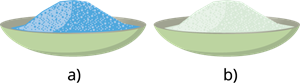
(a) Crystalline hydrated salt (b) Amorphous anhydrous salt
Similarly, ferrous sulphate heptahydrate \(FeSO_4.7H_2O\) from pale green on heating loses the water of crystallisation and changes to white anhydrous salt.
Plaster of Paris:
The calcium sulphate hemihydrate is commonly known as plaster of Paris. The name is derived from the place of its origin Montmartre in the Paris district. The chemical formula is .
Preparation of plaster of Paris:
When gypsum is heated in a rotating kiln at \(373 K\), it loses all its water molecule and forms calcium sulphate hemihydrate \(CaSO_4.1/2H_2O\).
\(2CaSO_4.2H_2O \xrightarrow {373K}CaSO_4.1/2H_2O + 1.5H_2O\)
Properties of plaster of Paris:
- It is a white colour powder.
- It acts as an oxidizing agent under extreme conditions.
- It produces gypsum when mixed with water.
\(CaSO_4.\frac{1}{2}H_{2}O + 1\frac{1}{2}.H_{2}O\rightarrow CaSO_4.2H_2O\)