

Acid and bases undergo several chemical reactions with different substances. In this theory, we will learn about the following reactions:
- Reaction with metal carbonated and metal hydogencarbonates
- Reaction of acids and bases with each other
- Reaction of acids with metal oxides and bases with non-metal oxides
These reactions helps us understand the chemical properties of acids and bases and the process of neutralisation.
Reaction of metal carbonates and metal hydrogencarbonates with acids:
Metal carbonates and metal hydrogencarbonates (bicarbonates) react with acids to form salt, water, and carbon dioxide gas.
Activity : To study the reaction of an acid with metal carbonates and metal hydrogen carbonates.
Instructions:
- Step 1: Take two test tubes and mark them as 'A' and 'B'.
- Step 2: Take \(0.5g\) of sodium carbonate \(Na_2CO_3\) in test tube 'A' and \(0.5g\) of sodium hydrogen carbonate (\(NaHCO_3\)) in test tube 'B'.
- Step 3: Add \(2mL\) of dilute hydrochloric acid in both the test tubes.
-
Step 4: Place a cork to the mouth of each test tube and insert the delivery tube into it.
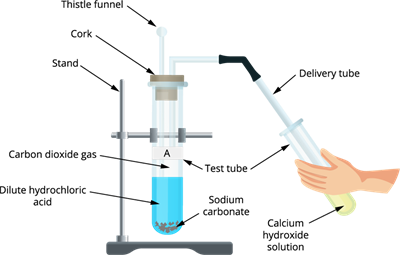
Passing carbon dioxide through calcium hydroxide solution
- Step 5: Take calcium hydroxide solution in a separate test tube and leave the free end of the delivery tube inside the test tube containing calcium hydroxide solution or lime water.
Observation:
-
Effervescence (bubbling) is observed in both test tubes.
-
A gas is produced during the reaction.
-
When this gas is passed through limewater, the limewater turns milky.
i. Test tube A: Metal carbonates with acids:
General reaction: Metal Carbonate + Acid → Salt + Water + Carbon dioxide
When sodium carbonate (\(Na_2CO_3\)) reacts with hydrochloric acid (\(HCl\)), it produces sodium chloride (salt), water, and carbon dioxide gas.
\(Na_2CO_3 + 2HCl \rightarrow 2NaCl + H_2O + CO_2\)
ii. Test tube B: Metal hydrogencarbonates with acids:
General reaction: Metal hydrogen carbonate + Acid → Salt + Water + Carbon dioxide
When sodium bicarbonate (sodium hydrogencarbonate) (\(NaHCO_3\)) reacts with hydrochloric acid (\(HCl\)), it produces sodium chloride, water, and carbon dioxide gas.
\(NaHCO_3 + HCl \rightarrow NaCl + H_2O + CO_2\)
Confirmation test for carbon dioxide gas:
The presence of carbon dioxide (\(CO_2\)) can be confirmed by passing it through limewater. The limewater turns milky due to the formation of calcium carbonate (\(CaCO_3\)).
\(Ca(OH)_2 + CO_2 \rightarrow CaCO_3 + H_2O\)
Neutralisation reaction:
When an acid and a base are combined, a chemical reaction occurs resulting in the formation of salt and water. This process is called neutralisation.
In a neutralisation reaction, there is the formation of a new substance, which is known as a salt. The salt produced as a product can be either acidic, basic or neutral. The reaction mixture produces heat during neutralisation; hence, it is an exothermic reaction.
The reaction between hydrochloric acid and sodium hydroxide yields a salt and water as products.
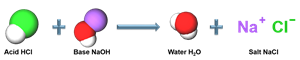
Acid-base reaction
i. Reaction of metal oxides with acids:
Metal oxides are basic in nature. When a metal oxide reacts with an acid, it forms a salt with water.
\(Metal\ oxide + Acid → Salt + Water\)
When copper(II) oxide (\(CuO\)) reacts with hydrochloric acid (\(HCl\)), it forms copper(II) chloride and water.
\(CuO + HCl \to CuCl_2 + H_2O\)
Copper(II) oxide is a black solid. When it reacts with hydrochloric acid, it forms copper(II) chloride solution, which is blue-green in colour.
Since, metallic oxides react with acids to give salts and water, similar to the reaction of a base with an acid (neutralisation), metallic oxides are said to be basic oxides.
ii. Reaction of non-metal oxides with bases:
Non-metallic oxides are acidic in nature. When a non-metal oxide reacts with a base, it forms a salt with water.
\(Non-metal\ oxide + Base → Salt + Water\)
Carbon dioxide reacts with calcium hydroxide to form calcium carbonate and water.
\(CO_2 + Ca(OH)_2 \to CaCO_3 + H_2O\)
Since non-metal oxides react with bases to give salts and water, similar to the reaction of an acid with a base (neutralisation), non-metal oxides are said to be acidic oxides.