

Imagine ordinary salt not just as something you sprinkle on food, but as a starting point for making many useful chemicals. From cleaning agents to medicines and even materials used in construction, common salts act like chemical factories in disguise.
\(NaOH + HCl \rightarrow NaCl + H_2O\)
Note: Mahatma Gandhi’s Dandi March: Sodium chloride played a prominent part in our fight for freedom.
\(NaCl\) - A raw material for chemicals:
Common salt is an important raw material for many substances that we use in our daily life, including sodium hydroxide, baking soda, washing soda, bleaching powder, and many others.
Chemicals from common salt:
1. Sodium hydroxide \(NaOH\):
The Chlor-alkali process is an industrial process that produces chlorine and sodium hydroxide by electrolysis of sodium chloride (brine) solution.
The overall reaction that occurs during the Chlor-alkali process is as follows:
\(2NaCl + 2H_2O \rightarrow 2NaOH + Cl_2 + H_2\)
The three by-products of this process are all useful.
- At cathode - \(H_2\) - Used as fuels, margarine, ammonia for fertilisers
- At anode - \(Cl_2\) - Used for water treatment, swimming pools, PVC, disinfectants, CFCs and pesticides etc.
- Sodium hydroxide \(NaOH\) is collected near the cathode, and used in soaps, detergents, paper making and artificial fibres.
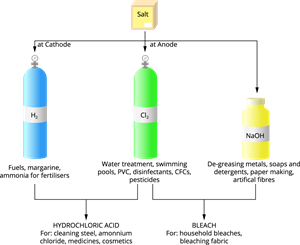
Important products from the Chlor-alkali process
2. Bleaching powder:
In \(1799\), the Scottish chemist Charles Tennant invented bleaching powder, a solid mixture of chlorine and slaked lime.
When chlorine is passed over solid slaked lime for an extended period of time, bleaching powder is formed. It is also known as lime chloride.
The chemical formula for bleaching powder is \(CaOCl_2\), but the actual composition is quite complex.
\(Ca(OH)_2 + Cl_2 \rightarrow CaOCl_2 + H_2O\)
Properties and uses of \(CaOCl_2\):
- It is a yellow-white solid with a strong smell of chlorine.
- Used as a bleaching agent and disinfectant for drinking water and also as a sanitiser for swimming pools.
- Used in the manufacturing of chloroform.
Note: Bleaching powder dissolves in water forming hypochlorous acid, which has effective germicidal property
\(Ca(OCl)_2 + 2H_2O \rightarrow 2HOCl + Ca(OH)_2\)
3. Sodium hydrogen carbonate or Baking soda \(NaHCO_3\):
Baking soda is a common ingredient in the preparation of tasty, crispy pakoras. It is sometimes added to speed up the cooking process. The compound's chemical name is sodium hydrogen carbonate \(NaHCO_3\). One of the raw materials used in its production is sodium chloride.
\(NaCl + H_2O + CO_2 + NH_3 \rightarrow NH_4Cl + NaHCO_3\)
Sodium bicarbonate is produced as an intermediate product in Solvay's process for producing sodium carbonate, where the soluble sodium bicarbonate crystallises.
\(Na_2CO_3 + H_2O + CO_2 \rightarrow 2NaHCO_3\)
Properties and uses of \(NaHCO_3\):
- It is a white crystalline powder.
- It is weakly alkaline in nature.
- Antacids contain sodium hydrogen carbonate because it is alkaline. It neutralises excess stomach acid and provides relief.
- It is used in fire extinguishing and deodrants.
- Baking powder is made from baking soda (sodium hydrogen carbonate) and a mild edible acid such as tartaric acid. The following reaction occurs when baking powder is heated or mixed with water.
\(NaHCO_3 + H^+ \rightarrow CO_2 + H_2O + \) Sodium salt of acid
The carbon dioxide produced during the reaction causes bread or cake to rise, resulting in soft and spongy bread or cake.
4. Sodium carbonate or Washing soda \(Na_2CO_3 . 10H_2O\):
Sodium carbonate exists in various forms, such as
- Anhydrous sodium carbonate, also known as soda ash \(Na_2CO_3\)
- Heptahydrate sodium carbonate \(Na_2CO_3 . 7H_2O\)
- Decahydrate sodium carbonate or washing soda or sal soda \(Na_2CO_3 . 10H_2O\)
Methods of preparation:
Nowadays, sodium carbonate is typically produced using the ammonia soda or Solvay process. The ingredients for this process are readily available and reasonably priced.
Washing soda can also be produced by the recrystallization of sodium carbonate.
\(Na_2CO_3 + 10H_2O \rightarrow Na_2CO_3 . 10 H_2O\)
Properties and uses of \(Na_2CO_3 . 10 H_2O\):
- It is a white crystalline solid and soluble in water.
- Used in manufacturing of glass, borax, soap, caustic soda and so on.
- Used in paint, paper and textile industries.
- Used for softening of hard water.
Water of crystallisation:
The number of water molecules found in the crystalline substance is called water of crystallisation. These salts are known as hydrated salts.
Copper sulphate pentahydrate (Blue vitriol):
Blue vitriol contains a total of five water molecules. As a result, its water of crystallisation is \(5\). When blue copper sulphate crystals are gently heated, they lose their five water molecules and transform into colourless anhydrous copper sulphate.
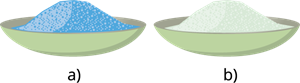
(a) Crystalline hydrated salt (b) Amorphous anhydrous salt
Similarly, ferrous sulphate heptahydrate \(FeSO_4.7H_2O\) from pale green on heating loses the water of crystallisation and changes to white anhydrous salt.
Plaster of Paris:
The calcium sulphate hemihydrate is commonly known as plaster of Paris. The name is derived from the place of its origin Montmartre in the Paris district. The chemical formula is .
Preparation of plaster of Paris:
When gypsum is heated in a rotating kiln at \(373 K\), it loses all its water molecule and forms calcium sulphate hemihydrate \(CaSO_4.1/2H_2O\).
\(2CaSO_4.2H_2O \xrightarrow {373K}CaSO_4.1/2H_2O + 1.5H_2O\)
Properties of plaster of Paris:
- It is a white colour powder.
- It acts as an oxidizing agent under extreme conditions.
- It produces gypsum when mixed with water.
\(CaSO_4.\frac{1}{2}H_{2}O + 1\frac{1}{2}.H_{2}O\rightarrow CaSO_4.2H_2O\)