

There are millions of known organic compounds, and many new organic compounds are discovered in nature or synthesised in the laboratory every year. This may greatly obscure organic chemistry.
However, each compound can be assigned a unique molecular structure, which can then be listed using systematic classification methods and eventually named based on its structural arrangements.
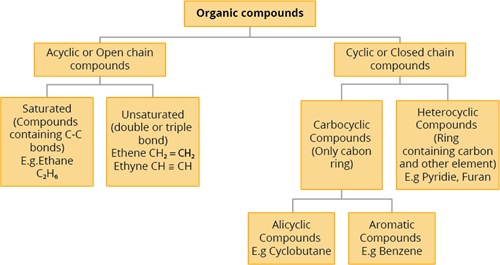
Classification of organic compounds
Organic compounds are classified into two types based on the skeleton of the carbon chain:
- Acyclic or Open-chain compounds
- Cyclic or Closed-chain compounds
1. Acyclic or Open-chain compounds:
The compounds in which the carbon atoms form a chain-linked in a linear pattern or branched are called as acyclic or open-chain compounds.
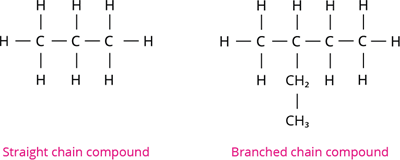
Open-chain compounds
Open-chain compounds are further classified as:
a) Saturated compounds: The compound is saturated if single bonds connect all of the carbon atoms in the chain. In this, all the valencies of carbon are satisfied by single bonds.
b) Unsaturated compounds: If there are double or triple bonds between the carbon atoms, the compound is unsaturated. In this, all the valencies of carbon are satisfied by multiple bonds.
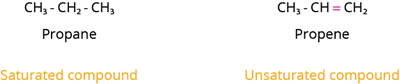
Open-chain compounds
2. Cyclic or Closed-chain compounds:
Cyclic compounds are organic compounds in which the carbon atom chain is closed or cyclic.
In heterocyclic compounds, the chain contains carbon as well as other atoms such as oxygen, nitrogen, sulphur, and so on.
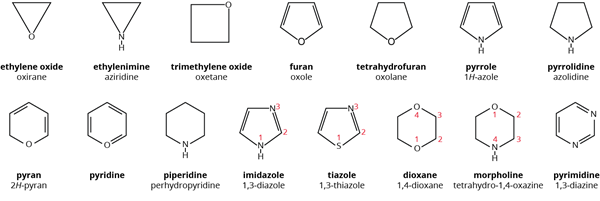
Heterocyclic compounds
Carbocyclic (Homocyclic) compounds are those in which the chain contains only carbon atoms.
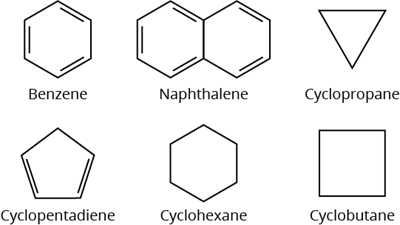
Homocyclic compounds
Carbocyclic compounds are further classified as:
- Alicyclic compounds
- Aromatic compounds
Alicyclic compounds have one or more carbocyclic rings that can be either saturated or unsaturated.
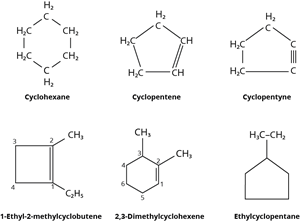
Alicyclic compounds
Aromatic compounds have one or more benzene rings (rings containing alternate double bonds between carbon atoms).
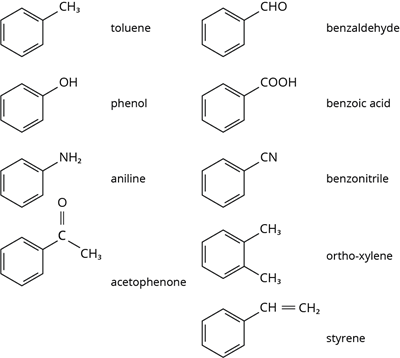
Aromatic compounds
Classification of hydrocarbons based on bonding:
Hydrocarbons are further classified into three classes:
i. Alkanes: Alkanes are hydrocarbons with only a single bond. Alkanes are saturated compounds because they all have single bonds (\(C-C\)).
Alkanes are represented by the general formula \(C_nH_{2n + 2}\) (where \(n = 1, 2, 3,\) and so on).
ii. Alkenes: Alkenes are hydrocarbons that contain one or more carbon to carbon bonds (\(C=C\)). Alkenes are unsaturated compounds because they have double bonds.
The general formula (\(C_nH_{2n}\)) is used to represent them.
iii. Alkynes: Alkynes are hydrocarbons with carbon to carbon triple bonds (\(C\equiv C\)). Alkynes are unsaturated due to the presence of a triple bond between carbon atoms.
Alkynes are represented by the general formula (\(C_nH_{2n – 2}\)).
|
Number
of
carbon atoms
|
Alkane
(\(C_nH_{2n + 2}\))
|
Alkene
(\(C_nH_{2n}\))
|
Alkyne
(\(C_nH_{2n – 2}\)).
|
|
\(1\)
|
Methane
(\(CH_4\))
|
-
|
-
|
|
\(2\)
|
Ethane
(\(C_2H_6\))
|
Ethene
(\(C_2H_4\))
|
Ethyne
(\(C_2H_2\))
|
|
\(3\)
|
Propane
(\(C_3H_8\))
|
Propene
(\(C_3H_6\))
|
Propyne
(\(C_3H_4\))
|
|
\(4\)
|
Butane
(\(C_4H_{10}\))
|
Butene
(\(C_4H_8\))
|
Butyne
(\(C_4H_6\))
|
|
\(5\)
|
Pentane
(\(C_5H_{12}\))
|
Pentene
(\(C_5H_{10}\))
|
Pentyne
(\(C_5H_8\))
|
Note: Methene and Methyne do not exist because they have only one carbon atom. These compounds cannot form multiple bonds, as hydrogen can share only one electron.
Bromine water test:
The reaction of hydrocarbon with bromine produces alkyl bromide. Unsaturated hydrocarbons like alkenes and alkynes are far more reactive than parent alkanes. They can quickly react with bromine.
Alkanes do not undergo this reaction because they already have single bonds and thus cannot become more structurally stable or stronger.
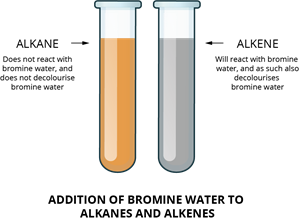
Test for unsaturation
If the given compound is unsaturated, it will decolourise bromine water, whereas saturated compounds will not.
Functional group:
A functional group is an atom or group of atoms in a molecule that determines its chemical properties.
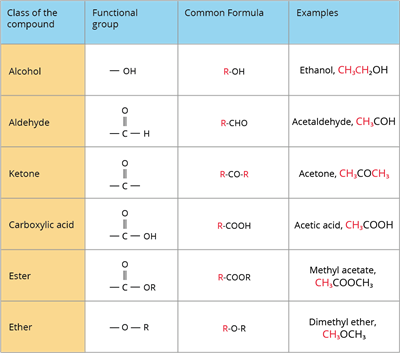
Classes of organic compounds based on functional group
Homologous series:
A homologous series is a group or class of organic compounds that have the same general formula and similar chemical properties but differ by a −\(CH_2\) group and thus by \(14\ amu\) in molecular mass.
Consider the members of the alkanes listed in the below table. The following are their condensed structural formulas:
|
Name
|
Molecular
formula
|
| Methane | \(CH_4\) |
| Ethane | \(CH_3CH_3\) |
| Propane | \(CH_3CH_2CH_3\) |
| Butane | \(CH_3(CH_2)_2CH_3\) |
| Pentane |
\(CH_3(CH_2)_3CH_3\)
|
If you look at the preceding series, each successive member has one more methylene (\(CH_2\)) group than the preceding member, which is why they are called homologs.