

Combustion:
Combustion is the process by which all carbon compounds burn in the presence of air to release heat, water, and carbon dioxide.
Example:
\(C\) + \(O_2\) → \(CO_2\) + Heat + Light
\(CH_4\) + \(2O_2\) → \(CO_2\) + \(2H_2O\) + Heat + light
\(CH_3CH_2OH\) + \(3O_2\) → \(2CO_2\) + \(3H_2O\) + Heat + light
Types of combustion:
i. Complete combustion:
Complete combustion is the burning of a carbon compound in the presence of a sufficient or excess supply of oxygen. In this reaction, all the carbon atoms are completely oxidised to carbon dioxide, while hydrogen atoms are converted into water.
Since the fuel burns completely, maximum energy is released, and produces blue, non-luminous flame. A blue flame indicates that the fuel is burning completely.
Example: Burning of LPG
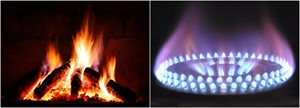
Incomplete and complete combustion
ii. Incomplete combustion:
Incomplete combustion occurs when a carbon compound burns in the presence of an insufficient or limited supply of oxygen. Because oxygen is not available in adequate quantity, the fuel does not burn completely.
As a result, carbon is only partially oxidised, forming carbon monoxide (CO) or solid carbon (soot) instead of carbon dioxide. Gives a yellow, luminous flame, and produces black smoke and soot.
Example: Burning of kerosene, coal.
Unsaturated hydrocarbons have a higher percentage of carbon compared to saturated hydrocarbons. Because of this higher carbon content, atmospheric oxygen is insufficient for complete combustion, leading to the production of unburnt carbon particles. This results in a yellow flame due to incomplete combustion.
i. Saturated compounds - lower carbon percentage - mostly undergo complete combustion
ii. Unsaturated compounds - higher carbon percentage - mostly undergo incomplete combustion
i. Saturated compounds - lower carbon percentage - mostly undergo complete combustion
ii. Unsaturated compounds - higher carbon percentage - mostly undergo incomplete combustion
Oxidation reaction:
An oxidation reaction is a reaction in which a substance gains oxygen or loses hydrogen.
Example:
Ethanol is oxidised to ethanoic acid.
\(CH_3CH_2OH\) (Ethanol) \(CH_3COOH\) (Acetic acid)
Oxidising agents used:
- Alkaline potassium permanganate (\(KMnO_4\)) - Purple colour
- Acidified potassium dichromate (\(K_2Cr_2O_7\)) - Orange colour
Addition reaction:
Hydrogenation is the process of adding hydrogen to an unsaturated hydrocarbon (containing double or triple bonds) in the presence of a catalyst such as nickel (Ni), palladium (Pd), or platinum (Pt).
The unsaturated hydrocarbons are converted into saturated hydrocarbons. The saturated hydrocarbons does not undergo addition reaction.
Example: Ethene reacts with hydrogen.
\(CH_ 2 = CH_ 2+ H_ 2\) \(CH_ 3 − CH_ 3\)
Addition reaction is also called as hydrogenation (adding hydrogen).
Industrial application:
Vegetable oils are converted into vanaspati ghee by hydrogenation.
Vegetable oil + Hydrogen → Vanaspati ghee
Catalyst: Finely divided Nickel
Excess consumption of hydrogenated oils containing trans fats may increase the risk of heart diseases.
Substitution reaction:
A substitution reaction is a reaction in which one atom or group of atoms in a molecule is replaced (substituted) by another atom or group.
Saturated hydrocarbons generally undergo substitution reactions because they do not contain double or triple bonds.
Example:
When methane reacts with chlorine gas in the presence of sunlight, it produces chloromethane and liberates hydrochloride gas. The further reaction of chloromethane with chlorine gas gives rise to a chain reaction, forming carbon tetrachloride.
\(CH_4\) + \(Cl_2\) \(CH_3Cl\) + \(HCl\)
| Reaction | Definition | Compounds Involved | Catalyst/Condition | Example |
|---|---|---|---|---|
| Combustion | Burning in oxygen to release heat and light | All carbon compounds | Oxygen | \(CH₄ + 2O₂ → CO₂ + 2H₂O\) |
| Oxidation | Gain of oxygen or loss of hydrogen | Alcohols and other organic compounds |
\(KMnO_4/K_2Cr_2O_
7\)
|
\(CH₃CH₂OH → CH₃COOH\) |
| Hydrogenation | Addition of hydrogen | Unsaturated hydrocarbons | Nickel (\(Ni\)) | \(C₂H₄ + H₂ → C₂H₆\) |
| Addition | Addition of atoms across a double/triple bond | Unsaturated hydrocarbons | Depends on reagent | \(C₂H₄ + Br₂ → C₂H₄Br₂\) |
| Substitution | Replacement of one atom by another | Saturated hydrocarbons | Sunlight/UV light | \(CH₄ + Cl₂ → CH₃Cl + HCl\) |