

Carbon is an inseparable element in human life, found in everything from the food we eat and the clothes we wear to fuels, paints, and medicines. While many elements exist, carbon is unique because it forms over 5 million compounds, which is far more than any other element. Compounds derived from living organisms (plants and animals) or containing carbon are generally called organic compounds.
Characteristics of organic compounds:
Everything in this world has a unique characteristics, and organic compounds are no exception. Some of them are as follows:
- Organic compounds have a complex structure and a high molecular weight.
- Organic compounds are mostly insoluble in water but soluble in organic solvents like ether, carbon tetrachloride, toluene, etc.
- Organic compounds are highly inflammable.
- When compared to inorganic compounds, organic compounds have lower melting and boiling points.
- Organic compounds are volatile in nature.
- Organic compounds can be synthesised in a laboratory.
Example: Urea or carbamide (\(CH_4N_2O\)) is widely regarded as the first organic compound synthesised from inorganic chemicals. Friedrich Wohler, a German chemist, created urea artificially in \(1828\) by treating silver cyanate with ammonium chloride.
Nature of bonding in organic compounds:
Atoms of different elements combine to form a molecule of a compound. This generally takes place in two ways. These are:
- Transfer of electrons — Transfer one or more of the valence electrons to another atom, or accept one or more electrons from some other atom is known as ionic bonding. Example: \(NaCl\)
- Sharing of electrons — Shares a few or all of their valence electrons with another atom known as covalent bonding. Example: \(CH_4\)
Covalent bonding in organic compounds:
Atomic number: \(6\)
Electronic configuration: \(2,4\)
Thus, carbon has four electrons in its outermost shell, known as the valence shell.
As a result, carbon completes its octet by sharing its four electrons with other carbon atoms or atoms of other elements, resulting in the formation of a covalent bond.
Why carbon does not form ionic compounds?
Carbon cannot easily gain four electrons (forming a \(C^{4−}\) anion) because its nucleus cannot easily hold ten electrons. It also cannot easily lose four electrons (forming a \(C^{4+}\) cation) because that would require too much energy.
Properties of covalent compounds:
i. Low melting and boiling points: The molecules in covalent compounds are held together by weak intermolecular forces, so they have low melting and boiling points. However, as the molecular weight (molecular mass) of a covalent compound increases, its melting and boiling points also generally increase.
ii. Poor conductivity of electricity: Covalent compounds are made up of neutral molecules. Since they do not contain free ions or free electrons, they generally do not conduct electricity.
Exception: Graphite, which conducts electricity due to the presence of free electrons.
Electron dot structures:
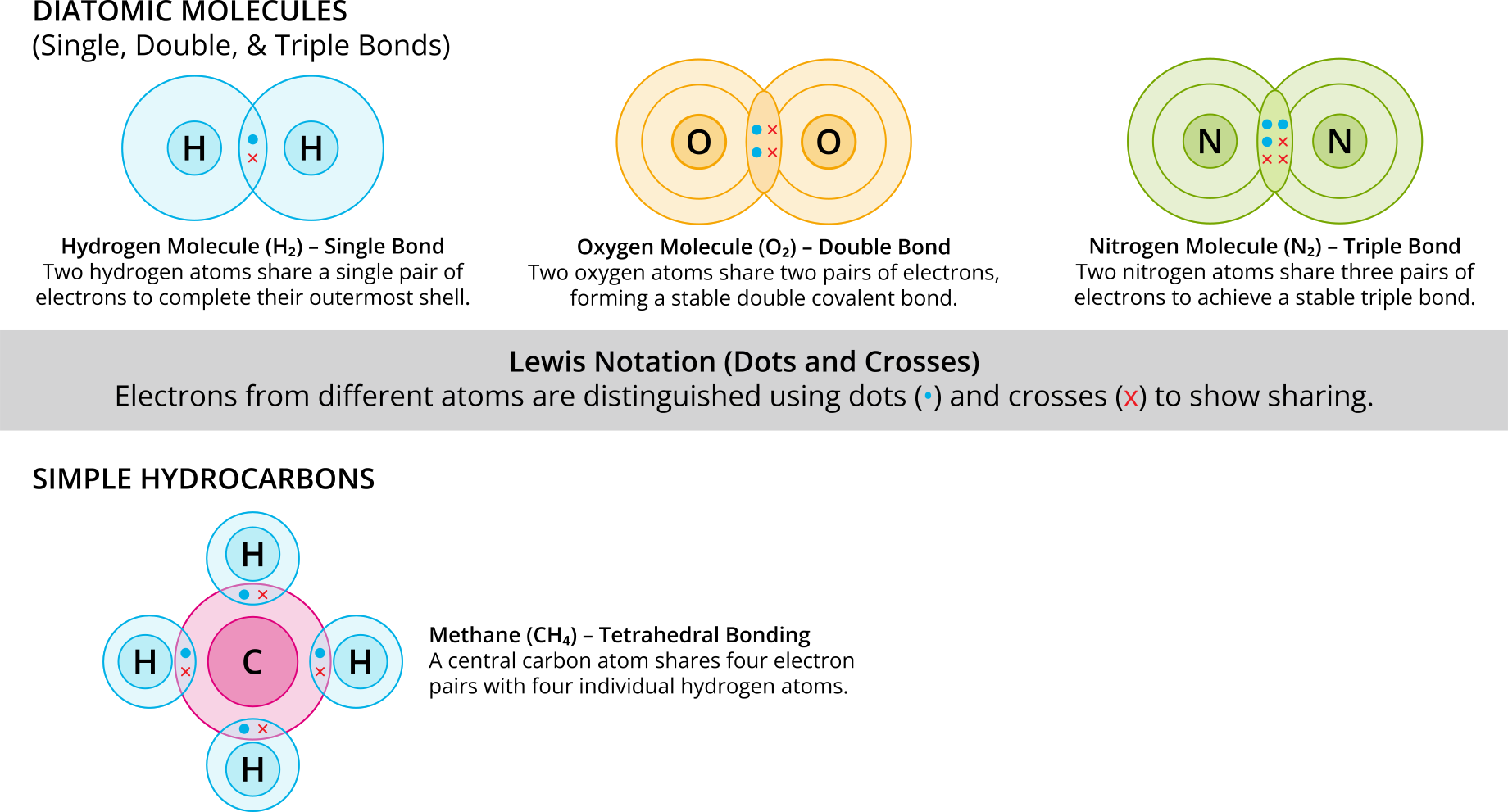
Electron dot structures represent the valence electrons of atoms using dots around their chemical symbols. They help in understanding how electrons are shared during covalent bond formation.
i. Hydrogen molecule: Each hydrogen atom has one valence electron. By sharing one pair of electrons, both hydrogen atoms attain a stable duplet configuration, forming a single covalent bond.
ii. Oxygen molecule: Each oxygen atom has six valence electrons and requires two more electrons for stability. Two pairs of electrons are shared, resulting in a double covalent bond.
Electron dot structures
iii. Nitrogen molecule: Each nitrogen atom has five valence electrons. Three pairs of electrons are shared between the atoms, forming a triple covalent bond.
iv. Methane: One carbon atom shares its four valence electrons with four separate hydrogen atoms to form four single covalent bonds.
Versartile nature of carbon:
1. Tetravalency:
Carbon has four valence electrons and can form four covalent bonds with other atoms. This property is known as tetravalency. Through tetravalency, carbon combines with elements such as hydrogen, oxygen, nitrogen, sulphur and chlorine to form stable compounds.
2. Catenation:
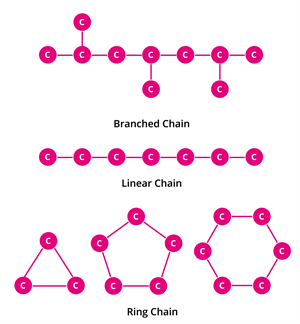
Carbon atoms have the unique ability to form strong covalent bonds with other carbon atoms. This property is known as catenation. Because carbon-carbon bonds are strong and stable, carbon atoms can join together to form:
- Straight chains
- Branched chains
- Cyclic or ring structures
Bonding of carbon compounds
The combination of tetravalency and catenation enables carbon to form millions of compounds with different structures and properties. Hence, carbon is known as the versatile element.
3. Isomerism:
Isomerism is another unique feature of carbon compounds mainly observed in catenated organic compounds.
Isomerism is the phenomenon in which two or more compounds have the same molecular formula but different structural arrangements of atoms, resulting in different properties. Such compounds are called isomers.
Examples:
1. The molecular formula of butane is \(C_4H_{10}\) represents two different compounds.
- n-butane \(CH_3-CH_2-CH_2-CH_3\)
- Iso butane \(CH_3-CH(CH_3)-CH_3\)
2. The given formula (\(C_2H_6O\)) is having two kinds of arrangement of atoms, as shown below.

Isomers
4. Allotropy:
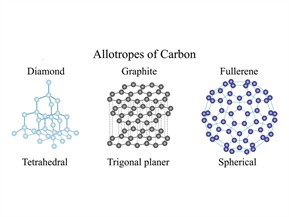
Carbon exists in different structural forms known as allotropes. Although these allotropes are made entirely of carbon atoms, they differ in the arrangement of atoms, leading to different physical properties.
The important allotropes of carbon are diamond, graphite and fullerenes.
Allotropes of carbon
|
Diamond
|
Graphite
|
| Each carbon has four covalent bonds. | Each carbon has three covalent bonds. |
| Hard, heavy and transparent. | Soft, slippery to touch and opaque. |
| It has tetrahedral units linked in three dimensions. | It has planar layers of hexagon units. |
| It is a non-conductor of heat and electricity. | It is a conductor of heat and electricity. |