

Organic compound names were once associated with the natural things from which they were derived. Formic acid, for example, was first obtained from 'red ants' by the distillation process.
'Formica' is the Latin name for the red ant. As a result, the name formic acid was derived from the Latin word. Organic compounds were later synthesised from sources other than natural sources.
Scientists devised a method for naming organic compounds based on their structures. As a result, the IUPAC (International Union of Pure and Applied Chemistry) developed a set of rules for chemical compound nomenclature.
Components of an IUPAC name:
Organic compounds on naming with IUPAC consist of \(3\) parts:
- Root word
- Prefix
- Suffix
These three components are combined in the following order to yield the IUPAC name of the compound.
\(\text{Prefix + Root word + Suffix → IUPAC Name}\)
1. Root word:
- It is the fundamental unit that describes the carbon skeleton.
- It specifies the number of carbon atoms in the compound's parent chain as well as the pattern of their arrangement.
- The majority of the names are derived from Greek numerals based on the number of carbon atoms present in the carbon skeleton (except the first four).
- The root words for the parent chain of hydrocarbons containing \(1\) to \(10\) carbon atoms as shown in the below table.
|
Number
of
carbon atoms
|
Root word
|
|
\(1\)
|
Meth-
|
|
\(2\)
|
Eth-
|
|
\(3\)
|
Prop-
|
|
\(4\)
|
But-
|
|
\(5\)
|
Pent-
|
|
\(6\)
|
Hex-
|
|
\(7\)
|
Hept-
|
|
\(8\)
|
Oct-
|
|
\(9\)
|
Non-
|
|
\(10\)
|
Dec-
|
2. Prefix:
- The prefix represents the substituents or branches in the parent chain.
- Atoms or groups of atoms other than hydrogen are known as substituents present in the parent chain of the carbon structure.
- The below table lists the major substituents and the prefixes that are used for organic compounds:
|
Substituent
|
Prefix used
|
|
\(-F\)
|
Fluoro
|
|
\(-Cl\)
|
Chloro
|
|
\(-Br\)
|
Bromo
|
|
\(-I\)
|
Iodo
|
|
\(-NH_2\)
|
Amino
|
|
\(-CH_3\)
|
Methyl
|
|
\(-CH_2CH_3\)
|
Ethyl
|
3. Suffix:
- The suffix forms the end name.
- It is further divided into two sections.
(a) Primary suffix: The primary suffix follows the root word. It represents the nature of the parent chain in carbon to carbon bonding.
If all of the bonds between the parent chain's carbon atoms are single, the suffix 'ane' must be used.
The suffixes ‘ene' and ‘yne' are used for compounds with double and triple bonds, respectively.
(b) Secondary suffix: The compound's functional group is described by the secondary suffix.
|
Class of the compound
|
Functional group
|
Suffix used
|
|
Alcohol
|
\(-OH\)
|
-ol
|
|
Aldehyde
|
\(-CHO\)
|
-al
|
|
Ketone
|
\(-C=O\)
|
-one
|
|
Carboxylic acid
|
\(-COOH\)
|
-oic acid
|
Rules for IUPAC nomenclature:
- Rule 1: Find the longest chain of carbon atoms to determine the parent name (root word).
- Rule 2: Start counting the carbon atoms in the parent chain at the closest end of the substituent or functional group. These are known as locant numbers. If both a functional group and a substituent are present, the functional group takes precedence.
- Rule 3: In the case of alkenes and alkynes, find the double or triple bond and use its locant number followed by a dash and a primary suffix. The carbon chain is numbered in such a way that multiple bonds have the lowest locant number possible.
- Rule 4: If the compound contains a functional group, find it and use the locant number followed by a dash and a secondary suffix to find it.
- Rule 5: When the primary and secondary suffixes are combined, the primary suffix's terminal 'e' is removed.
- Rule 6: Identify the substituent using a number followed by a dash and a prefix to specify its location and identity.
Naming of organic compounds:
1. \(CH_3-CH_2-CH_2-CH_2-CH_3\)
Step 1: According to rule \(1\), there is a five-membered carbon chain; hence, the root word is ‘Pent’.
Step 2: According to rule \(2\), all the bonds between carbon atoms are single bonds, and thus the suffix is ‘ane’.
So, the name of the given compound is \(\text{Pent + ane = Pentane}\).
2. 
Step 1: According to rule \(1\), there is a seven-membered carbon chain; hence, the root word is ‘Hept’.
Step 2: According to rule \(2\), there is a substituent. So, the carbon chain is numbered from the left end, which is closest to the substituent.
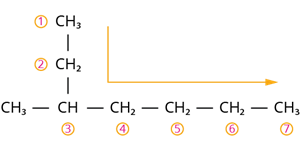
The correct way of numbering the carbon atoms
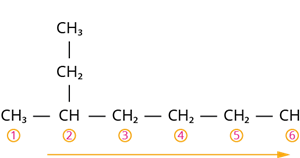
The incorrect way of numbering the carbon atoms
Step 3: All are single bonds between the carbon atoms, and thus the suffix is ‘ane’.
Step 4: According to rule \(6\), the substituent is a methyl group compound located at the third carbon atom.
So, its locant number is \(3\). Thus, the prefix is ‘\(3-Methyl\)’.
Hence, the name of the given compound is \(\text{3-Methyl + hept + ane = 3-Methyl heptane}\).
3. 
Step 1: According to rule \(1\), there is a five-membered carbon chain; hence, the root word is ‘Pent’.
Step 2: According to rule \(2\), there is a carbon to carbon double bond (\(C=C\)), and thus the suffix is ‘ene’.
Step 3: According to rule \(3\), the carbon chain is numbered from the end of the double bond that has the lowest locant number, as shown below
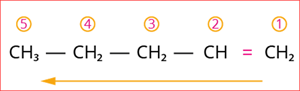
Numbering starts from the double bond.
Step 4: The locant number is \(1\) for the double bond, and hence the suffix is ‘\(-1-ene\)’.
Hence, the name of the given compound is \(\text{Pent + (-1-ene) = Pent-1-ene}\).
Naming carbon compounds with functional groups:
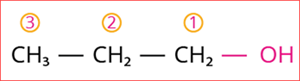
1. \(CH_3-CH_2-CH_2-OH\)
Step 1: According to rule \(1\), there is a three-membered carbon chain; hence, the root word is 'Prop'.
Step 2: According to rule \(2\), all the bonds between carbon atoms are single bond, and thus the primary suffix is ‘ane’.
Step 3: According to rule \(3\), the carbon chain is numbered from the end closest to the \(-OH\) group that has the lowest locant number, as shown below
Numbering of the carbon chain
Step 4: The locant number is \(1\) for the \(-OH\) group, and hence the secondary suffix is ‘\(-1-ol\)’.
Note: According to rule \(5\), when the primary and secondary suffixes are combined, the primary suffix's terminal 'e' is removed.
Hence, the name of the given compound is \(\text{Prop + ane + (-1-ol) = Propan-1-ol}\).
2. 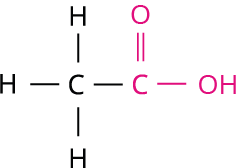
Step 1: According to rule \(1\), there is a two-membered carbon chain; hence, the root word is 'Eth'.
Step 2: According to rule \(2\), all the bonds between carbon atoms are single bonds, and thus the primary suffix is ‘ane’.
Step 3: The given compound contains carboxylic acid group (\(-COOH\)), and hence the secondary suffix is 'oic acid'.
Note: According to rule \(5\), when the primary and secondary suffixes are combined, the primary suffix's terminal 'e' is removed.
Hence, the name of the given compound is \(\text{Eth + ane + oic acid = Ethanoic acid}\).
3. 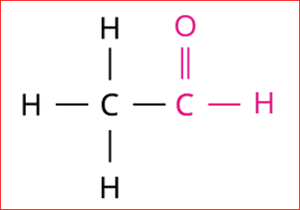
Step 1: According to rule \(1\), there is a two-membered carbon chain; hence, the root word is 'Eth'.
Step 2: According to rule \(2\), all the bonds between carbon atoms are single bond, and thus the primary suffix is ‘ane’.
Step 3: The given compound contains an aldehyde group (\(-CHO\)), and hence the secondary suffix is 'al'.
Note: According to rule \(5\), when the primary and secondary suffixes are combined, the primary suffix's terminal 'e' is removed.
Hence, the name of the given compound is \(\text{Eth + ane + al = Ethanal}\).
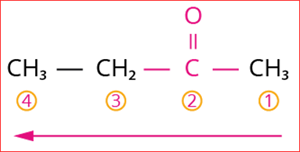
4. 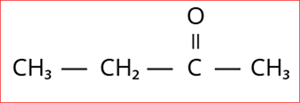
Step 1: According to rule \(1\), there is a four-membered carbon chain; hence, the root word is 'But'.
Step 2: According to rule \(2\), all the bonds between carbon atoms are single bonds, and thus the primary suffix is ‘ane’.
Step 3: The given compound contains ketone group (\(-C=O\)), and hence the secondary suffix is 'one'.
Step 4: The numbering of carbon chain occurs in such a way that the lowest possible number is given to the functional group in the chain.
So, its locant number is \(2\). Thus, the suffix is ‘\(2-one\)’.
Numbering of the carbon chain
Note: According to rule \(5\), when the primary and secondary suffixes are combined, the primary suffix's terminal 'e' is removed.
Hence, the name of the given compound is \(\text{But + ane + (-2-one) = Butan-2-one}\).
5. 
Step 1: According to rule \(1\), there is a four-membered carbon chain; hence, the root word is 'But'.
Step 2: According to rule \(2\), all the bonds between carbon atoms are single bonds, and thus the primary suffix is ‘ane’.
Step 3: The given compound contains halogen group (\(Cl\)), and hence the prefix is 'chloro'.
Step 4: According to rule \(6\), the substituent is a halogen group compound located at the first carbon atom.
The numbering of carbon chain occurs in such a way that the lowest possible number is given to the functional group in the chain. So, its locant number is \(1\). Thus, the prefix is ‘\(1-chloro\)’.
Hence, the name of the given compound is \(\text{1-chloro + But + ane = 1-Chloro butane}\).