

What is a chemical reaction?
A chemical reaction is a process in which one or more substances (reactants) are converted into new substances (products) with different properties.
Identification of a chemical reaction:
Burning of magnesium ribbon:
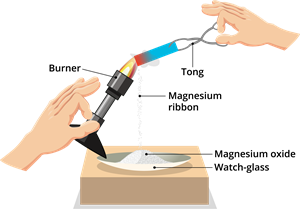
Burning of magnesium ribbon
\(2Mg + O_2 → 2MgO\)
Type of reaction: Combination (also exothermic) reaction.
- Formation of new substance white ash (\(MgO\))
- Type of reaction - Combination and exothermic (heat is released)
- A dazzling white flame is produced
Balancing chemical equations:
Example of an unbalanced equation:
\(Fe + H_2O → Fe_3O_4 + H_2\)
Steps to balance (Hit-and-trial method):
- Write a skeletal equation
- Count the atoms of each element on both sides
- Add coefficients to balance
- Check for correctness
- Include physical states
Balanced equation:
\(3Fe({s}) + 4H_2O({g}) → Fe_3O_4({s}) + 4H_2({g})\)
Types of chemical reactions:
1. Combination reaction:
When two or more reactants combine to form a single product.
\(CaO + H_2O → Ca(OH)_2 + heat\)
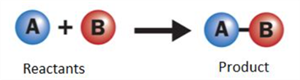
Combination reaction
Nature: Combination reactions are mostly exothermic (heat is released)
Application (Whitewashing): A shiny finish forms on walls due to calcium carbonate (\(CaCO_3\))
\(Ca(OH)_2 + CO_2 → CaCO_3 + H_2O\)
2. Decomposition reaction:
A reaction where one reactant breaks down into two or more simpler products.
Note: Most decomposition reactions are endothermic as they require energy to break down compounds. However, the decomposition of organic or vegetable waste into compost is an exothermic process, as it releases heat.
Types of decomposition reaction:
i. Thermal decomposition (by heat):
Example 1:
- \(Pb(NO_3)_2\): White or colourless solid
- \(PbO\): Yellow residue
- \(NO_2\): Brown fumes
Example 2:
- Reddish brown residue - \(Fe_2O_3\)
- Pungent smell - \(SO_2\)
ii. Electrolytic decomposition (by electricity):
Example: Electrolysis of water
- Gas liberated at the cathode (hydrogen) and the anode (oxygen)
- Confirmation test: Hydrogen (pop sound) and oxygen (glows brightly)
- Volume ratio: \(H_2 : O_2\) \(=2:1\)
- A few drops of \(H_2SO_4\) is added to increase conductivity
iii. Photolytic decomposition (by light):
Certain compounds decompose in the presence of sunlight.
- Pale yellow silver bromide (\(AgBr\)) decomposes under light to greyish white silver (\(Ag\)) and bromine \(Br_2\).
- Application: Used in black and white photography
Displacement reaction:
A more reactive element displaces a less reactive element from its compound. It is also called as single displacement reaction.
Example:
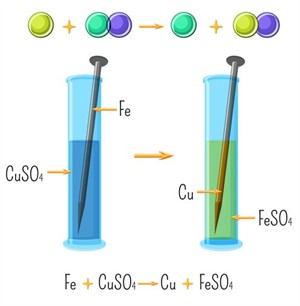
Reaction between iron and copper sulphate
- Blue colour of copper sulphate solution fades and a pale green colour iron sulphate solution is formed.
- Brown coating forms on the nail.
- Iron is more reactive and displaces copper.
Double displacement reaction:
The exchange of ions between the reactants to form new products. Double displacement reaction has the following two types:
i. Neutralisation reaction:
Acid + Base → Salt + Water
ii. Precipitation reaction:
1.
Reactants: Both are colourless solutions
Products: White precipitate (\(BaSO_4\))
2. \(Pb(NO_3)_2(aq) + 2KI(aq) → PbI_2(s) + 2KNO_3(aq)\)
Reactants: Both are colourless solutions
Products: Yellow precipitate \(PbI_2\)
Redox reaction:
| Oxidation | Reduction |
| Gain of oxygen | Loss of oxygen |
| Loss of hydrogen | Gain of hydrogen |
| Loss of electron | Gain of electron |
| Increase in oxidation number | Decrease in oxidation number |
Redox: Both oxidation and reduction occur simultaneously.
Example:
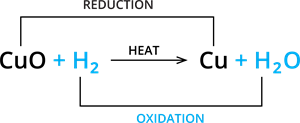
Redox reaction
- Heat copper powder → turns black (\(CuO\))
- Pass hydrogen → turns brown again (\(Cu\) metal)
- Copper oxide gets reduced
- Hydrogen gets oxidised
| Agent | What is does? | What happens to it? | Example |
| Oxidising agent | Causes oxidation of other substance | It gets reduced |
In \(CuO + H_2 → Cu + H_2O\),
\(CuO\) is the oxidising agent
|
| Reducing agent | Causes reduction of other substance | It gets oxidised |
In \(CuO + H_2 → Cu + H_2O\),
\(H_2\) is the reducing agent
|
Corrosion:
Corrosion is the progressive destruction of metals by the action of air, moisture or chemicals (such as an acid) on their surface.
Hints:
- Iron oxide - Reddish brown (Rust)
- Silver sulphide - Black (Tarnish)
- Copper carbonate - Green (Patina)
Rancidity:
The oxidation of oils and fats present in food material resulting in bad smell and taste.
Methods to prevent rancidity: Antioxidants, air tight containers, and flushing packets with nitrogen.
Change in temperature:
i. Exothermic - Release of heat
Examples: Combustion, combination, respiration, rusting of iron, neutralisation (mostly), decomposition of vegetable waste.
Examples: Combustion, combination, respiration, rusting of iron, neutralisation (mostly), decomposition of vegetable waste.
ii. Endothermic - Absorption of heat
Examples: Photosynthesis, melting of ice, decomposition (mostly), dissolving ammonium chloride/nitrate.