

Let's Recall - Redox reaction:
| Oxidation | Reduction |
| Gain of oxygen | Loss of oxygen |
| Loss of hydrogen | Gain of hydrogen |
| Loss of electron | Gain of electron |
| Increase in oxidation number | Decrease in oxidation number |
Redox: Both oxidation and reduction occur simultaneously.
Example:
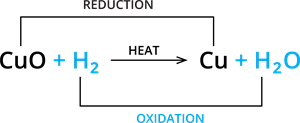
Redox reaction
Hints:
- Heat copper powder → turns black (\(CuO\))
- Pass hydrogen → turns brown again (\(Cu\) metal)
| Agent | What does it do? | What happens to it? | Example |
| Oxidising agent | Causes oxidation of another substance | It gets reduced |
In \(CuO + H_2 → Cu + H_2O\),
\(CuO\) is the oxidising agent
|
| Reducing agent | Causes reduction of another substance | It gets oxidised |
In \(CuO + H_2 → Cu + H_2O\),
\(H_2\) is the reducing agent
|
Understanding redox reactions helps us learn how materials change, why metals corrode, and how food quality is affected over time.
Effect of oxidations reaction in real life:
1. Corrosion:
Corrosion is the progressive destruction of metals by the action of air, moisture or chemicals (such as an acids) on their surface.
Examples:
- When iron is exposed to air and moisture for a long time, it forms a reddish-brown coating called rust (\(Fe_2O_3.xH_2O\)).
- Silver, when exposed to air for a long time, reacts with sulphur compounds present in the air and forms a black coating called tarnish (\(Ag_2S\)).
- Copper, when exposed to air and moisture for a long time, reacts with carbon dioxide and forms a green coating called patina (basic copper carbonate).
Prevention of corrosion:
- Painting, oiling, greasing, chrome plating, and anodising are all effective methods for preventing metals from rusting.
- Galvanisation is a process that coats steel and iron with a thin layer of zinc to prevent rusting. Even if the zinc coating on the galvanised item is damaged, it remains protected against rust.
- Alloying is an excellent way to improve a metal's properties. This method can be used to obtain the desired properties. When iron is combined with nickel and chromium, stainless steel is formed, which is hard and rust-resistant.
- Electroplating: Coating metals with corrosion-resistant metals like chromium or gold.
2. Rancidity:
The oxidation of oils and fats present in food materials resulting in bad smell and taste.
Hints:
Methods to prevent rancidity - Antioxidants, airtight containers, and flushing packets with nitrogen.
Change in temperature:
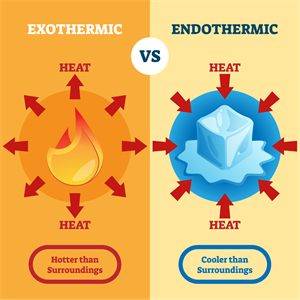
Exothermic vs Endothermic
- Exothermic - Release of heat
- Endothermic - Absorption of heat
- Endothermic examples: Photosynthesis, melting of ice, cooking of an egg, decomposition (mostly), dissolving ammonium chloride/nitrate, sublimation.
- Exothermic examples: Combustion, combination, respiration, rusting of iron, neutralisation (mostly), decomposition of vegetable waste.