

Redox reactions:
In chemistry, many reactions involve transfer of electrons between substances. These reactions are classified as:
- Oxidation reaction
- Reduction reaction
- Redox reaction
Oxidation reaction:
Oxidation is a-
-gain of oxygen
-loss of hydrogen
-loss of electrons
-an increase in oxidation number
-gain of oxygen
-loss of hydrogen
-loss of electrons
-an increase in oxidation number
Example:
\(2Mg + O_2 → 2MgO\)
Reduction reaction:
Reduction is a-
-loss of oxygen
-gain of hydrogen
-gain of electrons
-a decrease in oxidation number
-gain of hydrogen
-gain of electrons
-a decrease in oxidation number
Example:
\(C + 2H_2 → CH_4\)
Redox reaction:
A reaction involving both oxidation and reduction simultaneously means one reactant gets oxidised, the other gets reduced. Such reactions are named as oxidation-reduction reactions or redox reactions.
Let us perform an activity to see the process of oxidation and reduction.
Activity: Oxidation and reduction reactions
Materials required:
-Copper powder
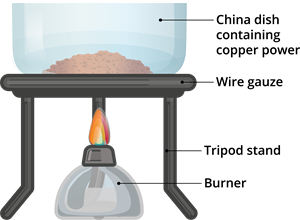
-China dish
-Burner
-Tripod stand and
-Wire gauze
Experimental procedure:
Step 1: Take \(1\) \(g\) of copper powder in the China dish.
Step 2: Put the tripod stand over the burner and the wire gauze on top of it.
Step 3: Now put the China dish containing copper powder over the wire gauze.
Step 3: Now put the China dish containing copper powder over the wire gauze.
Step 4: Turn on the burner and heat the China dish.
Step 5: Take the black copper(II) oxide powder and heat it again with hydrogen gas.
Observation:
- After heating, we observed that the copper powder becomes coated with black colour.
- This black coloured powder is copper(II) oxide.
- The black powder of copper(II) oxide turns brown.
Copper redox reaction
Result:
After heating, copper becames copper oxide because of oxidation; when a chemical reaction gains oxygen, it is said to be oxidised.
The black powder of copper(II) oxide turns brown again, and we get copper powder back. This reaction happens because of the reduction. When there is a loss of oxygen in a chemical reaction, it is said to be reduced.
Oxidation reaction:
\(2Cu\) + \(O_2\) → \(2CuO\)
Redox reaction:
\(CuO\) + \(H_2\) → \(Cu\) + \(H_2O\)
Conclusion:
In this activity, the copper(II) oxide is loses oxygen during the reduction reaction. The copper(II) oxide is reduced to copper. The hydrogen is gains oxygen, and is being oxidised. An oxidation-reduction reaction occurs when one reactant receives oxygen while the other reactant loses oxygen or when one reactant is oxidised while the other reactant is reduced at the same time. The oxidation-reduction reaction is also known as the redox reaction.
| Agent | What does it do? | What happens to it? | Example |
| Oxidising agent | Causes oxidation of another substance | It gets reduced |
In \(CuO + H_2 → Cu + H_2O\),
\(CuO\) is the oxidising agent
|
| Reducing agent | Causes reduction of another substance | It gets oxidised |
In \(CuO + H_2 → Cu + H_2O\),
\(H_2\) is the reducing agent
|