

In this theory we will learn about chemical properties of metals and non-metals.
- Reaction with water
- Reaction with acids
- Reactions of metals with metal salt solutions
Reaction of metals with water:
When metals react with water, metal oxide and hydrogen gas are produced. When soluble metal oxides dissolve in water, metal hydroxide is produced. On the other hand, not all metals react with water.
The reactivity of metals towards water differs. It is based on the reactivity of the metals,
i. Sodium and potassium react vigorously with cold water, which liberates a lot of heat during the reaction. The reaction is exothermic.
ii. Calcium reacts with normal water to form calcium hydroxide and hydrogen gas. Magnesium reacts with hot water to form magnesium hydroxide and hydrogen gas.
Calcium begins to float because the hydrogen gas bubbles that develop adhere to the metal's surface. Magnesium is unaffected by cold water. It forms magnesium hydroxide and hydrogen when it combines with hot water. It also starts floating due to the bubbles of hydrogen gas sticking to its surface.
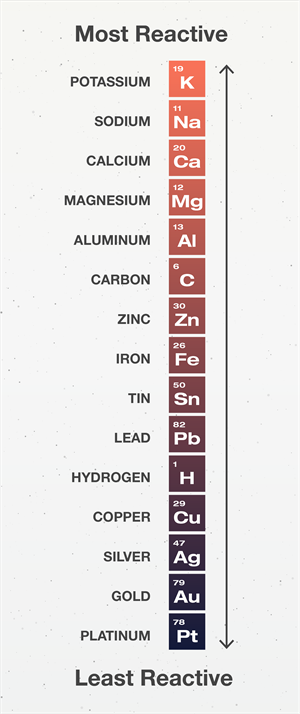
Reactivity series
iii. Iron, aluminium, and zinc do not react with either cold or hot water, but when they come into contact with steam, they produce metal oxide and hydrogen.
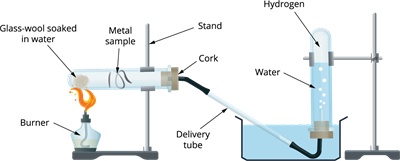
Metals like aluminium, iron and zinc contact with steam, forming metal oxide and hydrogen.
iv. Lead, copper, silver and gold do not react with water at all.
Thus, the increasing order of reactivity with cold or normal water: \(Ca < K < Na\)
The decreasing order of reactivity with water: \(Na > K > Ca > Mg > Al > Fe > Pb > Cu > Ag > Hg\)
Reaction of non-metals with water:
Non-metals do not react with water, but they are reactive in air.
Non-metal + Water \(\to\) No reaction
Reaction of metals with acids:
Most reactive metals react with acids to form salt and hydrogen gas
\(Metals + Acid → Salt + Hydrogen\ gas\)
When zinc granules are added to hydrochloric acid it results in the formation of zinc chloride salt and hydrogen gas.
\(Zn + 2HCl → ZnCl_2 + H_2\)
The metals placed below hydrogen atom in the reactivity series such as copper, silver, gold, and platinum will not react with acids.
Exception:
Nitric acid (\(HNO_3\)) is a powerful oxidising agent. By oxidising the \(H_2\) generated to water, it reduces itself to any of the nitrogen oxides (\(N_2O\), \(NO\), \(NO_2\)).
Magnesium (\(Mg\)) and manganese (\(Mn\)) react with very dilute \(HNO_3\) to produce \(H_2\) gas. The reaction was also the highly exothermic.
Aquaregia \(= 3 HCl : 1 HNO_3\)
It is the only acidic mixture which is highly corrossive, that dissolves gold and platinum, which do not react with \(HCl\) or \(HNO_3\) alone.
It is the only acidic mixture which is highly corrossive, that dissolves gold and platinum, which do not react with \(HCl\) or \(HNO_3\) alone.
Reaction of metals with metal salt solutions:
In solution or molten form, morereactive metals can displace less reactive metals from their compounds is known as displacement reaction.
All metals are not equally reactive in nature. . If metal X displaces metal Y from a solution, X is more reactive than Y. If the metal X is less reactive it will not displace the metal from its +salt solution.
When iron nail is placed in copper sulphate solution, it results in the formation of iron sulphate and copper.
- The Blue colour of copper sulphate solution fades and a pale green colour iron sulphate solution is formed.
- Brown coating forms on the nail.
- Iron is more reactive and displaces copper.
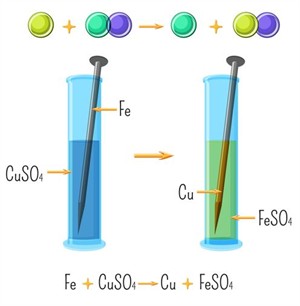
Reaction between iron and copper sulphate