

Most metals found in nature are not present in their pure form. The process of obtaining pure metals from their ores is called extraction of metals or metallurgy.
i. Extraction of less reactive metals:
Metals at the low end of the activity series are unreactive. Heating alone can convert the metal oxides to metals.
i. Cinnabar (\(HgS\)) is a mercury ore. It is first converted into mercuric oxide (\(HgO\)) when heated in the air. On additional heating, the mercuric oxide is converted to mercury as shown below:
ii. copper, which is found in nature as copper glance \(Cu_2S\), may be extracted from its ore by simply heating it in the air as follows:
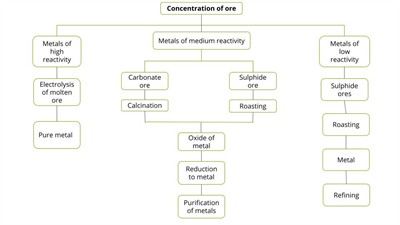
Extraction of metals
ii. Extraction of moderately reactive metals:
Iron, zinc, lead, copper and other metals in the middle of the activity series are moderately reactive. In nature, they are commonly found as sulphides or carbonates.
Metal sulphides and carbonates must be converted into metal oxides before reduction. Because compared to its sulphides and carbonates, it is easier to get metal from its oxide.
Step 1:
i. Heat is used to convert sulphide ores into oxides in the presence of excess air. This process is known as roasting.
ii. Heating carbonate ores rapidly in a limited amount of air, they are converted to oxides. This process is known as calcination.
Step 2:
Suitable reducing agents, such as carbon, are then used to reduce the metal oxides to the corresponding metals. For example, when zinc oxide is burned with carbon, it is converted into metallic zinc.
Metal oxides to metals:
Displacement reactions can occasionally be used instead of carbon (coke) to convert metal oxides to metals. Since highly reactive metals like sodium, calcium and aluminium can displace less reactive metals from their compounds, they are used as reducing agents.
Thermite reaction:
The thermite reaction is a highly exothermic displacement reaction in which a more reactive metal (usually aluminium) reduces the oxide of a less reactive metal, producing the metal in its molten state and releasing a large amount of heat.
Aluminium is more reactive than iron and has a greater affinity for oxygen. It removes oxygen from iron oxide, producing molten iron and releasing a large amount of heat.
iii. Extraction of highly reactive metals:
Metals at the top of the reactivity scale are extremely reactive. Electrolytic reduction is used to obtain these metals. For example, sodium, magnesium, and calcium are obtained via electrolysis of their molten chlorides.
Electrolytic reduction of \(NaCl\):
At cathode:
At anode:
Electrolytic refining:
Copper, zinc, tin, nickel, silver, gold and other metals are purified electrolytically.
- Anode: Impure metal
- Cathode: Pure metal
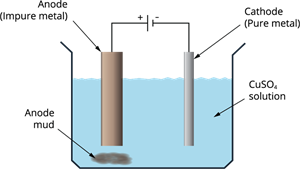
Electrolytic refining of metals
The impure metal from the anode dissolves into the electrolyte as the current is passed through it. The insoluble impurities gets collected at the bottom of the anode which is called anode mud.
Corrosion:
Corrosion is the progressive destruction of metals by the action of air, moisture or chemicals (such as an acid) on their surface.
| Metal | Reaction | Colour of the product |
| Silver | \(4Ag + 2H_2S + O_2 → 2Ag_2S + 2H_2O\) | Black (Tarnish) |
| Copper | \(2Cu + H_ 2 O + CO_ 2 + O_2 → Cu(OH)_ 2 + CuCO_ 3\) | Green (Patina) |
| Iron | \(Fe + O_2 + H_2O → 2Fe_2O_3.xH_2O\) | Reddish brown (Rust) |
Prevention of corrosion:
-
Painting
-
Oiling/greasing
-
Galvanisation (Zinc coating)
-
Chrome plating
-
Anodising
-
Alloying
Alloys:
A homogeneous mixture of metals (or metals & non-metals) to improve properties.
| Alloy | Composition | Uses |
| Brass | \(Cu + Zn\) | Decorative items, instruments |
| Bronze | \(Cu + Sn\) | Statues, tools and medals |
| Solder | \(Pb + Sn\) | Joining electrical components, plumbing etc |
| Amalgam | \(Metals + Hg\) | Dental fillings |
| Stainless Steel | \(Fe + Cr + Ni\) | Utensils, medical tools |
| Gold Alloy |
\(Au + Cu/Ag\)
\(22\) parts \(gold\) + \(2\) parts \(Cu/Ag\)
|
Harder than pure gold; used in jewellery |