

Why does common salt remain solid at room temperature? Why does it conduct electricity only when dissolved in water or melted? The answers lie in the way its atoms combine. In this theory, we will explore how ionic compounds are formed through electron transfer and understand why they exhibit their unique physical and chemical properties.
Ionic compounds:
Atoms combine with one another to achieve a stable electronic configuration. Most atoms become stable by having a completely filled outermost shell, similar to the noble gases. Noble gases, which have a completely filled valence shell, have little chemical activity. As a result, we describe element reactivity as a tendency to obtain a completely filled valence shell.
Ionic compounds or electrovalent compounds are compounds formed by transferring electrons from a metal to a non-metal.
| Type of element | Valence electrons |
| Metals | 1, 2, and 3 |
| Non-metals | 5, 6 and 7 |
Metal + non-metal → Ionic bond (or) electrovalent bond
Metal: Loss of electron - Cation (\(+\))
Non-metal: Gain of electron - Anion (\(-\))
Non-metal: Gain of electron - Anion (\(-\))
An ionic compound is a compound formed by the transfer of electrons from a metal atom to a non-metal atom. The resulting oppositely charged ions are held together by a strong electrostatic force of attraction called an ionic bond.
Examples: \(NaCl\), \(MgCl_2\), \(Na_2O\), \(MgO\) and \(AlCl_3\)
Formation of sodium chloride:
|
Sodium atom
|
Chlorine atom
|
|
Electrons present = \(11\)
Electronic configuration = (\(2, 8, 1\)) |
Electrons present = \(17\)
Electronic configuration = (\(2, 8, 7)\) |
A sodium atom has one electron in its outermost shell, as shown in the table. Its L shell becomes the outermost shell and has a stable octet if it loses one electron from its M shell. The nucleus of this atom still retains \(11\) protons, but the number of electrons has dropped to \(10\), resulting in a net positive charge, leading to the sodium cation \(Na^+\).
On the other hand, chlorine contains seven electrons in its outermost shell, it gains that one electron and attains stability.
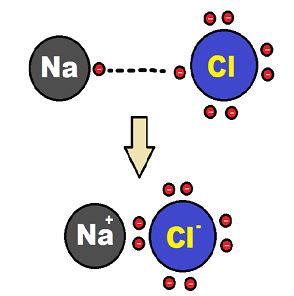
Sodium chloride formation
Formation of magnesium chloride:
|
Magnesium atom
|
Chlorine atom
|
|
Electrons present = \(12\)
Electronic configuration = (\(2, 8, 2\))
|
Electrons present = \(17\)
Electronic configuration = (\(2, 8, 7\)) |
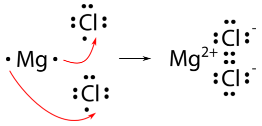
Magnesium chloride formation
Properties of ionic compounds:
Because of the strong force of attraction between the positive and negative ions, ionic compounds are solids but somewhat hard. When pressure is applied to such compounds, they become brittle and break into pieces.
- Physical state: Crystalline solids. Strong force of attraction between ions.
- High melting and boiling points: Large amount of energy is required to break inter-ionic forces
- Solubility: Soluble in polar solvents (water); Insoluble in non-polar solvents
- Conductivity: Do not conduct electricity in a solid state as ions are fixed.
Conduct in molten state or aqueous solution because ions are free to move.
Occurrence of metals:
Metals are found in nature either in the free state or in the combined state depending on their reactivity.
Abundance of metals:
- Aluminium is the most abundant metal in the Earth's crust.
- Iron is the second most abundant metal.
- Even though aluminium is abundant, it is extracted by electrolytic reduction because it is highly reactive.
\(Aluminium > Iron > Calcium > Sodium > Potassium > Magnesium\)
High reactive metals (\(K, Na, Ca, Mg, Al\))
-
Never found in free state
-
Strong affinity for oxygen
-
Extracted by electrolysis
Moderate reactive metals (\(Zn, Fe, Pb, Cu\))
-
Found as oxides, sulphides, and carbonates
-
Extracted by roasting/calcination and followed by reduction using carbon
Low reactive metals (Ag, Au, Pt)
-
Found native state (free)
-
Often require simple heating
Enrichment of ores:
A mineral from which a metal can be extracted economically is called an ore.