

From the pan to the plate, also from the fire to the food - our whole meal is a teamwork of metals and non-metals. Without which we couldn’t even boil water!
- Mostly metals are generally hard, shiny and good conductors of heat and electricity.
- Mostly non-metals may be solid, liquid or gas and are generally poor conductors.
Let’s learn about the metals and non-metals that we rely on in our daily lives.
Properties of materials:
1. State:
i. Most metals are solid at room temperature, except mercury, which is liquid.
ii. The non-metals naturally exist in three states: solid, liquid and gas.
- Sulphur and phosphorus occur in a solid-state.
- Bromine occurs in a liquid state.
- Oxygen, nitrogen, hydrogen, halogens and noble gases occur in the gaseous state.
2. Lustre:
i. Metals are lustrous in nature. Metals have a shining surface in their purest form. This property is known as 'metallic lustre'. Metallic lustre means reflected light resembles a polished metal surface. For example, gold and silver.
Metals have free electrons that reflect light, making them appear shiny and giving them a metallic lustre.
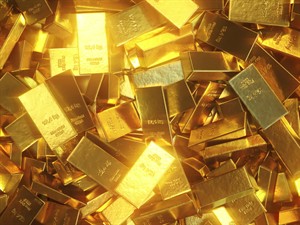
Gold
ii. Non-metals lack lustre because they have a dull appearance. Substances such as diamond (these are allotropes of carbon) and iodine are exceptions.
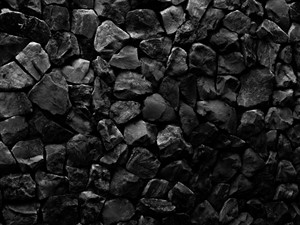
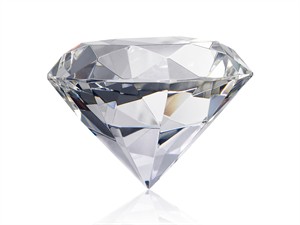
Carbon: non-lustrous; diamond: lustrous
3. Malleability:
Malleability refers to the ability of materials to be hammered or shaped permanently without breaking or cracking, allowing it to be beaten into thin sheets.
i. Metals are malleable. The most malleable metals are silver and gold. Aluminium is also malleable and can be beaten into thin sheets to create foils for wrapping food.
Most metals are hard; they can be beaten into thin sheets. However, some metals such as sodium, potassium and lithium are soft metals, and mercury is a liquid metal; hence they cannot be beaten into thin sheets.
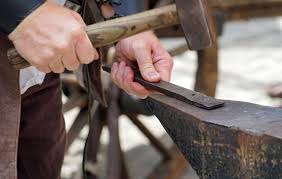
Hammering of an iron object
ii. Non-metals are non-malleable. When non-metals are hammered, they form a powdery mass because they are brittle in nature.
4. Ductility:
The property of materials that allows them to be pulled into thin wires is called ductility.
i. Most of the metals are ductile, and they can be drawn into thin wires. Gold is the most ductile metal. One gram of gold may produce a wire with a length of around \(2\) kilometres.
Metals can be moulded into various shapes according to our needs due to their malleability and ductility.
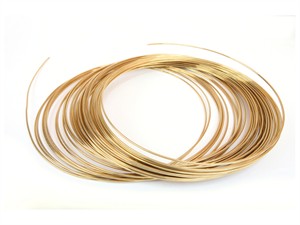
Thin wire of metal
ii. Non-metals are non-ductile. As they are brittle, they cannot be drawn into thin wires.
5. Heat conductivity:
i. Metals are good conductors of heat.
Silver and copper are the best conductors of heat, while lead and mercury are relatively poor conductors of heat.
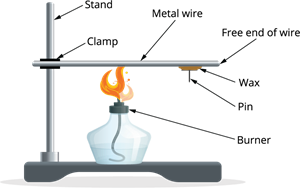
Heating a metal wire
The heat travels through the metal wire, melts the wax, and the pin falls down. This shows that most of the metals are good conductors of heat.
ii. Non-metals are poor conductors of heat; they do not transfer heat from one end to the other. Non-metals generally transfer heat poorly because they lack free electrons. Non-metals act as an insulator. But graphite conducts electricity.
6. Electrical conductivity:
Conductivity of electricity is the ability of a material to allow an electric current to pass through it.
i. Metals contain free electrons, making them good conductors of electricity. These free electrons move easily through the metal, allowing it to conduct an electric current.
When the metal coin in the circuit is replaced by a non-metal, the bulb does not glow.
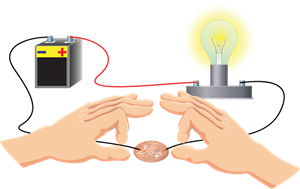
Electrical circuit
ii. Non-metals are poor conductors of electricity. Graphite (allotrope of carbon) conducts electricity because it has free electrons to allow current to pass through it.
7. Sonority:
The ability of a material to produce a loud sound or ringing sound when struck over is called sonority.
i. Metals are sonorous because they vibrate uniformly when struck, producing a ringing sound. When stuck over hard surface, vibration travels through the metal and produces a clear sound.
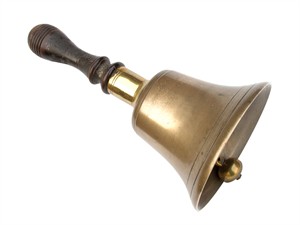
Metal bell
ii. Non-metals are non-sonorous because they do not vibrate uniformly when struck on a hard surface, and they do not resonate. So, non-metals cannot produce a loud, ringing sound.
| Property | Metals | Non-metals |
| Physical state |
Mostly solid at room temperature
Exception: \(Hg, Cs, Ga\) - Liquid near room temperature
|
Exist in all three states
Exception: \(Br\) - only liquid non-metal
|
| Lustre | Lustrous |
Dull
Exception: Iodine, graphite and diamond
|
| Hardness |
Mostly hard
Exception: \(Na, K, Li\) - Soft
|
Generally soft
Exception: Diamond (allotrope of carbon)
|
| Density |
High
Exception: Alkali metals (\(Li, Na, K\))
|
Low
Exception: Diamond
|
| Melting and boiling point |
High
Exception: \(Hg, Cs, Ga, Na, K, Li\)
|
Low
Exception: Diamond
|
| Malleability and ductility |
Malleable and ductile
Exception: \(Hg\)
|
Brittle
|
| Conductivity |
Good conductor of heat and electricity
Silver - Best conductor
Exception: Lead and mercury (Heat)
|
Poor conductor of heat and electricity
Exception: Graphite
|
| Sonority |
Sonorous
Exception: \(Hg\)
|
Non-sonorous |
Reaction with air:
i. Metals with air:
Most metals react with oxygen to form metal oxides. Most metal oxides are basic in nature.
Metal + Oxygen \(\to\) Metal oxide
Metals react with oxygen to form basic oxides.
Example: \(2Mg + O_2 → 2MgO\)
\(MgO + H_2O → Mg(OH)_2\)
However, the reactivity of metals towards oxygen differs. This depends on the reactivity of the metals,
- Sodium and potassium react vigorously with oxygen.
- Magnesium and calcium burn slightly above room temperature.
- Iron does not burn when heated, but iron filings do when put into the burner's flame. Copper does not burn, but it does leave a black film of copper (II) oxide on the hot metal.
- Gold and platinum do not combine with oxygen even at high temperatures.
Metals like potassium and sodium react rapidly with oxygen and readily catch fire in the air. As a result, they are immersed in kerosene oil to protect them and prevent accidental fires.
Amphoteric oxides: Oxides behaving as both acid and base. Example: \(Al_2O_3\) and \(ZnO\). Reacts with both acids and bases to form salt and water.
ii. Non-metals with air:
Non-metals react with oxygen to form non-metal oxides. Non-metal oxides are mostly acidic in nature.
Non-metal + Oxygen \(\to\) Non-metal oxide
Non-metals react with oxygen to form acidic oxides.
Example: \(S + O_2 → SO_2\)
\(SO_2 + H_2O → H_2SO_3\)
Some non-metals such as sulphur and phosphorus react rapidly with oxygen and readily catch fire in the air. As a result, they are stored in water to protect them and prevent accidental fires.