

- Understand the pH scale and identify whether substances are acidic, basic, or neutral, with examples from daily life like soil and water quality.
- Explain neutralisation reactions and relate them to real-world uses such as antacids and soil treatment.
- Describe how salts are prepared through reactions like neutralisation and identify different types of salts and their applications.
- Recognise practical uses of acids, bases, and salts in cleaning, digestion, food preservation, and various industries.
Acid and base in a water solution:
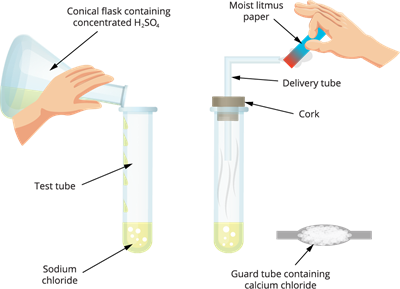
Acid produces hydrogen ions in water
- Dry \(HCl\) gas: Does not have separate \(H+\) ions, fails to turn blue litmus paper to red. Do not show the acidic character of an acid.
- \(HCl\) solution: Contains separate \(H^+\) ions, turns blue litmus red. Proves the acidic character of an acid.
- Acids: \(H^+\) ions
- Bases: \(OH^-\) ions
- Guard tube: Calcium cholride - Absorb moisture from the gas.
PYQ - Acid in water
Water is mixed with an acid or a base:
- Dissolving an acid and a base in water is an exothermic process
- Always add acid to water, never water to acid
- Adding water to an acid or a base decrease the concentration of the ions
- Concentrated acid/base: High percentage of acid/base and a low percentage of water
- Diluted acid/base: High percentage of water and a low percentage of acid/ base
PYQ - Dilution of an acid
Neutralisation reaction:
\(Acid\ + Base\ → Salt\ + Water\)
pH scale:
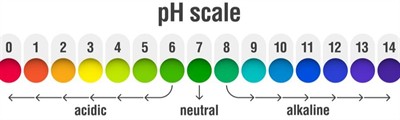
pH scale
- pH - potenz (potential) of hydrogen
- \(0\) to \(7\) - Acid
- \(7\) - Neutral
- \(7\) to \(14\) - Base
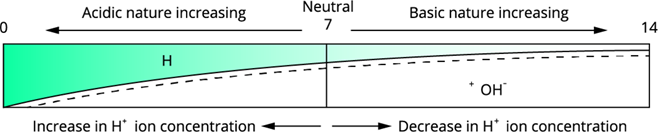
Variation of pH
PYQ - pH, pH of a solution
Importance of pH in everday life:
| Situation | Cause | Effect | Neutralisation |
| Insect/Bee sting | Formic acid | Pain & burning | Base (Baking soda/lime paste) |
| Wasp sting | Alkaline | Pain & burning | Acid (Vinegar) |
| Nettle sting | Methanoic acid | Burning pain | Base (Rub dock leaf) |
| Tooth decay | Mouth acids | Cavity formation | Basic toothpaste |
| Acidity | Excess HCl | Heartburn/ulcer | Antacids (\(Mg(OH)_2\) |
| Acidic soil | Fertilisers | Poor plant growth | Lime (\(CaO\) or \(Ca(OH)_2\)) |
| Alkaline soil | Excess base | Poor nutrient availability | Acid (Compost) |
| Industrial waste | Acidic effluents | Environmental damage | Lime or limestone |
PYQ - Neutralisation reaction
Salts:
- Strong acid + Strong base → Neutral Salt + Water
- Weak acid + Weak base → Neutral Salt + Water
- Strong acid + Weak base → Acidic Salt + Water
- Weak acid + Strong base → Basic Salt + Water
Chemicals from common salt:
| Common name | Chemical name | Formula | Uses | Method of preparation |
| Common salt | Sodium chloride |
\(NaCl\)
|
Raw material for NaOH, baking soda, washing soda; used as food preservative | Obtained from sea water & mining of rock salt |
| Caustic soda | Sodium hydroxide |
\(NaOH\)
|
Soaps, detergents, paper | Chlor-alkali process: Electrolysis of brine |
| Bleaching Powder | Calcium oxychloride or Calcium hypochlorite |
\(CaOCl_2\)
|
Bleaching agent, disinfectant, water treatment | Passing chlorine gas over slaked lime |
| Baking Soda | Sodium hydrogen carbonate or sodium bicarbonate |
\(NaHCO_3\)
|
Baking (release of \(CO_2\)), antacid, fire extinguishers, cleaning | Solvay process |
| Washing Soda | Sodium carbonate decahydrate |
\(Na_2CO_3.10H_2O\)
|
Glass, soap, paper industry, water softening | Recrystallisation of sodium carbonate/Solvay process |
| Plaster of Paris | Calcium sulphate hemihydrate |
\(CaSO_4.1/2H_2O\)
|
Making casts, statues, chalks, surgical bandages, wall designs | Heating gypsum at 373 K |
| Gypsum | Calcium sulphate dihydrate |
\(CaSO_4.2H_2O\)
|
Making POP, cement, agriculture, plastering | Naturally occurring mineral or addition of water to POP |