

Have you ever wondered why the Sun appears in the sky in the morning and disappears in the evening? Why does the Sun seem to rise in the East and set in the West? Does the Sun move around the Earth every day, or is there another reason for this apparent movement?
To understand this, imagine sitting on a merry-go-round. As you spin, the trees and buildings around you appear to move in the opposite direction, even though they are stationary. In a similar way, the Earth also spins continuously on its own axis. This movement is called rotation of the Earth. By learning about the direction and time taken for one complete rotation, we can understand why the Sun appears to move across the sky from East to West.
-
Rotation: The Earth spins on its own axis, just as a spinning top, fan, or ball turns around itself. Rotation is the motion of an object in which all its parts move in circles around an imaginary line that passes through it. This line is called the axis of rotation.
-
Earth’s axis: The axis of rotation passes through the geographic North Pole and the South Pole.
-
Time taken: The Earth completes one rotation in about \(24\) hours.
-
Direction of rotation: When viewed from above the North Pole, the Earth rotates in an anti-clockwise direction, from West to East.
-
Merry-go-round activity: When a person rotates in an anti-clockwise direction, stationary objects around them appear to move in the opposite, clockwise direction.
-
Apparent movement of the Sun: As the Earth rotates from West to East, the Sun appears to move across the sky from East to West.
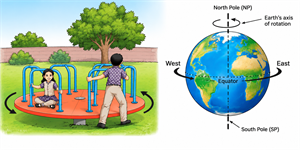 Merry go around and rotation of the earthA torch can represent the Sun, while a globe represents the Earth. When light from the torch falls on the globe, only half of the globe is illuminated, while the other half remains dark. The illuminated half experiences daytime, and the dark half experiences nighttime.
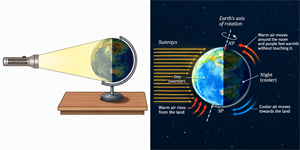 Demonstration of Day and Night: Sunlight, Earth’s RotationThe Earth rotates from West to East, causing the cycle of day and night. Sunrise occurs when a location moves into the illuminated part of the Earth, while sunset occurs when it moves into darkness. In India, sunrise occurs first in the eastern part and then in other parts as the Earth rotates.Due to the Earth's rotation from West to East, the Sun appears to rise in the East, move across the sky towards the West and set in the West. After sunset, stars become visible in the night sky. Thus, the Earth's rotation explains the apparent daily movement of the Sun and the regular cycle of day and night.Foucault Pendulum
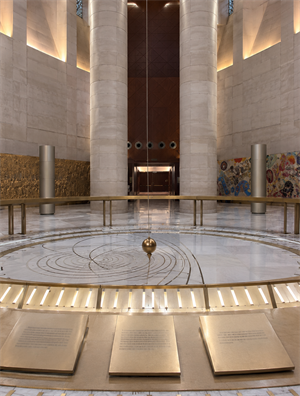 Galileo discovered an important property of a pendulum, which Christiaan Huygens later used to develop pendulum clocks for measuring time. In the nineteenth century, Leon Foucault used a long pendulum to demonstrate the Earth's rotation. This instrument, called the Foucault pendulum, consists of a heavy bob suspended from a long string attached to a high ceiling.A Foucault pendulum with a length of \(22\) metres hangs from a skylight in the Constitution Hall of the new Parliament building in New Delhi, India. It symbolises the integration of India's ideas with the vastness of the cosmos.