

Have you ever looked at the night sky and noticed that stars appear in different positions at different times? Does this mean that the stars are actually moving around the Earth?
In this activity, we learn how the rotation of the Earth makes stars appear to move across the night sky. By observing the Big Dipper (Saptarishi) and the Pole Star (Dhruva Tara), we can understand this apparent movement.
Activity:
-
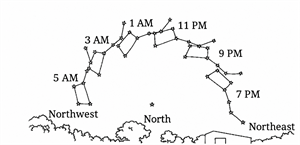
Observe the Big Dipper (Saptarishi) and the Pole Star (Dhruva Tara) on an early evening between March and May.
-
Record the date and location of observation.
-
Draw the position of the Big Dipper with respect to the Pole Star.
-
Observe and sketch the Big Dipper again after every two hours.
Observations:
-
The Big Dipper appears to change its position and orientation over time.
-
The stars appear to move around the Pole Star.
-
The Pole Star appears nearly stationary in the Northern Hemisphere.
Reason: The Earth's axis of rotation points very close to the Pole Star. Therefore, the Pole Star appears nearly stationary, while other stars appear to move around it.
Conclusion: The apparent movement of stars is caused by the Earth's rotation from West to East.
Star Trails:
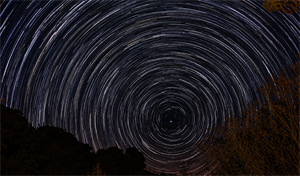
Star Trails
Astrophotographers take long-exposure photographs by keeping the camera shutter open for a long time. The apparent movement of stars is recorded as circular arcs called star trails.
Aryabhata:
- Aryabhata was a famous ancient Indian mathematician and astronomer who wrote Aryabhatiya around the fifth century CE.
- In Verse 9 of Golapada, he explained the apparent westward movement of stationary stars using the example of a person in a moving boat.
- He stated that the Earth takes approximately 23 hours, 56 minutes and 4.1 seconds to complete one rotation on its axis.
- His calculated value is remarkably close to the currently accepted value.
Revolution of the Earth:
-
Revolution is the movement of an object around another object.
-
The path followed by an object during revolution is called its orbit.
-
The Earth revolves around the Sun while rotating on its own axis.
-
The Earth's orbit around the Sun is nearly circular when viewed from the top.
-
The Earth takes approximately 365 days and 6 hours to complete one revolution around the Sun.