

Substances around us can be classified based on their properties as acids, bases, and neutral substances. These substances show different behaviours, such as sour taste, bitter taste, or colour change with indicators.
In this session, we will study their properties, reactions, and real-life applications.
Acids:
The properties of acids are as follows:
-
Acids are sour.
-
The pH level of an acid is less than 7.
-
Litmus paper: It turns blue to red.
-
Acids release \(H^+\) ions, which are responsible for their acidic properties.
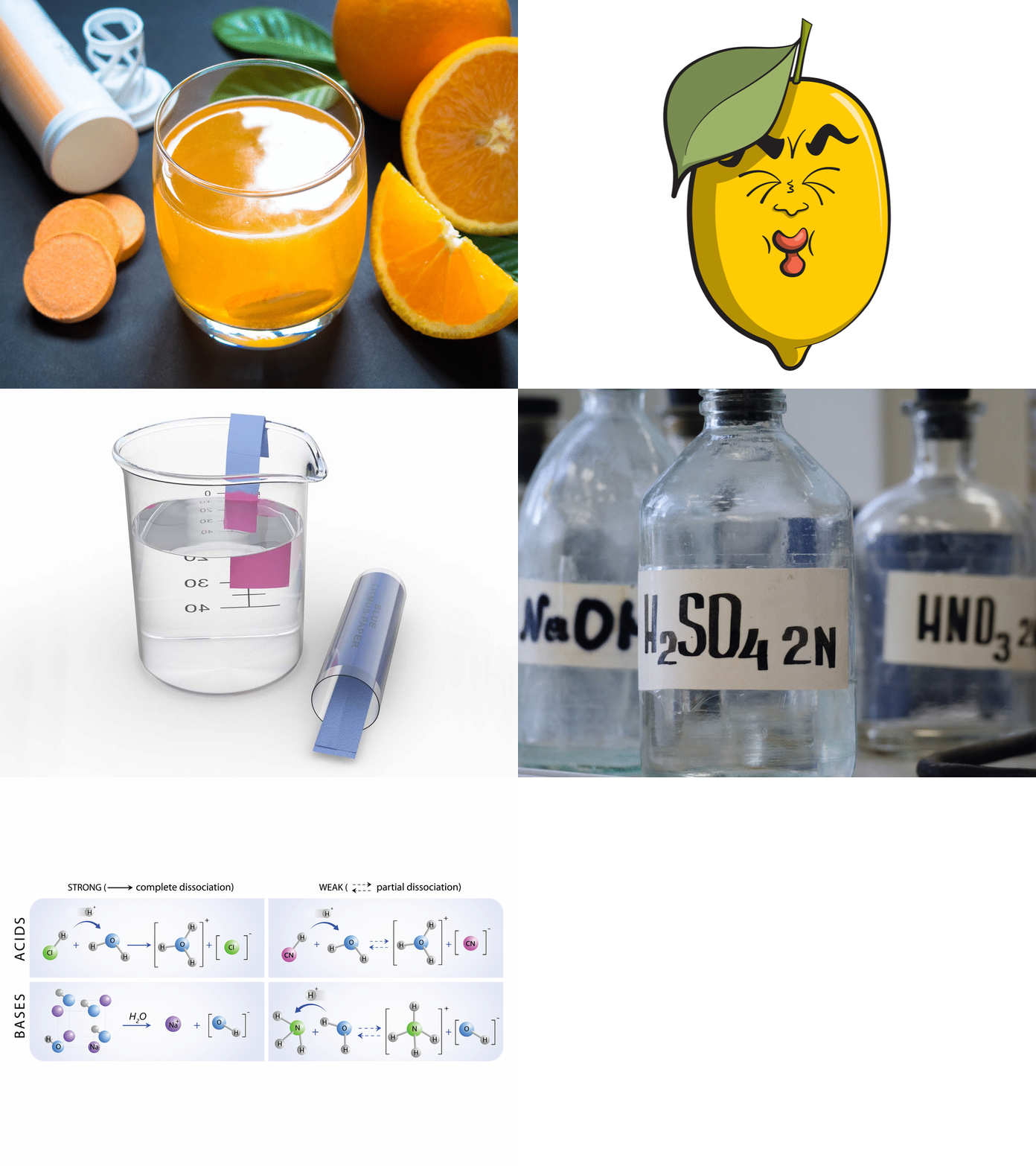
Properties of acid
Acids are commonly found in various fruits, including:
- Lemon contains citric acid.
- Oranges also rich in citric acid.
- Apple contains malic acid.
- Grapes have tartaric acid.
- Strawberry mainly contains citric acid and malic acid, with small amounts of ascorbic acid.
The acids that are present naturally are called organic acids, and acids which are synthesised in laboratories, like \(HCl\), \(HNO_3\) and \(H_2SO_4\), are mineral acids. Generally, organic acids are weak acids, whereas mineral acids are strong acids.
Bases:
The properties of bases are as follows
- Bases are bitter, and they feel soapy or slippery.
- The pH level of a base is greater than 7.
- Litmus paper: It turns red to blue.
- Bases that can dissolve in water are known as alkalis, for example, potassium hydroxide and sodium hydroxide.
- Bases release \(OH^-\) ions, which are responsible for their basic properties.
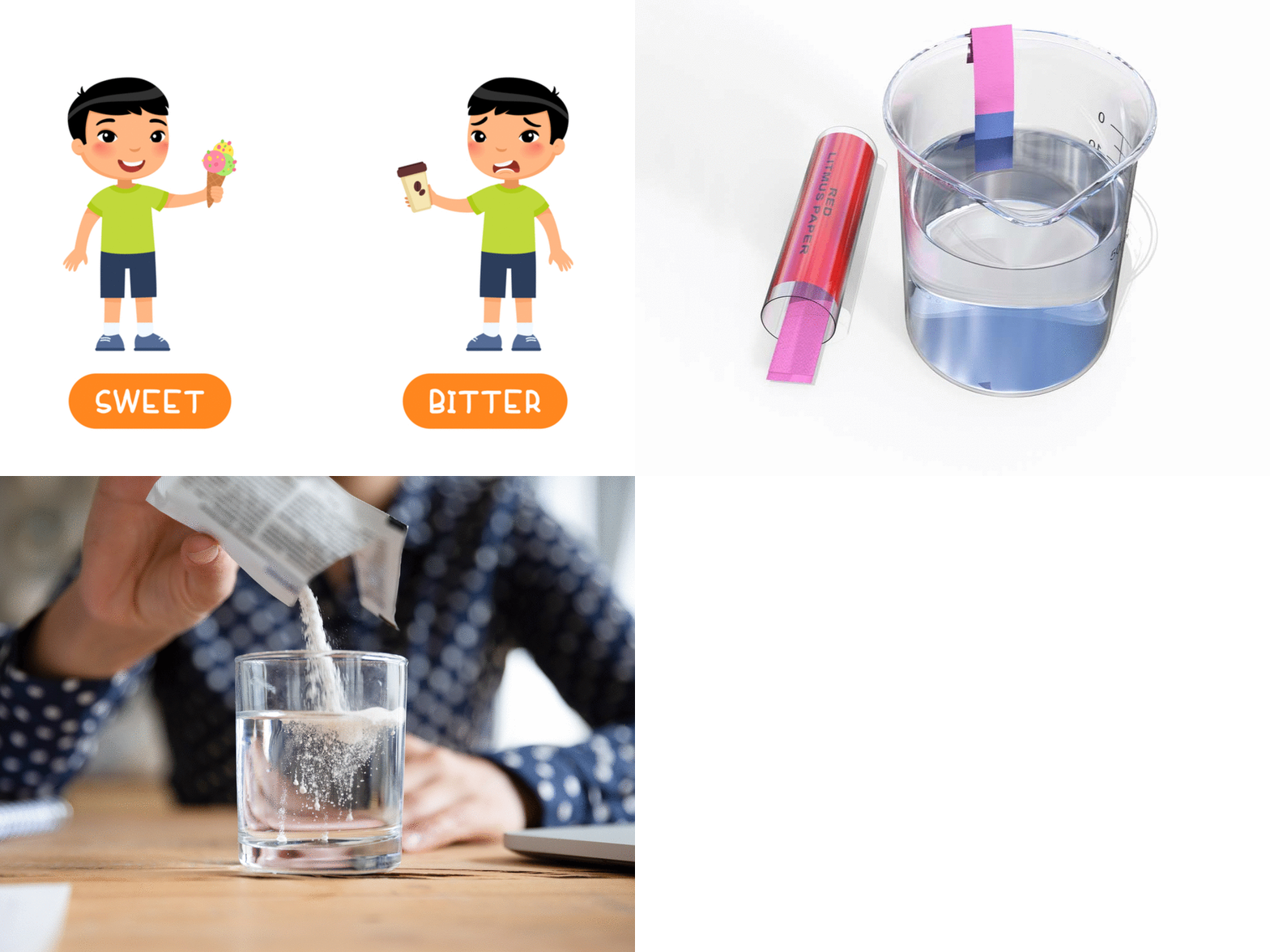
Properties of base
Bases commonly found in cleaning agents include:
- Soap is made using sodium hydroxide.
- Baking soda contains sodium bicarbonate.
- Cleaning products contains potassium hydroxide.
The organic bases are obtained naturally, like ammonia, urea, while inorganic bases are synthesised in laboratories like \(NaOH\), \(KOH\) and many more.
Neutralisation:
When two opposite characters meet, what happens? They don’t fight each other; instead, they shake hands and create peace. It’s like a coffee with a splash of milk, where the bitter black coffee meets the milk, which softens the bitterness, creating a delicious coffee.

Making coffee
When the angry acid comes in contact with the bitter base, they shake hands, resulting in the formation of peaceful droplets of water and salt, which enter the peacemaker- the neutralisation reaction.
When an acid and a base are combined, a chemical reaction occurs. This process is called neutralisation. The reaction mixture produces heat during neutralisation; hence, it is an exothermic reaction.
In a neutralisation reaction, there is the formation of a new substance, which is known as a salt. The salt produced as a product can be either acidic, basic or neutral.
Activity - Testing neutralisation of acid and base with litmus solution:
Instructions:
i. Take a small quantity of baking soda mixed with water in a clean test tube 'A', and add a few drops of red litmus solution.
ii. Observe the colour change, the red litmus solution changes to blue.
iii. To the same test tube, slowly add vinegar. At one point, the blue solution starts turning red as shown in 'B'.
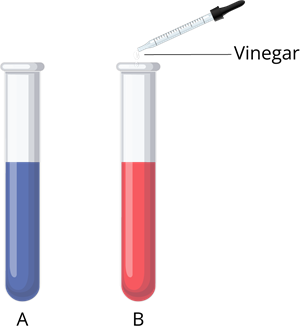
Litmus test
Science behind it!
When a red litmus solution is added to the baking soda solution, it turns blue due to its basic nature. When vinegar was added to the same test tube, the colour of the solution changed from blue to red.
Thus, the solution in the test tube is no longer basic; vinegar neutralises the effect of the base.
The reaction between hydrochloric acid and sodium hydroxide yields a salt and water as products. It is one example of a neutralisation reaction.
Hydrochloric acid + Sodium hydroxide → Sodium chloride + Water + Heat
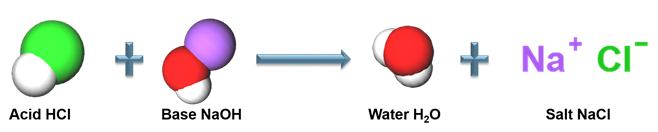
Acid-base reaction
Neutralisation reaction in daily life:
Acid-base balance is pivotal for our health and the environment. We unknowingly perform many neutralisation processes in our daily lives. Let us now explore the significance of some of those reactions.
| Situation | Cause | Effect | Neutralisation |
| Insect/Bee sting | Formic acid | Pain & burning | Base (Baking soda/lime paste) |
| Wasp sting | Alkaline | Pain & burning | Acid (Vinegar) |
| Tooth decay | Mouth acids | Cavity formation | Basic toothpaste |
| Acidity | Excess hydrochloric acid | Heartburn/ulcer | Antacids (magnesium hydroxide) |
| Acidic soil | Fertilisers | Poor plant growth | Slaked lime (calcium hydroxide) |
| Alkaline soil | Excess base | Poor nutrient availability | Acid (Compost) |
| Industrial waste | Acidic effluents | Environmental damage | Slaked lime (calcium hydroxide) |