

In the previous session, we learned about an indicator that allows us to understand the solution through colour changes. There is one more interesting factor, which indicates through smell, which is an olfactory indicator.
Olfactory Indicator:
The olfactory indicators are the substances which indicate a change in odour in acidic and basic media.
Example:
Onion, clove oil, garlic extract, and vanilla essence
When these substances are brought into contact with acids and bases, they convey the nature of the chemical, either becoming odourless or retaining the odour.
Activity - Testing solutions with an olfactory indicator:
Materials required:
- Onion and garlic
- Strips of clean cotton cloth
- Air-tight container
- Samples of acids and bases
Instructions:
Step 1: Take some garlic, finely chop it and add it to an airtight container.
Step 2: Add clean strips of cotton cloth to the same container, close it and leave it overnight.
Step 3: The next morning, remove the strips, and the strips smell like garlic.
Step 4: Now test the strips with acid and base samples. To one strip, add a few drops of lemon juice, and to the other strip, add a few drops of soap solution. Check the odour of the strips. Perform the same for onion.
Observation: In the acidic solution, the garlic-infused cloth strips retain the odour, while in the basic solution, they become odourless.
The observations are listed as follows,
|
Smell in acid
|
|---|
|
Retains odour
|
|
Retains odour
|
|
Retains odour
|
|
Retains odour
|
Neutralisation:
When two opposite characters meet, what happens? They don’t fight each other; instead, they shake hands and create peace. It’s like a coffee with a splash of milk, where the bitter black coffee meets the milk, which softens the bitterness, creating a delicious coffee.

Making coffee
When the angry acid comes in contact with the bitter base, they shake hands, resulting in the formation of peaceful droplets of water and salt, which enter the peacemaker- the neutralisation reaction.
When an acid and a base are combined, a chemical reaction occurs. This process is called neutralisation. The reaction mixture produces heat during neutralisation; hence, it is an exothermic reaction.
In a neutralisation reaction, there is the formation of a new substance, which is known as a salt. The salt produced as a product can be either acidic, basic or neutral.
Activity - Testing neutralisation of acid and base with litmus solution:
Instructions:
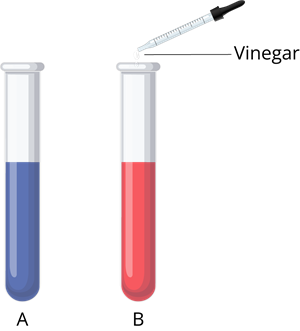
i. Take a small quantity of baking soda mixed with water in a clean test tube 'A', and add a few drops of red litmus solution.
ii. Observe the colour change, the red litmus solution changes to blue.
iii. To the same test tube, slowly add vinegar. At one point, the blue solution starts turning red as shown in 'B'.
Litmus test
Science behind it!
When a red litmus solution is added to the baking soda solution, it turns blue due to its basic nature. When vinegar was added to the same test tube, the colour of the solution changed from blue to red.
Thus, the solution in the test tube is no longer basic; vinegar neutralises the effect of the base.
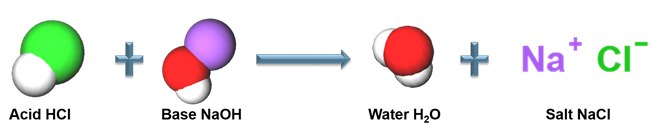
The reaction between hydrochloric acid and sodium hydroxide yields a salt and water as products. It is one example of a neutralisation reaction.
Hydrochloric acid + Sodium hydroxide → Sodium chloride + Water + Heat
Acid-base reaction
Similarly, other acids also produce salt and water when reacting with the base. Let us see some examples of the reaction of acids with sodium hydroxide (\(NaOH\)).
Sulphuric acid + Sodium hydroxide → Sodium sulfate + water
Activity - Ready to inflate a balloon with the help of kitchen ingredients:
Materials Required:
-
Balloon
-
Plastic bottle
-
Spoon
-
Baking soda
-
Vinegar
Instructions:
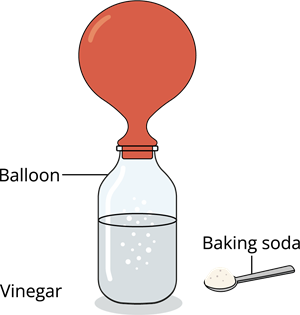
Step 1: Fill half of the bottle with vinegar
Step 2: Add a tablespoon of baking soda into the uninflated balloon
Step 3: Carefully place the open end of the balloon over the bottle’s neck, without letting the baking soda into the bottle
Step 4: Gently lift the balloon so that the baking soda falls into the vinegar solution, and observe the reactionScience behind it!
Baking soda reacts with vinegar
You might have observed that once the baking soda starts falling slowly, it mixes up and fizzes out, and the balloon begins inflating due to the release of carbon dioxide gas.
The following reaction occurs,
The acetic acid present in the vinegar, when it comes in contact with the base baking soda, leads to the formation of sodium acetate (salt), water, and carbon dioxide.