

Heat is a form of energy that always flows from a hotter object to a colder object until both reach the same temperature. Every day, we experience heat transfer while cooking food, ironing clothes, using metal spoons in hot liquids, or walking barefoot on different surfaces.
Nature transfers heat in three different ways:
- Conduction
- Convection
- Radiation
Activity:
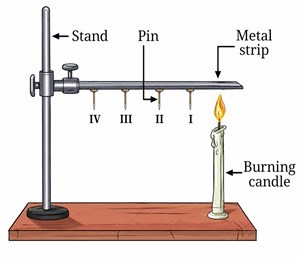
- Take a strip of a metal, such as aluminium or iron, about 15 cm long.
- Attach four pins to the strip with the help of wax such that they are arranged at nearly equal distances (about 2 cm apart).
- Secure the strip to a stand and label the pins as I, II, III, and IV.
Heat the end of the strip that is away from the stand with a candle or a spirit lamp.
Observation:
You observed that the pin closest to the candle flame (pin I) falls first, followed by pins II, III, and IV.
Inference:
As the heat travels along the strip and approaches a pin, the wax holding it melts and the pin falls. Here, the transfer of heat takes place from the hot end of the strip to the colder end.
Conduction of heat:
The process of heat transfer from the hotter part of an object to the colder part is called conduction.
In this process, the particle that gets heated, passes the heat on to its neighbour, and so on. However, the particles themselves do not move from their positions.
Good conductors of heat:
Materials like metals that allow heat to pass through them easily are called good conductors of heat. Because metals are good conductors of heat, we use utensils made of metals for cooking. In solids, heat transfer takes place mainly through the process of conduction.
Poor conductors of heat:
Materials such as glass and wood do not allow heat to pass through them easily and are poor conductors (insulators) of heat. Clay and porcelain are also poor conductors of heat — that is why tea or coffee kept in such cups stays hot longer.
Woollen clothes and layered clothing keep us warm because they trap air in their pores or between layers. Since air is a poor conductor of heat, the trapped air reduces the transfer of heat from our body to the surroundings.
Similarly, two thin blankets with a layer of trapped air between them can keep us warmer than one thick blanket. The same principle of reducing heat transfer is used in houses built in very hot or very cold regions to help maintain comfortable indoor temperatures.
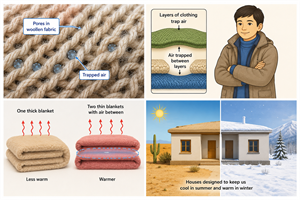
Poor conductors that prevent heat transfer
The upper Himalayan regions have extremely cold winters and heavy snowfall. Houses in these areas are designed to retain heat. Their walls may have two wooden layers with cow dung and mud filled between them. Since wood and mud are poor conductors of heat, they reduce heat loss and help keep the houses warm during winter.
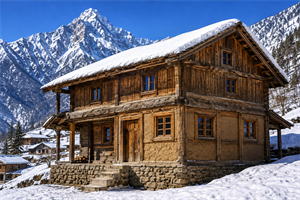
House built in himalayan region