

Have you ever noticed that the sand at a beach feels very hot during the day but becomes cooler at night, while the sea water does not change temperature as quickly? This happens because land and water get heated and cooled at different rates. This difference in heating and cooling causes the movement of air near coastal areas, giving rise to sea breeze during the day and land breeze at night.
Experiment

Two identical bowls are taken. One is filled halfway with soil and the other with water. A laboratory thermometer is placed in each bowl, ensuring that the thermometer bulbs are immersed without touching the bottom or sides. Both bowls are placed in sunlight. The temperatures of the soil and water are recorded every 5 minutes for 20 minutes. After heating, the bowls are brought indoors and allowed to cool for another 20 minutes.
Observation
The temperature of the soil rises faster and by a greater amount than that of the water during heating. When the setup is allowed to cool, the soil also cools faster than the water.
Conclusion
Soil heats up faster and cools down faster than water. Thus, land and water get heated and cooled at different rates.
Sea Breeze – Day:
During the day, land gets heated faster than water. The warm air above the land rises, causing cooler air from the sea to move towards the land. This movement of air is called sea breeze. It provides relief from heat in coastal areas, which is why windows of coastal houses are often placed facing the sea.
During the day, land gets heated faster than water. The warm air above the land rises, causing cooler air from the sea to move towards the land. This movement of air is called sea breeze. It provides relief from heat in coastal areas, which is why windows of coastal houses are often placed facing the sea.
Land Breeze – Night:
At night, in the absence of sunlight, land cools faster than sea water. The air above the sea remains warmer and rises. Cooler air from the land then moves towards the sea, creating a land breeze.
At night, in the absence of sunlight, land cools faster than sea water. The air above the sea remains warmer and rises. Cooler air from the land then moves towards the sea, creating a land breeze.
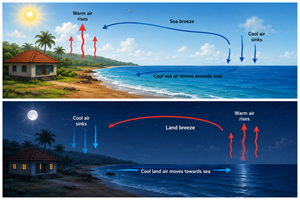
Sea Breeze and Land Breeze