

Have you ever noticed that the sand at a beach feels very hot during the day but becomes cooler at night, while the sea water does not change temperature as quickly? This happens because land and water get heated and cooled at different rates. This difference in heating and cooling causes the movement of air near coastal areas, giving rise to sea breeze during the day and land breeze at night.
Experiment
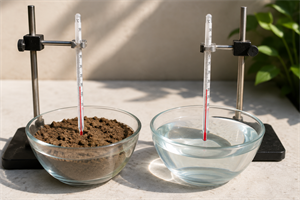
Two identical bowls are taken. One is filled halfway with soil and the other with water. A laboratory thermometer is placed in each bowl, ensuring that the thermometer bulbs are immersed without touching the bottom or sides. Both bowls are placed in sunlight. The temperatures of the soil and water are recorded every 5 minutes for 20 minutes. After heating, the bowls are brought indoors and allowed to cool for another 20 minutes.
Observation
The temperature of the soil rises faster and by a greater amount than that of the water during heating. When the setup is allowed to cool, the soil also cools faster than the water.
Conclusion
Soil heats up faster and cools down faster than water. Thus, land and water get heated and cooled at different rates.
Sea Breeze – Day:
During the day, land gets heated faster than water. The warm air above the land rises, causing cooler air from the sea to move towards the land. This movement of air is called sea breeze. It provides relief from heat in coastal areas, which is why windows of coastal houses are often placed facing the sea.
During the day, land gets heated faster than water. The warm air above the land rises, causing cooler air from the sea to move towards the land. This movement of air is called sea breeze. It provides relief from heat in coastal areas, which is why windows of coastal houses are often placed facing the sea.
Land Breeze – Night:
At night, in the absence of sunlight, land cools faster than sea water. The air above the sea remains warmer and rises. Cooler air from the land then moves towards the sea, creating a land breeze.
At night, in the absence of sunlight, land cools faster than sea water. The air above the sea remains warmer and rises. Cooler air from the land then moves towards the sea, creating a land breeze.
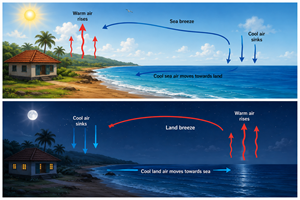
Sea Breeze and Land Breeze
Radiation:
When we sit near a fire, we feel warmth even without touching it. In this case, heat is transferred directly from the fire to us by a process called radiation. The heat from the Sun also reaches the Earth through radiation.
Radiation is the transfer of heat that does not require any medium. Unlike conduction and convection, heat can travel through empty space by radiation.
All objects radiate heat. For example, a hot utensil kept away from the flame gradually cools down because it radiates heat to its surroundings.
In everyday life, conduction, convection, and radiation often occur together during the transfer of heat.
Experiment
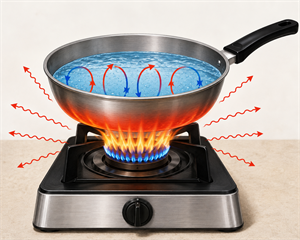
Take a metal pan containing water and place it over a flame. Observe how the pan, the water inside it, and the surrounding area become warm during heating.
Observation
The metal pan becomes hot when placed over the flame. The water inside the pan gradually gets heated. Warmth can also be felt around the flame and the hot pan even without touching them.
Inference
Different modes of heat transfer occur simultaneously during the heating of water:
- Conduction: Heat is transferred from the flame to the metal pan and through the pan by direct contact.
- Convection: The water inside the pan gets heated by the movement of water particles. Hot water rises while cooler water sinks, forming convection currents.
- Radiation: Heat from the flame and the hot pan reaches the surroundings directly without requiring any medium.
Conclusion
Heat can be transferred by three processes—conduction, convection, and radiation. In this activity, all three modes of heat transfer occur together while heating water in a pan.
In the upper Himalayan regions, a traditional room heater called a bukhari is used to keep rooms warm during winter. It consists of an iron stove in which wood or charcoal is burnt. A long chimney pipe attached to the stove carries the smoke outside. The flat top of the bukhari can also be used for cooking utensils.
The bukhari demonstrates all three modes of heat transfer. The iron stove transfers heat by conduction, warm air circulates through the room by convection, and heat from the hot stove spreads to the surroundings by radiation, helping to warm the room and cook food simultaneously.
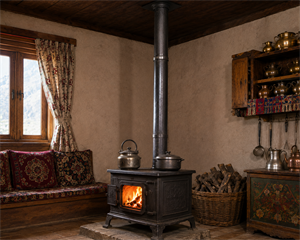
A long chimney pipe
Light-coloured clothes reflect most of the heat falling on them and absorb less heat. Therefore, they help us stay cooler and are more comfortable to wear during summer.
Dark-coloured clothes absorb more heat from their surroundings. Therefore, they help keep us warm and are more comfortable to wear during winter.
The Sun is the main source of heat for the Earth. Heat from the Sun helps in the evaporation of water. For example, wet clothes dry faster on a sunny day because the Sun's heat increases the rate of evaporation. Similarly, water from oceans, lakes, and other water bodies evaporates due to the Sun's heat. This evaporation is an important process in the water cycle.