

Water exists in three states in nature—liquid, solid, and gas. It is found as liquid water in oceans, rivers, and lakes; as solid ice, snow, and glaciers in mountains and polar regions; and as water vapour in the atmosphere.
The Sun’s heat causes water from oceans, rivers, lakes, and plants to change into water vapour through evaporation and transpiration. As the water vapour rises, it cools and condenses to form clouds. These clouds release water back to the Earth as rain, snow, or hail, a process known as precipitation.
The continuous movement of water from the Earth's surface to the atmosphere and back again is called the water cycle. Rainwater either flows into rivers, lakes, and oceans or seeps into the ground. The water cycle helps redistribute and replenish water resources and maintains the overall balance of water on Earth.
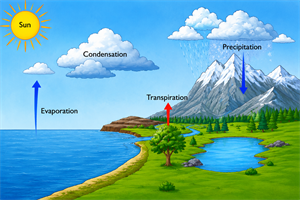
Water cycle
Aim
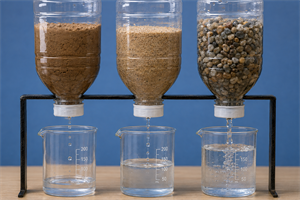
To compare the seepage of water through clay, sand, and gravel.
Procedure:
- Take three bottles with small holes in their caps.
- Fill one with clay, one with sand, and one with gravel.
- Place a beaker below each bottle.
- Pour \(200\ mL\ \)of water into each bottle.
- Observe the amount of water collected after \(10\) minutes.
Observation:
| Material | Seepage of water |
| Clay | Very slow |
| Sand | Slow |
| Gravel | Fast |
Conclusion:
Water seeps fastest through gravel, slower through sand, and slowest through clay because gravel has wider spaces between its particles.
Water seeps through the Earth's surface by a process called infiltration. It moves fastest through gravel, slower through sand, and slowest through clay because gravel has larger and better-connected spaces between its particles. The infiltrated water gets stored in the pore spaces of sediments and rocks beneath the ground as groundwater.
The underground layers of rocks and sediments that store groundwater are called aquifers. Groundwater from aquifers is obtained through wells and bore wells, and it may be located a few metres to hundreds of metres below the surface.
Groundwater is a valuable but limited resource. Excessive extraction, reduced vegetation cover, and increasing concrete surfaces have decreased groundwater recharge and caused depletion. Practices such as rainwater harvesting and recharge pits help replenish groundwater. The water cycle plays an important role in recharging aquifers and maintaining a sustainable supply of groundwater.
Ice Stupa:
An Ice Stupa is a cone-shaped artificial ice structure built in Ladakh to store water during winter. Water from mountain streams is carried through underground pipes and sprayed into the extremely cold air. The water freezes layer by layer, forming a tall ice tower. During spring and summer, when natural water sources become scarce, the ice stupa melts slowly and supplies water for irrigation and other needs. Thus, ice stupas help local communities overcome seasonal water shortages and support agriculture in cold desert regions.
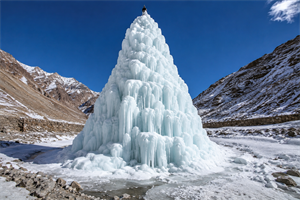
Ice stupa