

Just as metals and non-metals differ in their physical properties, they also differ in their chemical properties. A chemical property describes how a substance behaves when it reacts with another substance to form a new substance.
Effect of Air and Water on Metals
You would often have noticed that iron objects develop brown deposits when left out in open for a few days. This brown deposit is called rust.
Rusting:
The process of formation of rust on objects made of iron is called rusting.
The chemical process of rusting is as follows,
\(Iron\) \(+\) \(Oxygen\) \(+\) \(Water\) \(\to\) \(Iron\) \(oxide(rust)\)
\(Fe + O_2 + xH_2O \to Fe_2O_3.xH_2O\)
\(Iron\) \(+\) \(Oxygen\) \(+\) \(Water\) \(\to\) \(Iron\) \(oxide(rust)\)
\(Fe + O_2 + xH_2O \to Fe_2O_3.xH_2O\)
Many other metals also exhibit discolouration when kept open in the atmosphere.
i. Copper, when exposed to moist air, undergoes corrosion and forms a greenish layer called patina (copper carbonate). The green coating is primarily due to copper reacting with carbon dioxide (\(CO_2\)) and moisture (\(H_2O\)) in the air to form basic copper carbonate \(CuCO_{3}\).
ii. Silver metal reacts with hydrogen sulfide gas present in the air to form silver sulfide. As a result, silver objects appear dull and black due to the layer of silver sulfide \(Ag_{2}S\) that is created on their surface.
Corrosion:
Gradual deterioration of metal surfaces caused by air, water, or other substances is known as corrosion.
Prevention of corrosion:
- Painting, oiling, greasing, chrome plating, and anodising are all effective methods for preventing iron from rusting.
- Galvanisation is a process that coats steel and iron with a thin layer of zinc to prevent rusting. Even if the zinc coating on the galvanised item is damaged, it remains protected against rust. Because zinc is more reactive than iron, so zinc corrodes in preference to iron and protects it.
Activity:
Step 1: Take a magnesium ribbon (2 to 3 cm long) and clean it with sandpaper. This cleaning will remove the oxide layer on the magnesium ribbon, making it inactive.
Step 2: Hold the magnesium ribbon over a watch glass with tongs and burn it in the air using a burner. Using a pair of dark-coloured goggles, watch the burning magnesium ribbon.
Step 3: Take a watch glass and collect the the ashes.
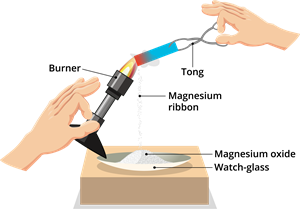
Burning of magnesium ribbon
Observation:
- We observe that the magnesium ribbon burns with a dazzling white flame.
- The magnesium ribbon is converted into a white powder (collected in the watch glass).
Result:
The white powder collected after burning the magnesium ribbon is magnesium oxide \((MgO)\).
\(2Mg + O_{2} \to 2MgO\)
\(Magnesium + Oxygen \to Magnesium \ oxide\)
Litmus test:
- Transfer the white powder to a beaker with a small amount of distilled water, then mix it thoroughly.
- Pour a few drops of the mixture into the watch glass, and place the blue and red litmus paper on it.
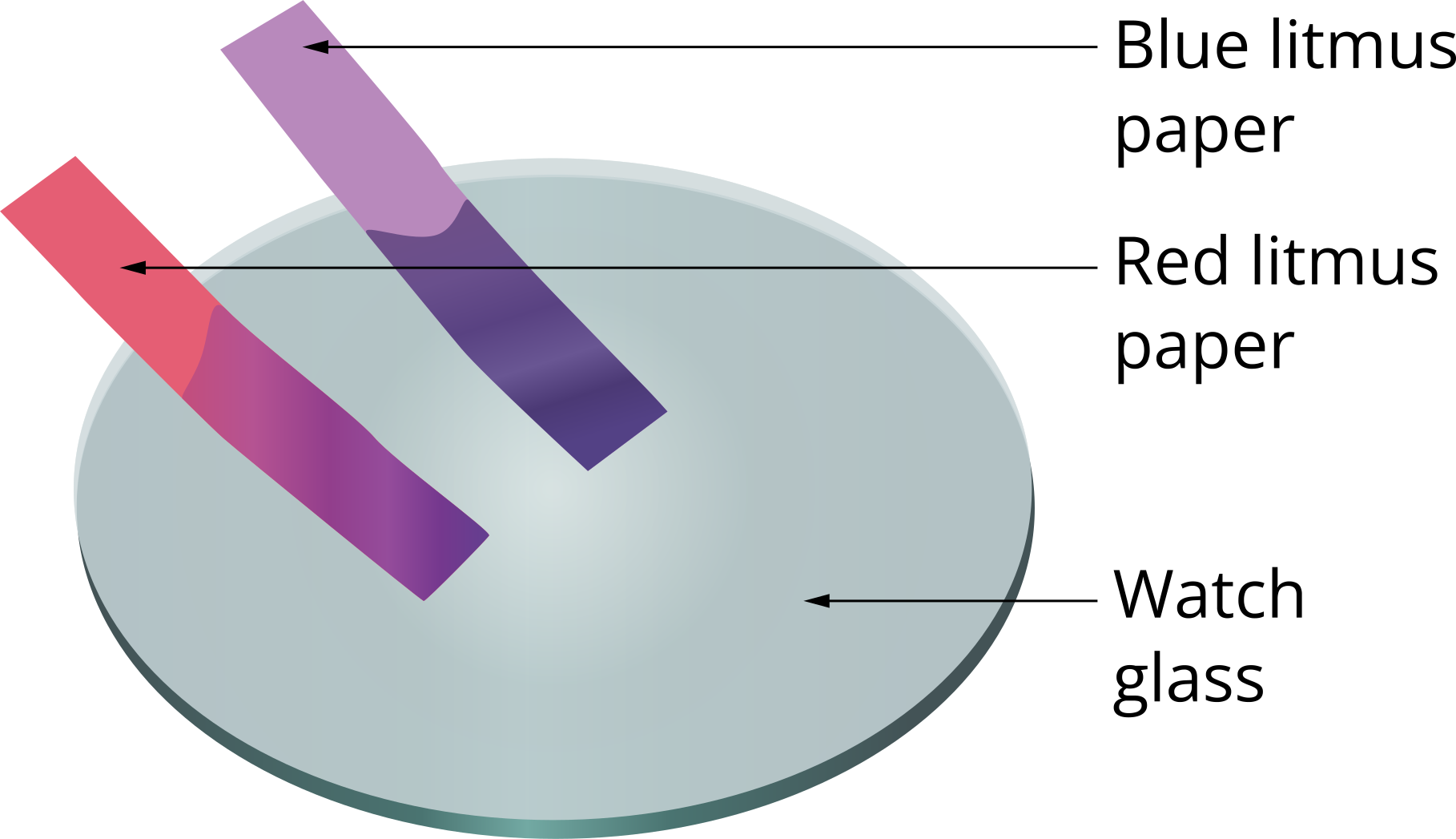
Litmus test of magnesium oxide
Among the red and blue litmus papers, the colour of red litmus paper changes to blue. The colour of blue litmus paper remains the same (no change).
The difference in the colour of red litmus paper to blue suggests that the aqueous solution of magnesium oxide is basic in nature.
\(Metal + Oxygen \to Metal \ oxide\)
Most metals react with oxygen to form metal oxides. These metal oxides are basic in nature.
Important!
Sodium is a metal which is stored in kerosene because it reacts vigorously with oxygen and water. A lot of heat is generated in the reaction. Storing sodium in kerosene prevents its exposure to moisture and air.
Effect of air and water on non-metals
Activity: To find the chemical properties of non-metals
- Take a small amount of sulphur powder on a spatula, and heat it over a burner.
- To collect the liberated gas, place an inverted test tube over the spatula.
- Carefully remove the test tube without allowing the gas to escape.
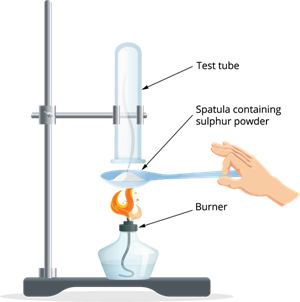
Burning sulphur powder on a spatula
Reaction:
Heating sulphur produces sulphur dioxide gas.
\(S + O_{2} \to SO_{2}\)
Litmus test:
Fill the test tube with distilled water and shake it. On dissolving sulfur dioxide gas in water, sulfurous acid is formed. On a watch glass, add a few drops of the solution and place blue and red litmus paper on it.
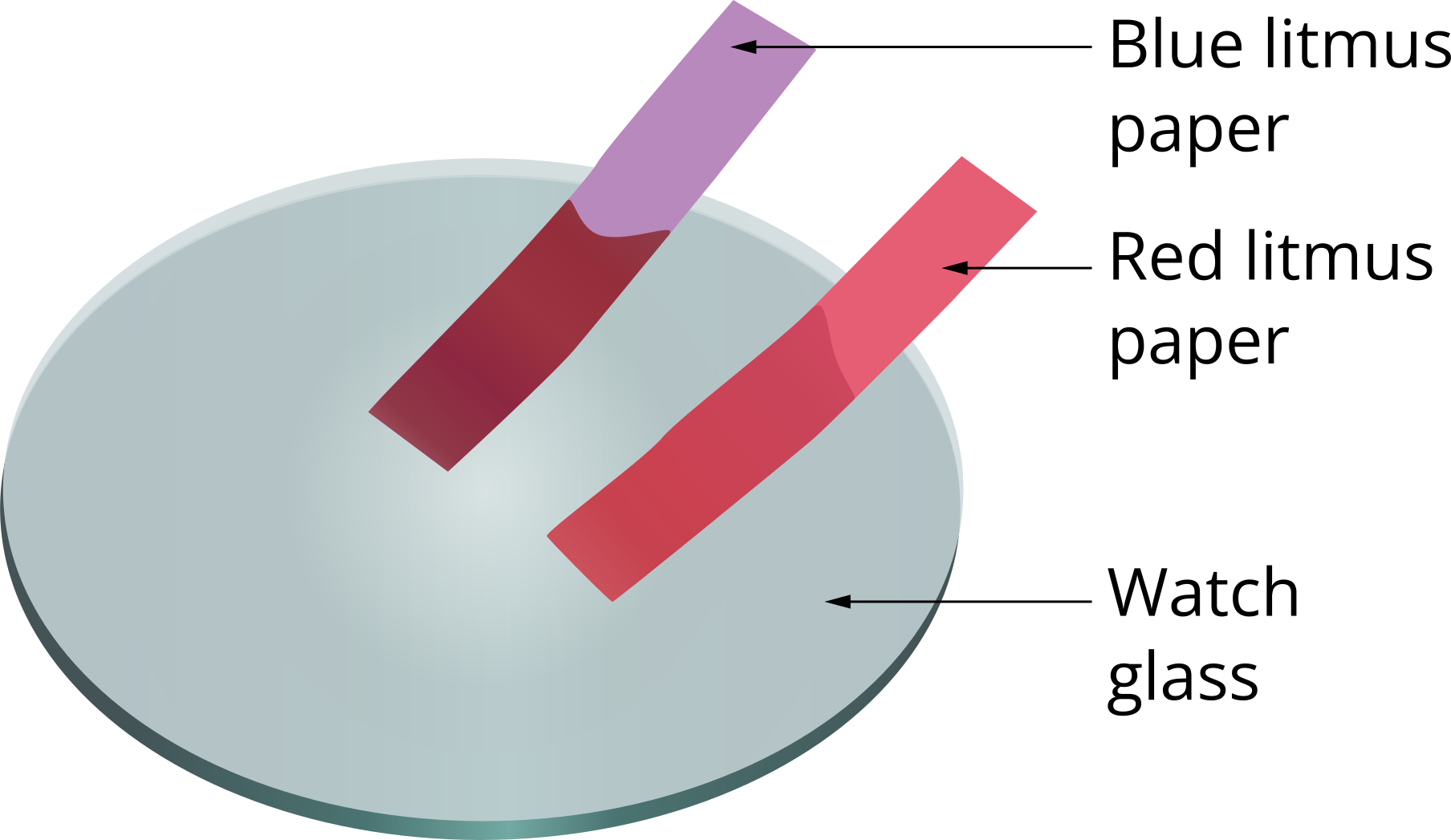
Litmus test of sulphur dioxide
Among the red and blue litmus papers, the colour of the blue litmus paper changes to red. The colour of red litmus paper remains the same (no change).
The difference in the colour of blue litmus paper to red suggests that sulphur dioxide is acidic in nature.
Non-metals react with oxygen to form non-metal oxides. Non-metal oxides are mostly acidic in nature.
\(Non-metal + Oxygen \to Non-metal \ oxide\)
Important!
Non-metals such as sulphur and phosphorus react rapidly with oxygen and readily catch fire in the air. As a result, they are stored in water to protect them and prevent accidental fires.
Importance of non-metals in everyday life:
- Oxygen is essential for respiration, and it supports combustion.
- Carbon is essential in everyday life because it is the building block of all life forms. It is a key component of proteins, fats, and carbohydrates, which are necessary for growth and energy.
- Nitrogen is used in the manufacturing of fertilisers and other chemicals. It is an essential nutrient for the growth of plants.
- Chlorine is a non-metal commonly used in water purification.
- A solution of iodine, a non-metal, is applied on wounds as an antiseptic.