

Effect of air and water on non-metals:
Activity: To find the chemical properties of non-metals
- Take a small amount of sulphur powder on a spatula, and heat it over a burner.
- To collect the liberated gas, place an inverted test tube over the spatula.
- Carefully remove the test tube without allowing the gas to escape.
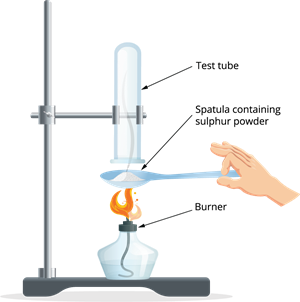
Burning sulphur powder on a spatula
Reaction:
Heating sulphur produces sulphur dioxide gas.
\(S + O_{2} \to SO_{2}\)
Litmus test:
Fill the test tube with distilled water and shake it. On dissolving sulfur dioxide gas in water, sulfurous acid is formed. On a watch glass, add a few drops of the solution and place blue and red litmus paper on it.
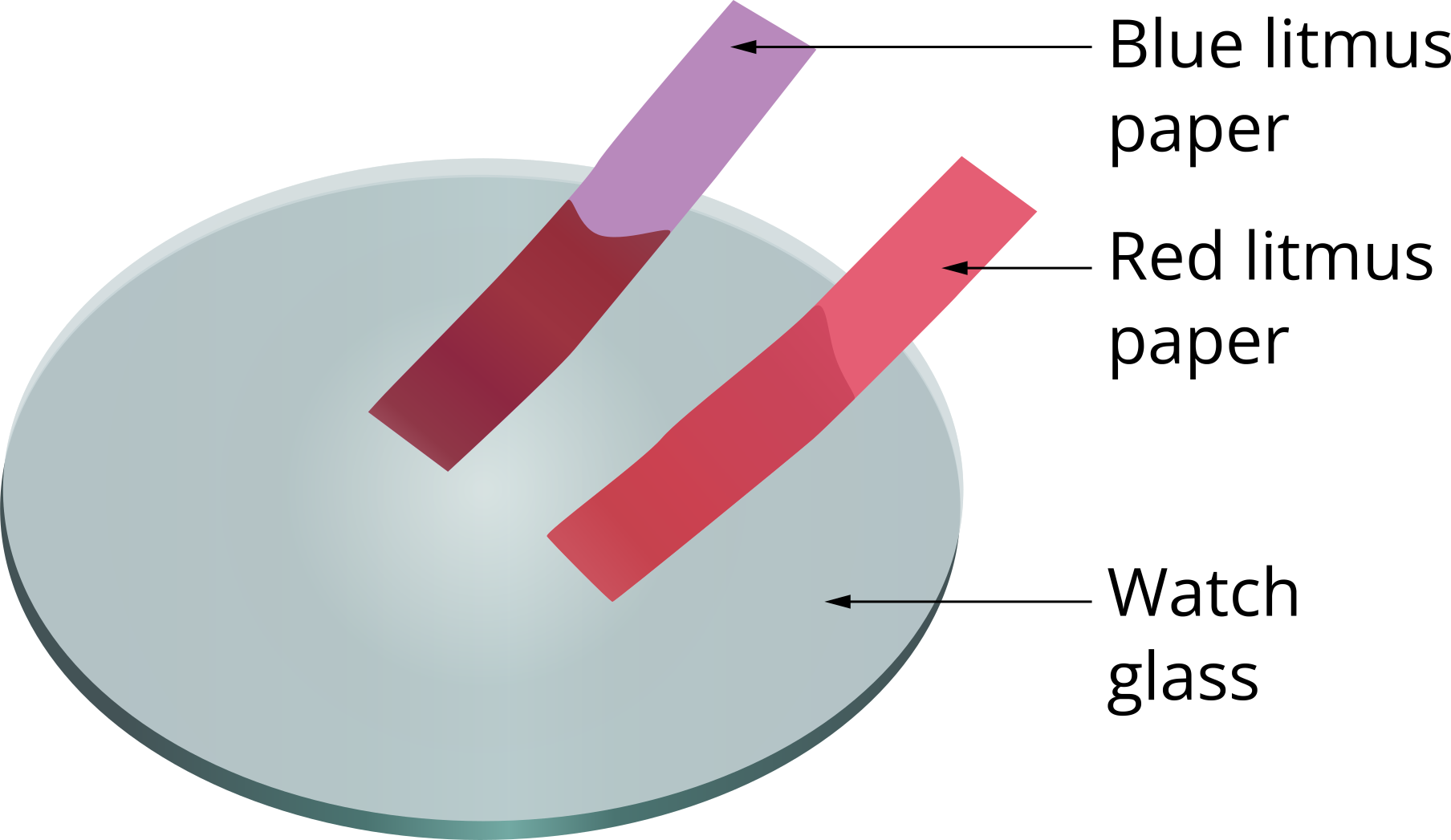
Litmus test of sulphur dioxide
Among the red and blue litmus papers, the colour of the blue litmus paper changes to red. The colour of red litmus paper remains the same (no change).
The difference in the colour of blue litmus paper to red suggests that sulphur dioxide is acidic in nature.
Non-metals react with oxygen to form non-metal oxides. Non-metal oxides are mostly acidic in nature.
\(Non-metal + Oxygen \to Non-metal \ oxide\)
Important!
Non-metals such as sulphur and phosphorus react rapidly with oxygen and readily catch fire in the air. As a result, they are stored in water to protect them and prevent accidental fires.
Importance of non-metals in everyday life:
- Oxygen is essential for respiration, and it supports combustion.
- Carbon is essential in everyday life because it is the building block of all life forms. It is a key component of proteins, fats, and carbohydrates, which are necessary for growth and energy.
- Nitrogen is used in the manufacturing of fertilisers and other chemicals. It is an essential nutrient for the growth of plants.
- Chlorine is a non-metal commonly used in water purification.
- A solution of iodine, a non-metal, is applied on wounds as an antiseptic.