

Electricity has become an inevitable part of our lives; it is often defined as the flow of electrons. But only certain materials would allow the electricity to flow through them.
The ability of a material to allow an electric current to pass through it is known as electrical conductivity.
Based on this property, we can classify materials as
- Good conductors
- Poor conductors
We could understand the difference with an activity,
Activity:
1. Make a circuit by using a battery, bulb and copper wires, as shown below.
2. Place a copper coin between the two free ends of the wire in the circuit, as shown below.
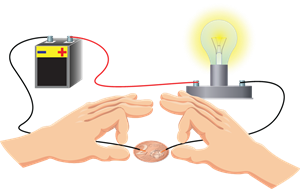
Electrical circuit
The bulb is glowing because metal (copper) is good conductor of electricity.
Good conductors of electricity:
Metals contain free electrons, making them good conductors of electricity. These free electrons move easily through the metal, allowing it to conduct an electric current.
Example:
Gold(Au), Copper(Cu), Aluminium(Al), Silver(Ag) etc.
But if we repeat the activity by replacing the copper coin with a rubber, the bulb would not glow. This is because the material is rubber, which doesn’t have free electrons and so doesn’t allow electricity to pass through.
Poor conductors of Electricity:
Materials that do not allow electricity to pass through them are called poor conductors or insulators of electricity.
When the metal coin in the circuit is replaced by a non-metal, the bulb does not glow. Non-metals are poor conductors of electricity.
Example:
Oxygen(O), Sulphur(S), Nitrogen(N),Carbon(C) etc.
Important!
Graphite (an allotrope of carbon) conducts electricity because it has free electrons that allow current to pass through it.
You may note that the wires in our houses are coloured; the insulation is a rubber-like material called polyvinyl chloride.

PVC
PVC is used to coat electric wires and cables to prevent electric shock since it is an insulator and a poor conductor of electricity.
Applications of materials that conduct electricity:
- Copper is used in household electrical wiring and electrical circuits.
- Aluminium is used in power line wiring.
- Copper, aluminium, and iron are used in the manufacturing of electrical appliances, including heaters, kettles, electric stoves, and fans.
- Gold and silver are used in circuit boards and microchips.
| Good conductors | Poor conductors |
| Materials that allow electricity to pass through them are called Good conductors of electricity. | Materials that do not allow electricity to pass through them are called Poor conductors or insulators of electricity. |
| Metals contain free electrons, making them good conductors of electricity. These free electrons move easily through the metal, allowing it to conduct an electric current. |
Non-metals lack free electrons, making them poor conductors of electricity.
|
| Examples: Gold(Au), Copper(Cu), Aluminium(Al), Silver(Ag) etc. | Examples: Oxygen(O), Sulphur(S), Nitrogen(N),Carbon(C) etc. |