

In the previous lesson, we classified metals and non-metals based on their appearance and hardness. We learned that metals are generally shiny and hard, while non-metals are usually dull and softer. Let us now explore some more physical properties of metals and non-metals, such as malleability and ductility, and understand how these properties make them useful in our daily lives.
Have you ever wondered how electricity reaches your home?
Electricity travels through long wires connected to power stations, electric poles, and our homes. These wires are often made of metals such as copper and aluminium. But how can metals be made into such long and thin wires without breaking?
The answer lies in a special property of metals called ductility.
Ductility:
The property of materials that allows them to be pulled into thin wires is called ductility.
i. Most of the metals are ductile, and they can be drawn into thin wires. Gold is the most ductile metal. One gram of gold may produce a wire with a length of around \(2\) kilometres.
Metals can be moulded into various shapes according to our needs due to their malleability and ductility.
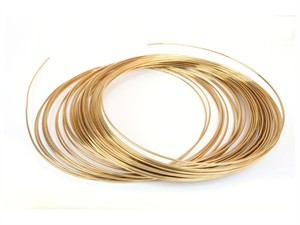
Thin wire of metal
ii. Non-metals are non-ductile. As they are brittle, they cannot be drawn into thin wires.
Importance of ductility: The ductile nature of metals promotes for a wide range of applications,
- Copper is used in electrical wiring.
- Gold and silver can be used for making jewellery.
- Cables for electronics and constructions.
- Aluminium wires used in power cables.
Malleability:
Malleability refers to the ability of materials to be hammered or shaped permanently without breaking or cracking, allowing it to be beaten into thin sheets.
Activity: To Differentiate Between Malleable and Brittle Materials
Materials required:
- Hammer
- Iron material
- Charcoal
- Sulphur
- Copper
- Piece of aluminium
Instruction:
Place an iron material on a hard surface and beat it with a hammer. Repeat the same process for other materials. Observe the changes.
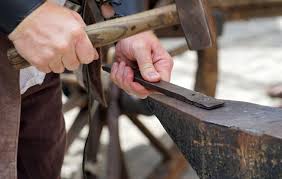
Hammering of an iron object
Observation:
You might have observed that certain materials exhibit different behaviour when hammered,
- Iron, copper, and aluminium can be flattened easily on hammering.
- In contrast, sulphur and charcoal do not flatten, instead they break into pieces, because they are brittle.
From this activity, we can infer that most metals are malleable, whereas most non-metals are non-malleable (brittle)
Metals Around Us and their uses:
| Object | Metal Used | Property Utilised | Use |
|---|---|---|---|
| Electrical wire | Copper | Ductility | Carrying electricity in homes and appliances |
| Aluminium foil | Aluminium | Malleability | Wrapping and storing food |
| Hammer | Iron | Hardness | Hitting, shaping, or breaking objects |
| Cooking vessel | Steel | Strength and durability | Cooking food safely and efficiently |
| Jewellery | Gold | Lustre and malleability |
Making attractive ornaments and decorative items
|
The properties of metals, such as lustre, hardness, malleability, and ductility, make them suitable for a variety of uses in our daily lives. This is why different metals are selected for different purposes.