

In the previous lesson, we learned about the properties of metals and non-metals such as lustre, hardness, malleability, and ductility. Let us now explore two more important properties - sonority and conductivity of heat and understand how they help us in our daily lives.
Have you ever wondered?
When a school bell rings, why does it produce a clear, loud sound? Why does a metal spoon make a ringing sound when tapped against a steel tumbler, while a piece of wood does not?
This is due to a special property called sonority.
Sonority:
The ability of a material to produce a loud sound or ringing sound when struck over is called sonority.
Activity: To determine the sonority of materials
Materials required:
- Hammer
- Steel plate
- Aluminium utensil
- Wooden block
- Rubber
Instructions:
Take a hammer and gently strike the steel plate, observing the sound produced. Repeat the same for materials such as aluminium utensil, wooden block, and rubber.
Observation:
A steel plate and an aluminium utensil produce a clear ringing sound, while a wooden block and a rubber produce a dull sound.
Conclusion:
i. Metals are sonorous because they vibrate uniformly when struck, producing a ringing sound. When stuck over hard surface, vibration travels through the metal and produces a clear sound.
ii. Non-metals are non-sonorous because they do not vibrate uniformly when struck on a hard surface, and they do not resonate. So, non-metals cannot produce a loud, ringing sound.
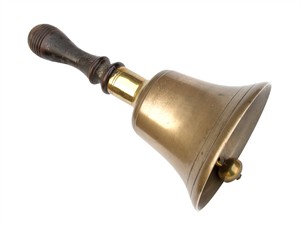
Metal bell
Application of sonority in daily life:
Metals are used widely because they are sonorous, durable and can be moulded to desired shapes - also, their ability to produce a resonant sound.
The practical applications of sonorous property in daily life and in industries are,
i. Musical instruments such as bells, drums, strings, and guitars.
ii. Bells, wind chains, electrical buzzers.
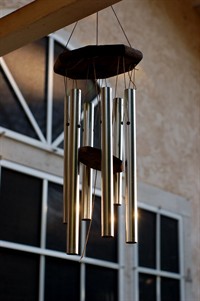
Wind chain
On a hot summer day, you and your friend are heading to a park, to a place, and to spend some time. After a joyful round of play, you all decide to find a spot where you can relax. You all noticed two benches unoccupied in the park.
One is a metal bench and the other is a wooden bench. You all decided to sit on a metal bench because it was attractive. While sitting on it, all felt that it was very hot.

A metal bench
Then, everyone decided to change the spot and sat on a wooden bench; it did not feel very hot. What could be the reason for the metal bench to be hot?
It is a special property of metals known as the conductivity of heat.

A wooden bench
Heat conductivity:
Conductivity is the ability of a material to conduct heat or electricity.
i. Metals are good conductors of heat.
Activity: To find out if metals are good conductors of heat
- Take a wire made of aluminium or copper.
- Clamp this wire on a stand. Using wax, attach a pin to the free end of the wire.
- Heat the wire near the clamping point with a spirit lamp, candle or burner.
- What do you notice when some time has passed?
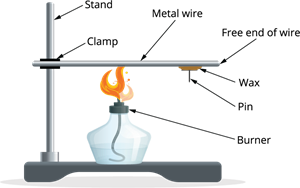
Heating a metal wire
Answer: The heat travels through the metal wire, melts the wax, and the pin falls down. This shows that metals are good conductors of heat.
Silver and copper are the best conductors of heat, while lead and mercury are relatively poor conductors of heat.
ii. Non-metals are poor conductors of heat; they do not transfer heat from one end to the other. Non-metals generally transfer heat poorly because they lack free electrons. Non-metals act as an insulator. But graphite conducts heat.
Activity: Heat transfer in materials
Instructions:
- Place a glass tumbler and fill it with hot water.
- Into the glass tumbler, immerse a metal spoon and a wooden spoon of the same length, and leave them for a few minutes.
- Later, carefully touch the upper end of each spoon.
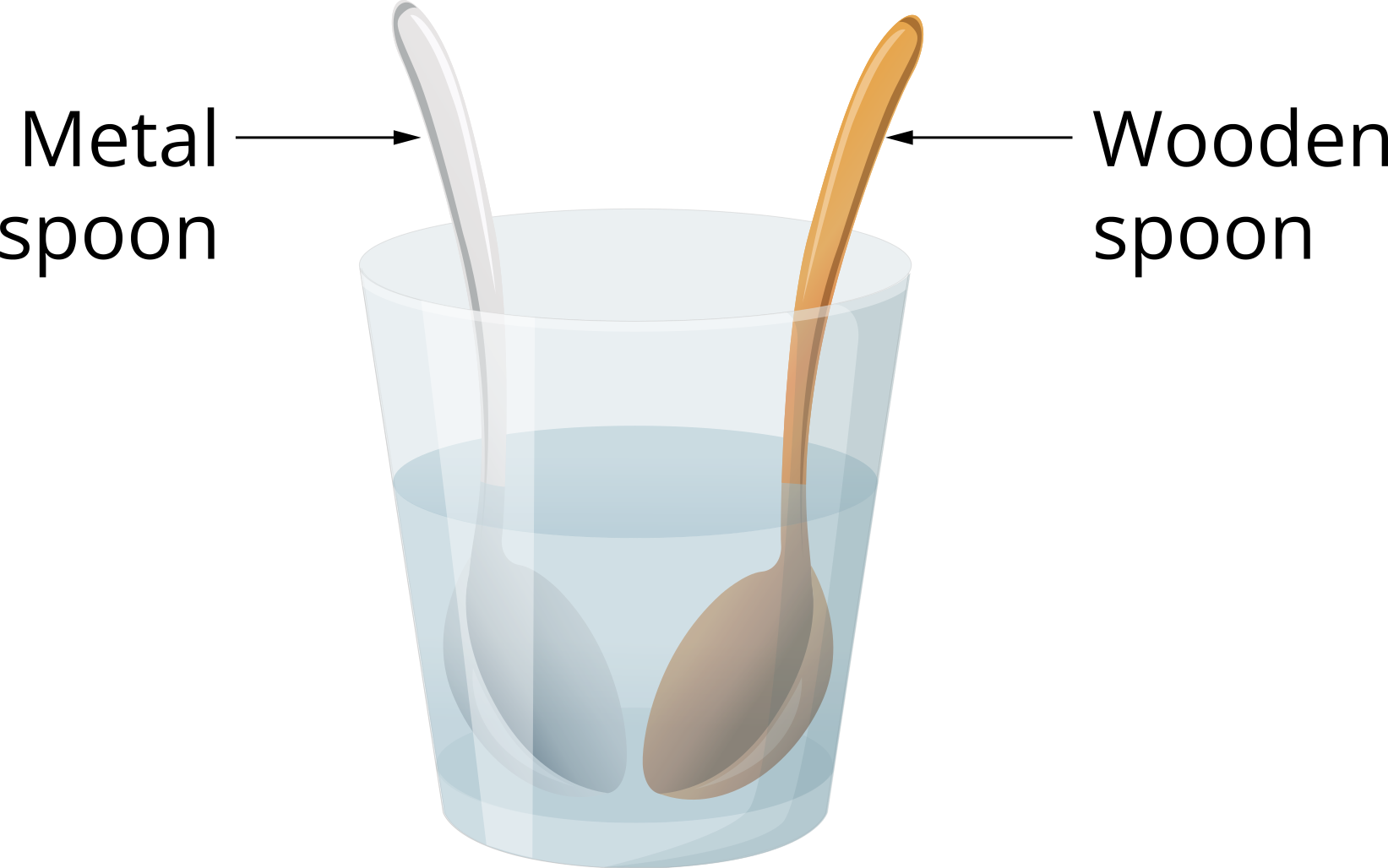
Metal and wooden spoons immersed in water
Observation:
Even though both the metal and wooden spoons are placed in water of the same temperature and at the same time, the metal spoon feels hotter to the touch. This is because metal is a good conductor of heat, which allows it to transfer heat quickly. In contrast, wood has poor heat transfer properties, making it feel less hot.
As a result, most metals are considered good conductors of heat, while non-metals are poor conductors.
Applications of materials conducting heat:
- Copper, aluminium, iron, and stainless steel are used in the manufacturing of cooking utensils including pans, kettles, cookers, and pots.
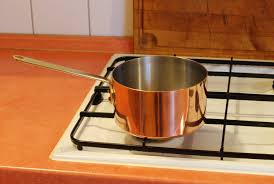
Cooking utensil
- Aluminium, being a lightweight material, conducts heat quickly and evenly. It is cheaper than copper. Hence, it is widely used in the manufacturing of cooking utensils.
- Copper, steel, and aluminium are used in making heaters and electronic irons as they distribute heat quickly.
Have you noticed that the handles of cooking vessels, frying pans, and pressure cookers are often made of wood or plastic?
Wood and plastic are poor conductors of heat. They do not allow heat to pass through them easily. Therefore, even when the metal vessel becomes hot during cooking, the handle remains relatively cool and can be held safely. Therefore, wood and plastic are used as handles because they act as insulators and help prevent burns.
Reference:
https://1.bp.blogspot.com/-kpCdiNTyXf4/WMbnYWVLboI/AAAAAAAARQk/ih7_pQFGR-ckJDjRtkXVyVlbSx6Pv0jwgCLcB/s1600/CONDUCTINGINSULATINGWIRE.png
https://www.flickr.com/photos/daveparker/4984482207
https://pxhere.com/en/photo/1627149
https://www.flickr.com/photos/ell-r-brown/4153212203