

On a hot, sweltering summer day, you have decided to pull out a dark chocolate from the refrigerator. As you leave it outside, it starts to transform. The chocolate softens and melts because of the heat in the surroundings.
Now, imagine an ice cube placed on a plate. At first, it is cold and solid and placed on a plate. It begins to lose its form, slowly turning into a small pool of water.
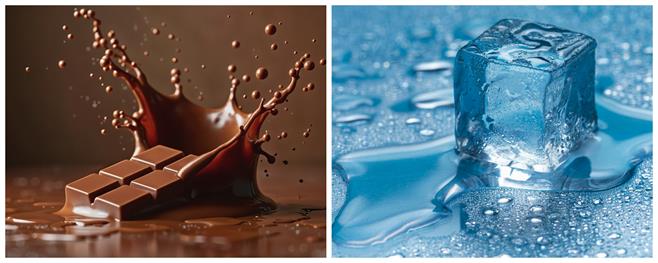
Physical change - Melting of dark chocolate and an ice cube with water drops, and the ice is melting
If you take the melted chocolate or the water fromed from the ice cube and place it back to the freezer, it returns to its original solid state. This fascinating transformation is a perfect example of a physical change, as no new substance is formed and the change can be reversed.
On the other hand, if you burn a piece of paper, is it possible to get it back? No! This is a chemical change. It is a irreversible change, resulting in the formation of a new substance.
In this chapter, we will explore the physical and chemical changes that occur around us in our everyday life.
Change is a process in which a substance becomes a different one from what it was earlier. It is the difference between the initial and the final state of any substance.
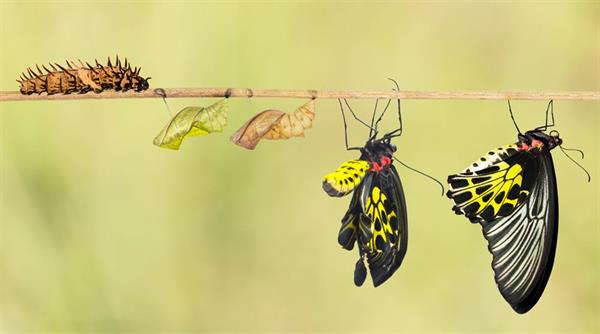
Life cycle of a butterfly - Combination of both physical and chemical changes
Physical change:
With the help of a woollen yarn, we can knit a sweater. In this scenario, the sweater can be unknitted to get back the yarn, showing that the change can be reversed.
A substance that changes only in its physical properties, such as size, shape, colour, or state, is known as a physical change.
Here, no new substance is formed. These changes are reversible; they can be brought back to their original form in nature.
Example:
i. Tearing a sheet of aluminium foil - Change in size.
ii. Melting an ice cube - Change in the state.
ii. Melting an ice cube - Change in the state.
Let us create and learn:
i. A paper plane is made by folding a sheet of paper. When unfolded, it comes to its original shape as before.
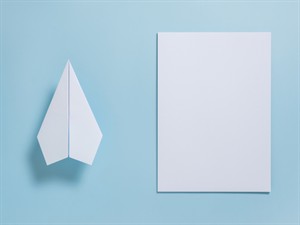
Making a paper plane
ii. When a balloon is inflated, it does not burst. As air is blown into the balloon, its shape and size change. When the air is released from the balloon, it returns to its original shape and size.
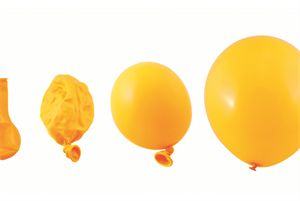
Inflated and deflated balloon
Primary aspects:
- A physical reaction does not produce any new substances.
- Although usually reversible in many aspects, it may be a slow process or even irreversible, like breaking a glass object or cutting paper into pieces.
- The changes generally occur only in the physical properties, such as size, shape, colour and state. The changes are involved in the form, not in the substance identity.
Chemical change:
Green leaves can change to brown, crimson, or yellow in the autumn season. It's not merely drying up, it's a chemical change! A substance completely changes into something new. Chemical change alters something, preventing its return to the original form.
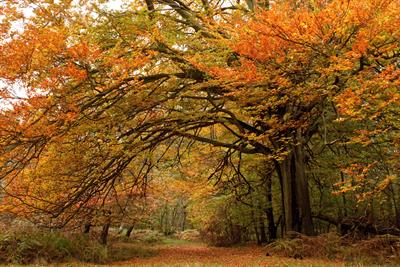
Transformation of leaf colours in the autumn season
Any substance that changes its chemical properties is known as chemical change. In this change, a new substance is formed, and these changes are irreversible (i.e. they cannot be brought back to their original form) in nature. These changes are permanent.
Example:
i. Bursting of firecrackers
ii. Rusting of iron
iii. Burning of a matchstic
ii. Rusting of iron
iii. Burning of a matchstic
i. Burning of a matchstick: When the matchstick is burned, it turns into ashes when it undergoes complete combustion. The ashes have an entirely new chemical composition from that of the unburnt matchstick.
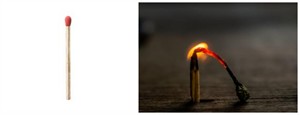
Burining a matchstick
Activity: To demonstrate a chemical change
Materials required:
- Glass tumblers
- Distilled water
- Lime water
- Straw
Instructions:
Step 1: Take two glass tumblers and label them as \(X\) and \(Y\). In the glass tumbler \(X\), fill with water and in \(Y\) fill with lime water.
Step 2: Use a separate straw for both the glass tumbler and blow air through the straw, and observe the changes.
Observation:
- Glass tumbler \(X\) - Due to the blowing of air, only bubbles arise in water, but there is no change in the appearance or colour of the water.
- Glass tumbler \(Y\) - Blowing air into the lime water, along with the bubbles, turns the lime water milky, which appears to be white.
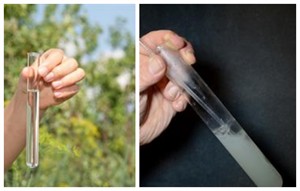
Lime water turns milky
Result:
In glass tumbler \(X\), there is no change. Whereas, in the glass tumbler \(Y\), when blowing air, the carbon dioxide gas passes into the lime water, it turns milky due to the formation of a new product, calcium carbonate.
The reaction can be given as,
Calcium hydroxide \(+\) Carbon dioxide \(\to\) Calcium carbonate \(+\) Water
The new substance is formed; it is a chemical change.
Primary aspects:
- A chemical reaction results in the formation of a new substance.
- Chemical changes are irreversible.
- There are several indicators of a chemical change, including a change in chemical properties, a colour change, the evolution of gas, and the absorption or release of heat or light during the reaction.
ii. Rusting:
The usage of iron and steel articles has become an integral part of our daily life. People use iron for a wide range of daily life items, making bridges, ships, cars, truck bodies, grills in windows and many other articles.
Chemical reactions on the surface of shining metals and other items cause these articles to lose their shine. When exposed to atmospheric air, silver articles turn black.
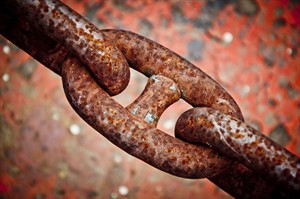
Rusted iron chain
Iron material loses its shine and turns into a red-brown flaky substance when exposed to air and moisture in the atmosphere for an extended period, a process known as rusting. It is a natural process that is irreversible, resulting in the formation of a new substance.
The chemical process of rusting is as follows,
\(Iron\) \(+\) \(Oxygen\) \(+\) \(Water\) \(\to\) \(Iron\) \(oxide(rust)\)
\(Fe + O_2 + H_2O \to Fe_2O_3\)
Rusting occurs more rapidly in environments with high humidity (i.e., a high moisture content in the atmosphere) and a high salt content in the water.
iii. Combustion:
Combustion is commonly known as burning. When a substance burns, it turns into ashes. The ashes have an entirely new chemical composition from that of the unburnt substances. It is an exothermic reaction.
The chemical process in which substances burn in the presence of air (oxygen) to release energy in the form of heat and light is called combustion.
Example:
Burning of a candle wick, paper, matchstick, fireworks, etc., are some of the common chemical changes that we see around us.
Burning of wood
Any substance that burns requires three essential elements: oxygen, heat, and fuel. Combustion is an exothermic process, which generally occurs with the release of heat to the surroundings as a product of the reaction.
1. Air: Oxygen is the essential element for any substance to burn. Oxygen is also called the supporter.
Activity: Oxygen is the supporter for combustion
For instance, light two candles inside a glass container. Cover one glass container with the lighted candle and leave the other uncovered.
Observation:
What happens to the flame of the burning candle in a closed container?
The burning wick of the candle inside the closed container turns off after a minute, while the other in the open container continues to burn. It turns off due to the absence of oxygen in a closed container, which stops the combustion process.
Burning a candle inside an open and a closed container
Result:
The main element of air that supports combustion is oxygen. Once there is no supply of oxygen, burning will not occur.
2. Fuel or Combustible substance: The substances that can catch fire in the presence of air are known as combustible substances. They can be solid, liquid or gases and must be flammable substances in nature, such as paper, wood, petrol, diesel, LPG, and CNG.
3. Heat: The lowest temperature at which a material catches fire is known as the ignition temperature. For example, let us compare wood and paper. Wood has a higher ignition level than paper. So when we burn both these at the same time, paper catches fire quickly than wood.
In the absence of any one element, burning will not occur. It requires three essential components: air, oxygen, and fuel, and this is known as the fire triangle. The final product of any combustible substance on complete burning produces ashes, carbon dioxide, water, water vapour, and smoke.