

Every day we see the sky change from bright day to dark night, but have you ever wondered why this happens? The Sun does not move around us. It is the Earth that keeps spinning like a top. When our part of the Earth faces the Sun, it is day, and when it turns away, it becomes night.
Activity:
To understand Earth’s rotation and day–night cycle using a globe
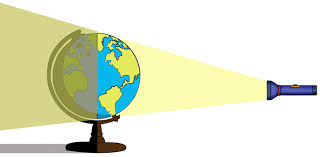
Shining torch on one side of the globe
Step 1: Place a sticker on the globe to mark your location.
Step 2: View the globe from above the North Pole and slowly rotate it anti-clockwise.
Step 3: Take a torch in a dark room and shine it on the globe from about 1.5 metres away.
Step 4: Observe that one half of the globe receives light (day) and the other half remains dark (night).
Step 5: Rotate the globe from West to East and watch how your sticker moves into light (sunrise) and then into darkness again (sunset).
Observation:
When the globe is rotated anti-clockwise (West to East), the sticker marking your location moves into the illuminated half of the globe, showing sunrise. As the globe continues to rotate, the sticker moves fully into light (day), and later exits into darkness again (sunset and night). Only half of the globe receives light from the torch at any time, and the eastern part of India receives light first when the globe rotates from West to East.
Conclusion:
- This combined activity clearly shows that the Earth rotates on its axis from West to East, and this rotation causes the cycle of day and night.
- Any location on Earth experiences sunrise when it moves from darkness into sunlight, and sunset when it moves out of sunlight into darkness.
- The direction of rotation also explains why sunrise occurs first in the eastern regions of India and the world.
Have you ever wondered why the Sun rises first in the eastern part of India?
When we rotate a globe and shine light on it like sunlight, we notice that the eastern side of India enters the light before the western side. This happens because the Earth rotates from West to East. As the Earth spins in this direction, the eastern regions face the Sun earlier, so they experience sunrise before the rest of the country. This simple observation on a globe helps us understand why different places see sunrise at different times and why the eastern part of India brightens first every morning.
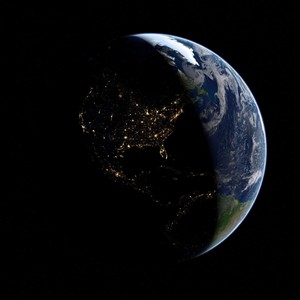
Sunrise on Eastern side of the Earth
Earth's rotation:
Earth’s rotation is the turning of the Earth on its axis from West to East. During this rotation, every location on the Earth moves in a circular path and returns to its starting position after one complete turn. This continuous spinning explains why we experience regular changes such as sunrise, noon, and sunset as the Earth keeps rotating.
Cause of day and night:
- Day and night occur because only one half of the Earth faces the Sun at a time. As the Earth rotates from West to East, different places move into sunlight, creating daytime, and then move into darkness, creating nighttime.
- This rotation also explains why the eastern parts of the Earth receive sunlight first and see the sunrise earlier than other regions.
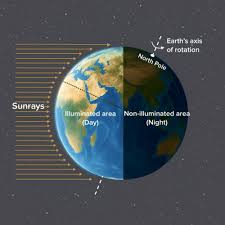
Sunlight falling on one half of the Earth
Important!
If you imagine yourself standing on the Equator, you would see the Sun appear in the East in the morning, rise higher by noon, and move toward the West in the evening before disappearing, making the stars visible in the night sky. This apparent movement of the Sun across the sky is a result of Earth’s rotation.
Let us perform an activity to understand this.
Activity:
To observe the apparent movement of the Big Dipper
Step 1: On an early evening between March and May, go outside and locate the Big Dipper (Saptarishi) and the Pole Star (Dhruva Tara), if visible.
Step 2: Note down your location and the date of observation.
Step 3: Draw the position of the Big Dipper in the sky with respect to the Pole Star, or with respect to a fixed object like a tree/building if the Pole Star is not visible.
Step 4: Write the time below your sketch.After two hours, observe the Big Dipper again.
Step 5: Draw its new position and note the time.After another two hours, repeat the observation and make the third sketch.
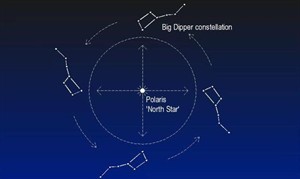
Big Dipper and Pole Star
Observation:
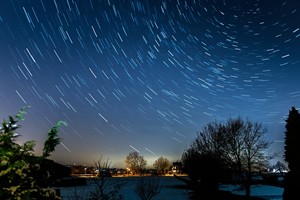
With each sketch, the Big Dipper appears to have shifted its position in the sky. It seems to move slowly around the Pole Star, even though the Pole Star itself appears almost fixed. The Big Dipper’s orientation changes over time, showing a circular pattern of movement.
Conclusion:
The activity shows that the apparent movement of the stars is caused by the rotation of the Earth from West to East. Because the Earth’s axis points close to the Pole Star, the Pole Star remains nearly stationary, while other stars like those in the Big Dipper seem to move around it in the night sky.
Astrophotographers capture long-exposure photographs by keeping the camera’s shutter open for an extended time. This allows the apparent movement of the stars to be recorded as curved arcs in the sky, which are called star trails.
Star trails