

A few weeks later, Juno was gazing at the full Moon when he noticed it looked slightly dark in one part. Curious, he asked his mother, “Why does the Moon look like this tonight?”
His mother smiled and said, “That’s a lunar eclipse. This happens when the Earth comes between the Sun and the Moon, and our planet’s shadow falls on the Moon.”
Lunar eclipse:
A lunar eclipse is an event that occurs when the Earth comes between the Sun and the Moon, blocking sunlight from reaching the Moon.
During this event, we can observe the Earth’s shadow falling on the Moon.
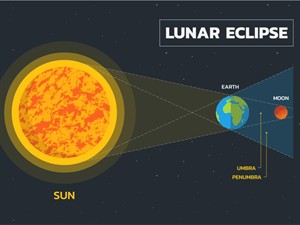
Lunar eclipse
Total lunar eclipse:
A total lunar eclipse occurs when the Earth passes directly between the Sun and the Moon, causing the Earth to cast its full shadow (the umbra) across the entire lunar surface.
During this alignement, the Moon often appears reddish, know as a "Blood Moon", due to sunlight refracting through the Earth's atmosphere.
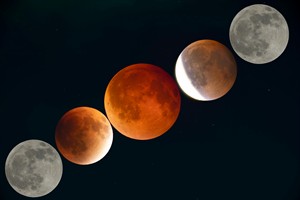
Total lunar eclipse
Partial lunar eclipse:
A partial lunar eclipse occurs when only part of the Moon passes into the Earth’s shadow, so only a portion of the Moon is covered, while the rest remains illuminated.
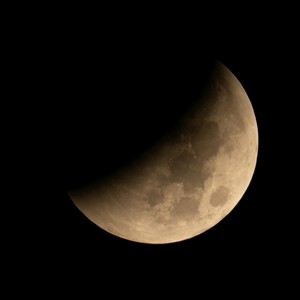
Partial lunar eclipse
Unlike solar eclipses, a lunar eclipse can be safely observed with the naked eye without any protective eyewear.
Activity: To demonstrate how a lunar eclipse occurs and understand the difference between total and partial lunar eclipses.
Step 1: Place a torch at one end of a table or room to represent the Sun.
Step 2: Hold a large ball to represent the Earth in the middle.
Step 3: Move a smaller ball (to represent the Moon) slowly around the Earth.
Step 4: Observe when the Earth’s shadow falls on the Moon.
Step 5: Identify total and partial lunar eclipses.
Observation:
- The Moon is partially or fully covered by the Earth’s shadow depending on its position.
- If the whole Moon is in shadow, it represents a total lunar eclipse.
- If only part of the Moon is covered, it represents a partial lunar eclipse.
Result:
A lunar eclipse occurs when the Earth comes between the Sun and the Moon, causing the Moon to fall in the Earth’s shadow.
About lunar eclipses:
- Lunar eclipses occur \(2\ \)to \(5\ \)times a year, but total eclipses are less frequent.
- A lunar eclipse can be seen from anywhere on the night side of Earth.
- The term “Blood Moon” is often used to describe a total lunar eclipse because of the reddish appearance of the Moon.
- Ancient civilizations used lunar eclipses for astronomical observations and sometimes for predicting events.
Why are lunar eclipses important?
- Lunar eclipses help scientists study the Earth’s atmosphere, because the red light on the Moon shows how sunlight bends through it.
- They also help in understanding the orbits of the Moon and Earth, and improve predictions of future eclipses.
Kodaikanal Solar Observatory:
The Kodaikanal Solar Observatory is situated in the scenic Palani hills of southern India. Established in \(1899\), it has been collecting valuable information about the Sun for more than a century. The observatory is managed by the Indian Institute of Astrophysics (IIA), Bengaluru.
M.K. Vainu Bappu: Father of Modern Indian Astronomy
M.K. Vainu Bappu is regarded as the father of modern Indian astronomy. He played a key role in establishing several telescopes and instruments across India, including those at Manora Peak near Nainital (Uttarakhand) and Kavalur (Tamil Nadu). The Kavalur observatory has been named in his honor. Bappu primarily studied stars and even discovered a comet. He also traveled to various parts of the world to observe solar eclipses.