

The Earth is constantly in motion, and these movements are responsible for many natural phenomena that we observe every day and throughout the year. Its two main motions; rotation and revolution. These explain the occurrence of day and night, the apparent movement of the Sun and stars, and the changing patterns of constellations in the night sky.
Rotation of the Earth:
Rotation is the spinning of the Earth around its own axis, similar to how a top, a fan, or a ball spins in place.
Direction of Earth’s rotation:
The Earth rotates from West to East. When viewed from above the North Pole, this rotation appears anti-clockwise. Because of this direction of spin, different parts of the Earth face the Sun at different times, causing the cycle of daytime and nighttime.
Effect of Earth’s rotation:
The Earth’s rotation from West to East causes day and night and creates the apparent motion of the Sun, the Moon, and the stars across the sky. These heavenly bodies seem to rise in the East and set in the West, not because they are moving around us, but because the Earth is constantly turning on its axis.
Axis of rotation:
Rotation is the movement of an object in which every part of the object moves in a circular path around an imaginary straight line that runs through it. This imaginary line is called the axis of rotation, and it acts as the pivot around which the object spins.
Have you ever wondered why the Sun rises first in the eastern part of India?
When we rotate a globe and shine light on it like sunlight, we notice that the eastern side of India enters the light before the western side. This happens because the Earth rotates from West to East. As the Earth spins in this direction, the eastern regions face the Sun earlier, so they experience sunrise before the rest of the country. This simple observation on a globe helps us understand why different places see sunrise at different times and why the eastern part of India brightens first every morning.
Earth's rotation:
Earth’s rotation is the turning of the Earth on its axis from West to East. During this rotation, every location on the Earth moves in a circular path and returns to its starting position after one complete turn. This continuous spinning explains why we experience regular changes such as sunrise, noon, and sunset as the Earth keeps rotating.
Cause of day and night:
- Day and night occur because only one half of the Earth faces the Sun at a time. As the Earth rotates from West to East, different places move into sunlight, creating daytime, and then move into darkness, creating nighttime.
- This rotation also explains why the eastern parts of the Earth receive sunlight first and see the sunrise earlier than other regions.
Important!
If you imagine yourself standing on the Equator, you would see the Sun appear in the East in the morning, rise higher by noon, and move toward the West in the evening before disappearing, making the stars visible in the night sky. This apparent movement of the Sun across the sky is a result of Earth’s rotation.
Revolution of the Earth:
Revolution of the Earth is the movement of the Earth around the Sun along a fixed path called its orbit.
Orbit of the Earth:
The path that Earth follows while revolving around the Sun is called its orbit. When viewed from above, this orbit looks almost circular.
The Earth takes about 365 days and 6 hours to complete one full revolution around the Sun.
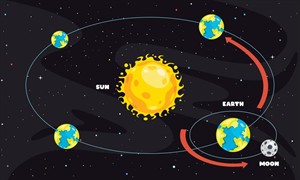
Rotation and revolution of the Earth
How the night sky changes throughout the year:
- Each evening, after the Sun sets in the west, the night sky becomes visible because of Earth's rotation.
- But over months, we notice a different change. Because the Earth is also moving around the Sun, the set of stars visible just after sunset slowly shifts throughout the year.
- Different stars rise at sunset in different months.
- Patterns of stars (constellations) that were visible in one season may not be visible in another.
- By observing the sky at the same time every night but over different months, you can clearly notice this shifting star pattern.
- This change occurs because as the Earth moves along its orbit, we face different parts of the sky at night.