

A few weeks after learning about Earth’s rotation, Juno noticed something strange, the stars he saw at night in April were not the same ones he saw in June. Curious again, he asked his mother, “Why do the stars keep changing?”
She replied, “Because the Earth doesn’t just spin. It also goes around the Sun. As we move along this path, we face different parts of the sky, so different stars appear.”
Juno wanted to understand this better, so he grabbed a ball and a torch.
“Let’s try an activity to see how Earth travels around the Sun!” his mother said.
Activity: To understand and observe Earth's revolution.
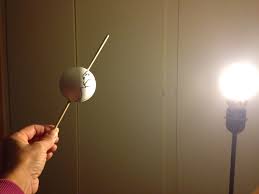
A ball held infront of a light source
Step 1: Place a torch or lamp at the center of the table to represent the Sun.
Step 2: Take a ball or globe as the Earth and mark one spot with a sticker.
Step 3: Tilt the ball slightly and keep the tilt fixed throughout the activity.
Step 4: Walk in a circle around the lamp while holding the tilted ball.
Step 5: Stop at four points during the circle and observe how the light falls on the marked spot each time.
Observations:
- The marked point faces the lamp differently at different positions. At some positions, the marked area receives more direct light (longer days).
- At other positions, the marked area receives less light (shorter days).
- The angle of sunlight keeps changing as the Earth moves around the Sun.
- The part of Earth facing away from the Sun is dark, showing why different constellations are visible at different times of the year.
Conclusion:
- The Earth revolves around the Sun while maintaining a fixed tilt.
- One complete revolution takes about 365 days and 6 hours, which forms a year.
- Due to revolution and the tilt of the Earth, different places receive sunlight differently in different months, causing seasons.
- We see different stars in the night sky at different times of the year.
- Therefore, revolution is responsible for the changing seasons and the changing view of the night sky.
Revolution of the Earth:
- The Earth does not only spin on its axis, it also travels around the Sun. This movement around the Sun is called revolution, and it is different from rotation.
- Rotation is the Earth spinning on its own axis, whereas revolution is the movement of one object around another.
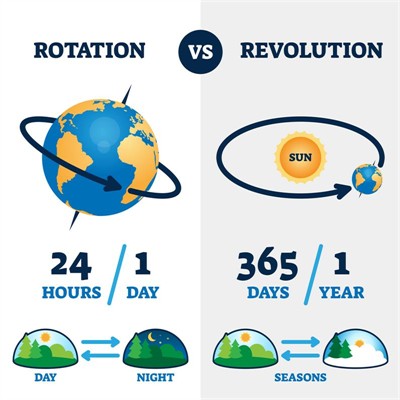
Rotation and revolution difference
Revolution of the Earth is the movement of the Earth around the Sun along a fixed path called its orbit.
Orbit of the Earth:
The path that Earth follows while revolving around the Sun is called its orbit. When viewed from above, this orbit looks almost circular.
Important!
The Earth takes about 365 days and 6 hours to complete one full revolution around the Sun.
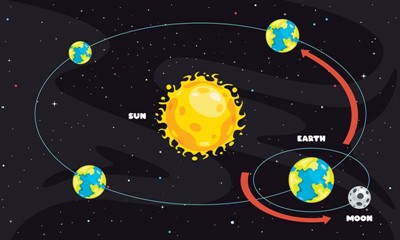
Rotation and revolution of Earth
How the night sky changes throughout the year:
- Each evening, after the Sun sets in the west, the night sky becomes visible because of Earth's rotation.
- But over months, we notice a different change. Because the Earth is also moving around the Sun, the set of stars visible just after sunset slowly shifts throughout the year.
- Different stars rise at sunset in different months.
- Patterns of stars (constellations) that were visible in one season may not be visible in another.
- By observing the sky at the same time every night but over different months, you can clearly notice this shifting star pattern.
- This change occurs because as the Earth moves along its orbit, we face different parts of the sky at night.
Fascinating cultural connection:
Indigenous communities like the Bhil and Pawara tribes from the Tapi Valley in western India traditionally used the appearance of certain star patterns as natural indicators. The rising of specific constellations signaled the arrival of the monsoon, helping them understand seasonal changes long before modern weather forecasts existed. This shows how strongly the movement of Earth and the stars has been connected to human life for centuries.