

Every morning, Juno watched the Sun rise near the neem tree on the left side of the playground. But by afternoon, he always found it far on the other side near the water tank. One day he wondered, “Is the Sun really moving across the sky?”
When he asked his mother, she explained, “Sometimes things only seem to move because we are the ones moving.” She told him that the Sun stays in the same place, but the Earth spins like a giant top, making the Sun appear to travel from East to West.
Juno was amazed to learn that what he saw each day was just an effect of the Earth’s rotation.
Let us perform an activity to understand this better.
Activity:
To observe how earth rotates with the help of a spinning chair.
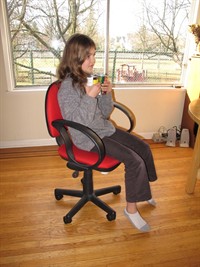
A girl on a spinning chair facing outward
Step 1: Sit on a spinning chair facing outward, so you can easily see the objects around you in the room.
Step 2: Ask a friend to slowly rotate the chair in the anti-clockwise direction.
Step 3: While the chair is moving, look at the objects around you such as desks, cupboards, or walls.
Step 4: Notice the direction in which these objects seem to move as you rotate.
Step 5: Now, fix your gaze on one particular object, such as a door or a window, while the chair continues to turn anti-clockwise.
Step 6: Observe whether the object remains in your view all the time and how it appears to move relative to you.
Observations:
- When the spinning chair moves anti-clockwise, the objects around you appear to move in the opposite direction, that is, clockwise.
- When you fix your eyes on a specific object, such as a door or window, it seems to enter your view from the left, move across the front, and then leave towards the right as you continue rotating.
- Even though the objects are not actually moving, they appear to move because you are the one turning.
Conclusion:
- Just like objects appear to move in the opposite direction when you rotate on a spinning chair, the Sun appears to move across the sky from East to West because the Earth is rotating from West to East.
- The Sun itself is not moving around the Earth, instead, we observe apparent motion due to the rotation of our own planet.
Rotation of the Earth:
Rotation is the spinning of the Earth around its own axis, similar to how a top, a fan, or a ball spins in place. The Earth’s axis is an imaginary line that passes through the North Pole and the South Pole. The Earth completes one full rotation in about 24 hours, and this continuous spinning is what gives us day and night.
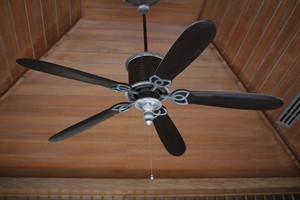

A spinning fan and top
Direction of Earth’s rotation:
The Earth rotates from West to East. When viewed from above the North Pole, this rotation appears anti-clockwise. Because of this direction of spin, different parts of the Earth face the Sun at different times, causing the cycle of daytime and nighttime.
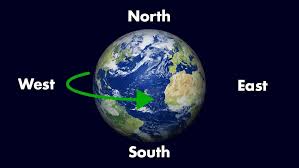
Direction of Earth's rotation
Effect of Earth’s rotation:
The Earth’s rotation from West to East causes day and night and creates the apparent motion of the Sun, the Moon, and the stars across the sky. These heavenly bodies seem to rise in the East and set in the West, not because they are moving around us, but because the Earth is constantly turning on its axis.
Axis of rotation:
Rotation is the movement of an object in which every part of the object moves in a circular path around an imaginary straight line that runs through it. This imaginary line is called the axis of rotation, and it acts as the pivot around which the object spins.
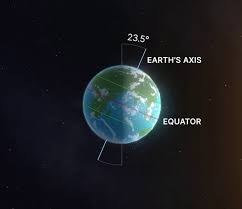
Axis of Earth